Na Rangsee Nopphamon, Yanatatsaneejit Pattamawadee, Pisitkun Trairak, Somparn Poorichaya, Jintaridth Pornrutsami, Topanurak Supachai
1Department of Molecular Tropical Medicine and Genetics, Faculty of Tropical Medicine, Mahidol University, Bangkok, 10400 Thailand.
2Department of Botany, Faculty of Science, Chulalongkorn University, Bangkok, 10330 Thailand.
Infect Agent Cancer. 2020 Feb 3;15:7. doi: 10.1186/s13027-020-0271-4. eCollection 2020.
Human papillomavirus (HPV) infection causes around 90% of cervical cancer cases, and cervical cancer is a leading cause of female mortality worldwide. HPV-derived oncoprotein E7 participates in cervical carcinogenesis by inducing aberrant host DNA methylation. However, the targeting specificity of E7 methylation of host genes is not fully understood but is important in the down-regulation of crucial proteins of the hallmark cancer pathways. In this study, we aim to link E7-driven aberrations in the host proteome to corresponding gene promoter hypermethylation events in the hope of providing novel therapeutic targets and biomarkers to indicate the progression of cervical cancer.
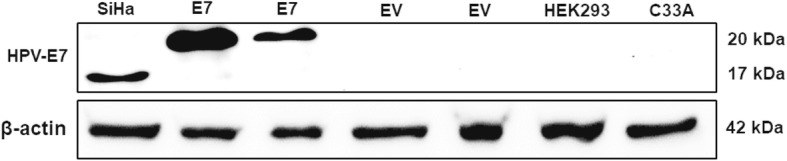
HEK293 cells were transfected with pcDNA3.1-E7 plasmid and empty vector and subjected to mass spectrometry-based proteomic analysis. Down-regulated proteins (where relative abundance was determined significant by paired T-test) relevant to cancer pathways were selected as gene candidates for mRNA transcript abundance measurement by qPCR and expression compared with that in SiHa cells (HPV type 16 positive). Methylation Specific PCR was used to determine promoter hypermethylation in genes downregulated in both SiHa and transfected HEK293 cell lines. The FunRich and STRING databases were used for identification of potential regulatory transcription factors and the proteins interacting with transcription factor gene candidates, respectively.
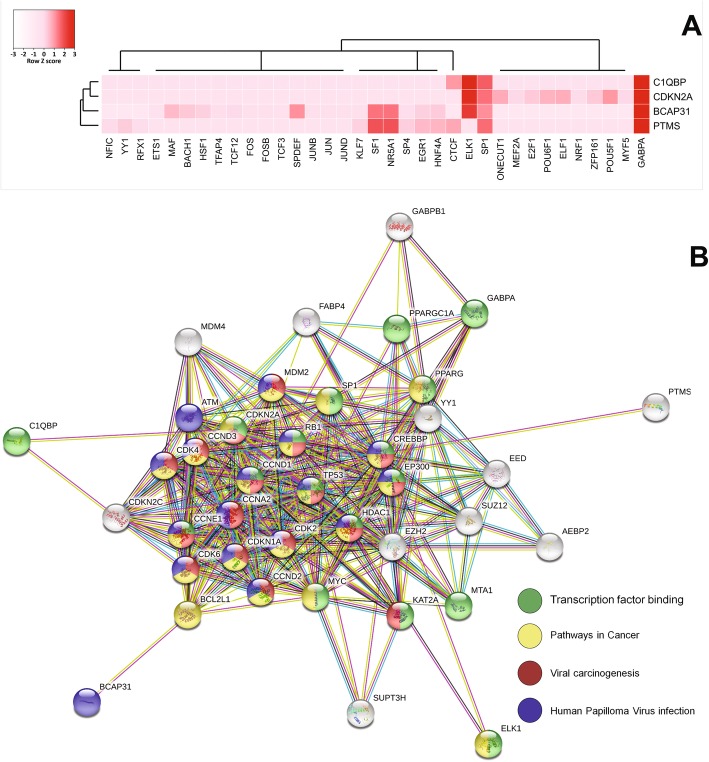
Approximately 400 proteins totally were identified in proteomics analysis. The transcripts of six genes involved in the host immune response and cell proliferation ( and ) were down-regulated, corresponding to proteomic results. Methylation assays showed four gene promoters ( and ) were hypermethylated with 61, 55.5, 70 and 78% increased methylation, respectively. Those four genes can be regulated by the GA-binding protein alpha chain, specificity protein 1 and ETS-like protein-1 transcription factors, as identified from FunRich database predictions.
HPV E7 altered the HEK293 proteome, particularly with respect to proteins involved in cell proliferation and host immunity. Down-regulation of these proteins appears to be partly mediated via host DNA methylation. E7 possibly complexes with the transcription factors of its targeting genes and DNMT1, allowing methylation of specific target gene promoters.
人乳头瘤病毒(HPV)感染导致约90%的宫颈癌病例,宫颈癌是全球女性死亡的主要原因。HPV衍生的癌蛋白E7通过诱导宿主DNA异常甲基化参与宫颈癌的发生。然而,宿主基因E7甲基化的靶向特异性尚未完全明确,但对于下调标志性癌症通路的关键蛋白很重要。在本研究中,我们旨在将宿主蛋白质组中E7驱动的异常与相应的基因启动子高甲基化事件联系起来,以期提供新的治疗靶点和生物标志物来指示宫颈癌的进展。
将pcDNA3.1-E7质粒和空载体转染HEK293细胞,并进行基于质谱的蛋白质组学分析。选择与癌症通路相关的下调蛋白(通过配对T检验确定相对丰度有显著差异)作为基因候选物,通过qPCR测量mRNA转录本丰度,并与SiHa细胞(HPV 16型阳性)中的表达进行比较。甲基化特异性PCR用于确定SiHa和转染的HEK293细胞系中下调基因的启动子高甲基化情况。分别使用FunRich和STRING数据库鉴定潜在的调控转录因子以及与转录因子基因候选物相互作用的蛋白质。
蛋白质组学分析共鉴定出约400种蛋白质。涉及宿主免疫反应和细胞增殖的六个基因(和)的转录本下调,与蛋白质组学结果一致。甲基化分析显示四个基因启动子(和)发生高甲基化,甲基化分别增加了61%、55.5%、70%和78%。根据FunRich数据库预测,这四个基因可由GA结合蛋白α链、特异性蛋白1和ETS样蛋白-1转录因子调控。
HPV E7改变了HEK293蛋白质组,特别是与细胞增殖和宿主免疫相关的蛋白质。这些蛋白质的下调似乎部分是通过宿主DNA甲基化介导的。E7可能与其靶向基因的转录因子和DNMT1形成复合物,使特定靶基因启动子发生甲基化。