Karpova Darja, Rettig Michael P, DiPersio John F
Division of Stem Cells and Cancer, German Cancer Research Center (DKFZ) and DKFZ-ZMBH Alliance, Heidelberg, 69120, Germany.
Division of Oncology, Department of Medicine, Washington University School of Medicine,, St. Louis, Missouri, 63110, USA.
F1000Res. 2019 Dec 20;8. doi: 10.12688/f1000research.21129.1. eCollection 2019.
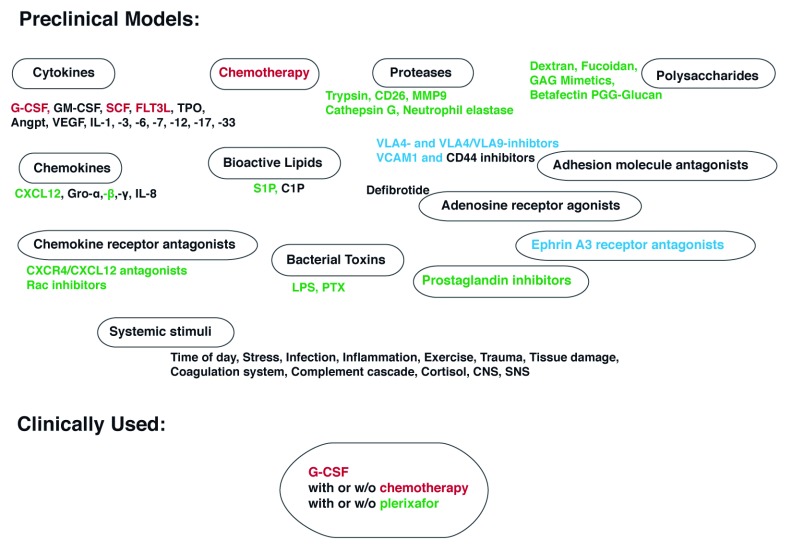
Enforced egress of hematopoietic stem cells (HSCs) out of the bone marrow (BM) into the peripheral circulation, termed mobilization, has come a long way since its discovery over four decades ago. Mobilization research continues to be driven by the need to optimize the regimen currently available in the clinic with regard to pharmacokinetic and pharmacodynamic profile, costs, and donor convenience. In this review, we describe the most recent findings in the field and how we anticipate them to affect the development of mobilization strategies in the future. Furthermore, the significance of mobilization beyond HSC collection, i.e. for chemosensitization, conditioning, and gene therapy as well as a means to study the interactions between HSCs and their BM microenvironment, is reviewed. Open questions, controversies, and the potential impact of recent technical progress on mobilization research are also highlighted.
造血干细胞(HSCs)从骨髓(BM)强制流出进入外周循环,即动员,自四十多年前被发现以来已经取得了长足的进展。由于需要在药代动力学和药效学特征、成本以及供体便利性方面优化目前临床上可用的方案,动员研究仍在不断推进。在这篇综述中,我们描述了该领域的最新发现以及我们预期它们将如何影响未来动员策略的发展。此外,还综述了动员在造血干细胞采集之外的意义,即用于化疗增敏、预处理和基因治疗,以及作为研究造血干细胞与其骨髓微环境之间相互作用的一种手段。还强调了悬而未决的问题、争议以及近期技术进展对动员研究的潜在影响。