Orben Amy, Przybylski Andrew K
Emmanuel College, University of Cambridge, Cambridge, UK.
MRC Cognition and Brain Sciences Unit, University of Cambridge, Cambridge, UK.
PeerJ. 2020 Jan 28;8:e8427. doi: 10.7717/peerj.8427. eCollection 2020.
Throughout the developed world, adolescents are growing up with increased access to and engagement with a range of screen-based technologies, allowing them to encounter ideas and people on a global scale from the intimacy of their bedroom. The concerns about digital technologies negatively influencing sleep are therefore especially noteworthy, as sleep has been proven to greatly affect both cognitive and emotional well-being. The associations between digital engagement and adolescent sleep should therefore be carefully investigated in research adhering to the highest methodological standards. This understood, studies published to date have not often done so and have instead focused mainly on data derived from general retrospective self-report questionnaires. The value of this work has been called into question by recent research showing that retrospective questionnaires might fail to accurately measure these variables of interest. Novel and diverse approaches to measurement are therefore necessary for academic study to progress.
This study analyses data from 11,884 adolescents included in the UK Millennium Cohort Study to examine the association between digital engagement and adolescent sleep, comparing the relative effects of retrospective self-report vs. time-use diary measures of technology use. By doing so, it provides an empirical lens to understand the effects of digital engagement both throughout the day and before bedtime and adds nuance to a research area primarily relying on retrospective self-report.
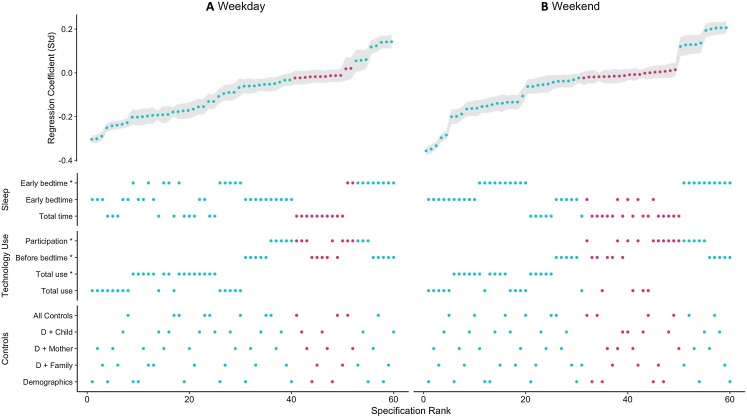
The study finds that there is a small negative association relating digital engagement to adolescent sleep both on weekdays and weekend days (median standardized association β = -0.06 and β = -0.03). There is a more negative association between digital engagement and total sleep time on weekdays compared to weekend days (median standardized β = -0.08, median standardized β = -0.02), while there is no such difference when examining adolescents' bedtime. Surprisingly, and contrary to our expectations, digital technology use before bedtime is not substantively associated with the amount of sleep and the tardiness of bedtime in adolescents.
Results derived from the use of transparent Specification Curve Analysis methods show that the negative associations in evidence are mainly driven by retrospective technology use measures and measures of total time spent on digital devices during the day. The effects are overall very small: for example, an additional hour of digital screen time per day was only related to a 9 min decrease in total time spent sleeping on weekdays and a 3 min decrease on weekends. Using digital screens 30 min before bed led to a 1 min decrease in total time spent sleeping on weekdays and weekends. The study shows that more work should be done examining how to measure digital screen time before interventions are designed.
在整个发达国家,青少年成长过程中接触和使用各类基于屏幕的技术的机会增多,这使他们能在卧室的私密空间里接触到全球范围内的思想和人物。因此,对数字技术对睡眠产生负面影响的担忧尤为值得关注,因为睡眠已被证明对认知和情绪健康都有极大影响。所以,在遵循最高方法标准的研究中,应仔细调查数字使用与青少年睡眠之间的关联。尽管如此,迄今为止发表的研究往往没有这样做,而是主要集中在从一般回顾性自我报告问卷中得出的数据上。最近的研究表明回顾性问卷可能无法准确测量这些感兴趣的变量,这使得这项工作的价值受到质疑。因此,新颖多样的测量方法对于学术研究的进展是必要的。
本研究分析了英国千禧队列研究中11884名青少年的数据,以检验数字使用与青少年睡眠之间的关联,比较回顾性自我报告与技术使用时间使用日记测量方法的相对影响。通过这样做,它提供了一个实证视角,以了解全天和睡前数字使用的影响,并为主要依赖回顾性自我报告的研究领域增添了细微差别。
研究发现,无论是工作日还是周末,数字使用与青少年睡眠之间都存在微弱的负相关(标准化关联中位数β = -0.06和β = -0.03)。与周末相比,工作日数字使用与总睡眠时间之间的负相关更强(标准化β中位数 = -0.08,标准化β中位数 = -0.02),而在研究青少年的就寝时间时则没有这种差异。令人惊讶的是,与我们的预期相反,睡前使用数字技术与青少年的睡眠时间和就寝延迟并无实质性关联。
使用透明规范曲线分析方法得出的结果表明,明显的负相关主要由回顾性技术使用测量方法以及白天在数字设备上花费的总时间测量方法驱动。总体影响非常小:例如,每天额外一小时的数字屏幕时间仅与工作日总睡眠时间减少9分钟以及周末减少3分钟有关。睡前30分钟使用数字屏幕导致工作日和周末总睡眠时间减少1分钟。该研究表明,在设计干预措施之前,应进一步研究如何测量数字屏幕时间。