Rodríguez-Romero José de Jesús, Aceves-Lara César Arturo, Silva Cristina Ferreira, Gschaedler Anne, Amaya-Delgado Lorena, Arrizon Javier
Industrial Biotechnology Department, Centro de Investigación y Asistencia en Tecnología y Diseño del Estado de Jalisco, A.C., Jalisco, Mexico.
TBI, Université de Toulouse, CNRS, INRA, INSA, Toulouse, France.
Biotechnol Rep (Amst). 2020 Jan 24;25:e00420. doi: 10.1016/j.btre.2020.e00420. eCollection 2020 Mar.
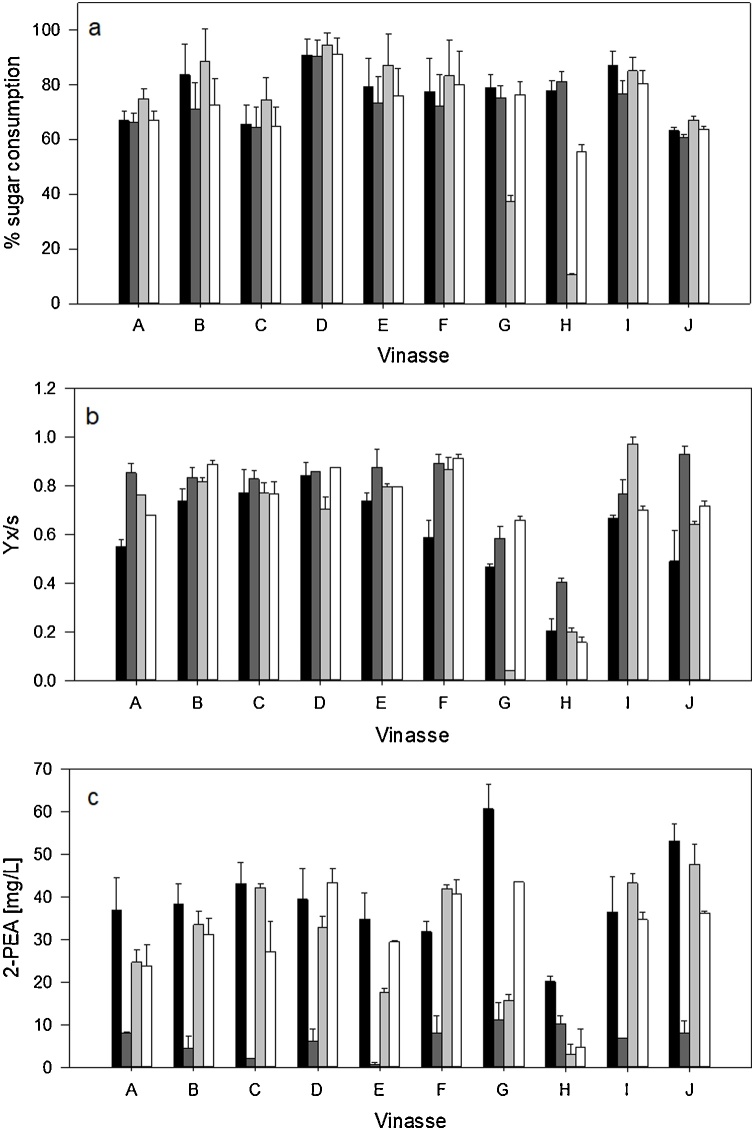
Vinasses from the tequila industry are wastewaters with highly elevated organic loads. Therefore, to obtain value-added products by yeast fermentations, such as 2-phenylethanol (2-PE) and 2-phenylethylacetate (2-PEA), could be interesting for industrial applications from tequila vinasses. In this study, four yeasts species () were evaluated with two different chemically defined media and tequila vinasses. Differences in the aroma compounds production were observed depending on the medium and yeast species used. In tequila vinasses, the highest concentration (65 mg/L) of 2-PEA was reached by , the inhibitory compounds decreased biomass production and synthesis of 2-PEA, and biochemical and chemical oxygen demands were reduced by more than 50 %. Tequila vinasses were suitable for the production of 2-phenylethylacetate by the shikimate pathway. A metabolic network was developed to obtain a guideline to improve 2-PE and 2-PEA production using flux balance analysis (FBA).
龙舌兰酒行业产生的酒糟是有机负荷极高的废水。因此,通过酵母发酵获得增值产品,如2-苯乙醇(2-PE)和2-苯乙酸乙酯(2-PEA),可能对龙舌兰酒糟的工业应用具有吸引力。在本研究中,使用两种不同的化学成分确定的培养基和龙舌兰酒糟对四种酵母菌株进行了评估。观察到根据所用培养基和酵母菌株的不同,香气化合物的产量存在差异。在龙舌兰酒糟中, 产生的2-PEA浓度最高(65毫克/升),抑制性化合物降低了生物量产量和2-PEA的合成,生化需氧量和化学需氧量降低了50%以上。龙舌兰酒糟适合通过莽草酸途径生产2-苯乙酸乙酯。开发了一个代谢网络,以获得使用通量平衡分析(FBA)提高2-PE和2-PEA产量的指导方针。