Shretta Rima, Silal Sheetal Prakash, Celhay Olivier J, Gran Mercado Chris Erwin, Kyaw Shwe Sin, Avancena Anton, Fox Katie, Zelman Brittany, Baral Ranju, White Lisa Jane, Maude Richard James
Global Health Group, University of California, San Francisco, 550 16th St, 3rd Floor, Box 1224, San Francisco, CA, 94158, USA.
Swiss Tropical and Public Health Institute, Socinstrasse 57, 4002 Basel, Switzerland.
Wellcome Open Res. 2019 Apr 1;4:60. doi: 10.12688/wellcomeopenres.14769.2. eCollection 2019.
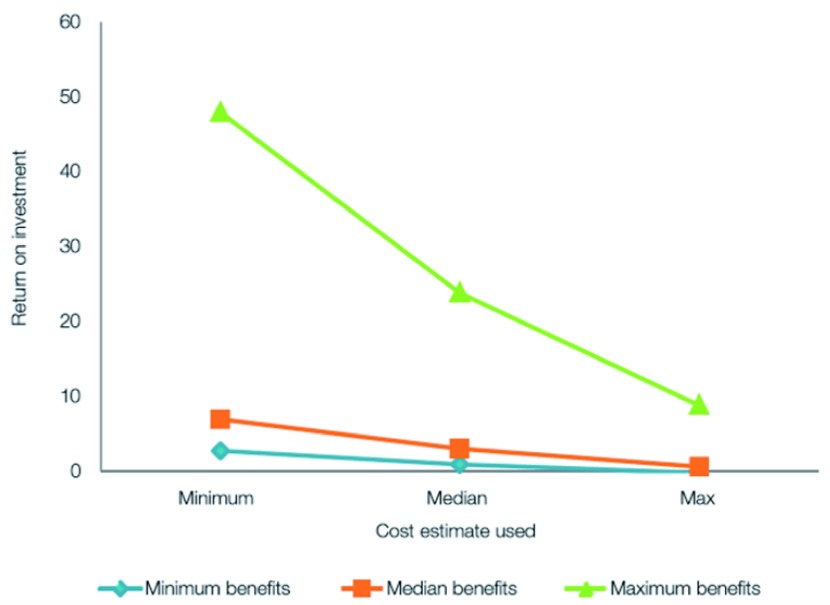
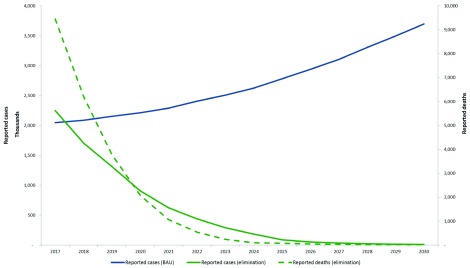
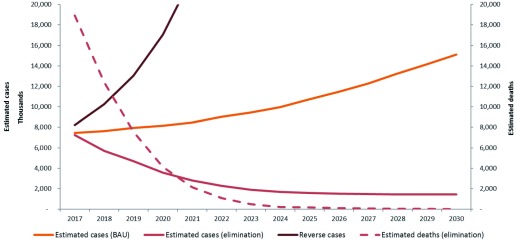
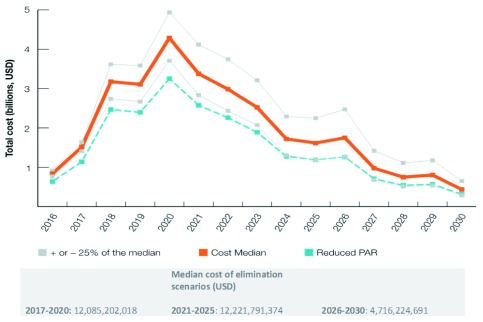
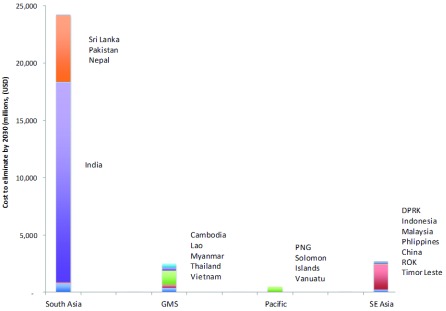
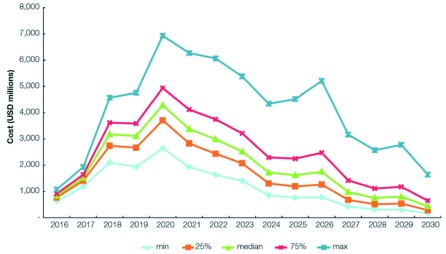
The Asia-Pacific region has made significant progress against malaria, reducing cases and deaths by over 50% between 2010 and 2015. These gains have been facilitated in part, by strong political and financial commitment of governments and donors. However, funding gaps and persistent health system challenges threaten further progress. Achieving the regional goal of malaria elimination by 2030 will require an intensification of efforts and a plan for sustainable financing. This article presents an investment case for malaria elimination to facilitate these efforts. A transmission model was developed to project rates of decline of and malaria and the output was used to determine the cost of the interventions that would be needed for elimination by 2030. In total, 80 scenarios were modelled under various assumptions of resistance and intervention coverage. The mortality and morbidity averted were estimated and health benefits were monetized by calculating the averted cost to the health system, individual households, and society. The full-income approach was used to estimate the economic impact of lost productivity due to premature death and illness, and a return on investment was computed. : The study estimated that malaria elimination in the region by 2030 could be achieved at a cost of USD 29.02 billion (range: USD 23.65-36.23 billion) between 2017 and 2030. Elimination would save over 400,000 lives and avert 123 million malaria cases, translating to almost USD 90 billion in economic benefits. Discontinuing vector control interventions and reducing treatment coverage rates to 50% will result in an additional 845 million cases, 3.5 million deaths, and excess costs of USD 7 billion. Malaria elimination provides a 6:1 return on investment. This investment case provides compelling evidence for the benefits of continued prioritization of funding for malaria and can be used to develop an advocacy strategy.
亚太地区在抗击疟疾方面取得了重大进展,2010年至2015年间病例和死亡人数减少了50%以上。这些成果部分得益于政府和捐助方坚定的政治和财政承诺。然而,资金缺口和持续存在的卫生系统挑战威胁到进一步的进展。要实现到2030年消除疟疾的区域目标,需要加大努力并制定可持续融资计划。本文提出了一个消除疟疾的投资案例,以推动这些努力。开发了一个传播模型来预测疟疾发病率的下降速度,其输出结果用于确定到2030年消除疟疾所需干预措施的成本。总共在各种抗药性和干预覆盖假设下模拟了80种情景。估计了避免的死亡率和发病率,并通过计算对卫生系统、家庭和社会避免的成本将健康效益货币化。采用全收入方法估计因过早死亡和疾病导致的生产力损失的经济影响,并计算了投资回报率。该研究估计,2017年至2030年间,以290.2亿美元(范围:236.5亿至362.3亿美元)的成本可实现该区域疟疾的消除。消除疟疾将挽救40多万人的生命,避免1.23亿例疟疾病例,带来近900亿美元的经济效益。停止病媒控制干预措施并将治疗覆盖率降至50%将导致新增8.45亿例病例、350万例死亡以及70亿美元的额外成本。消除疟疾的投资回报率为6:1。这个投资案例为继续优先为疟疾提供资金的益处提供了有力证据,可用于制定宣传战略。