• 文献检索
  • 文档翻译
  • 深度研究
  • 学术资讯
  • Suppr Zotero 插件Zotero 插件
  • 邀请有礼
  • 套餐&价格
  • 历史记录
应用&插件
Suppr Zotero 插件Zotero 插件浏览器插件Mac 客户端Windows 客户端微信小程序
定价
高级版会员购买积分包购买API积分包
服务
文献检索文档翻译深度研究API 文档MCP 服务
关于我们
关于 Suppr公司介绍联系我们用户协议隐私条款
关注我们

Suppr 超能文献

核心技术专利:CN118964589B侵权必究
粤ICP备2023148730 号-1Suppr @ 2026

文献检索

告别复杂PubMed语法,用中文像聊天一样搜索,搜遍4000万医学文献。AI智能推荐,让科研检索更轻松。

立即免费搜索

文件翻译

保留排版,准确专业,支持PDF/Word/PPT等文件格式,支持 12+语言互译。

免费翻译文档

深度研究

AI帮你快速写综述,25分钟生成高质量综述,智能提取关键信息,辅助科研写作。

立即免费体验

英国医学生对人工智能与放射学的态度和认知:一项多中心调查

Attitudes and perceptions of UK medical students towards artificial intelligence and radiology: a multicentre survey.

作者信息

Sit Cherry, Srinivasan Rohit, Amlani Ashik, Muthuswamy Keerthini, Azam Aishah, Monzon Leo, Poon Daniel Stephen

机构信息

Department of Radiology, Guy's and St. Thomas' NHS Foundation Trust, London, UK.

Department of Interventional Radiology, Guy's and St. Thomas' NHS Foundation Trust, London, UK.

出版信息

Insights Imaging. 2020 Feb 5;11(1):14. doi: 10.1186/s13244-019-0830-7.

DOI:10.1186/s13244-019-0830-7
PMID:32025951
原文链接:https://pmc.ncbi.nlm.nih.gov/articles/PMC7002761/
Abstract

OBJECTIVES

To explore the attitudes of United Kingdom (UK) medical students regarding artificial intelligence (AI), their understanding, and career intention towards radiology. We also examine the state of education relating to AI amongst this cohort.

METHODS

UK medical students were invited to complete an anonymous electronic survey consisting of Likert and dichotomous questions.

RESULTS

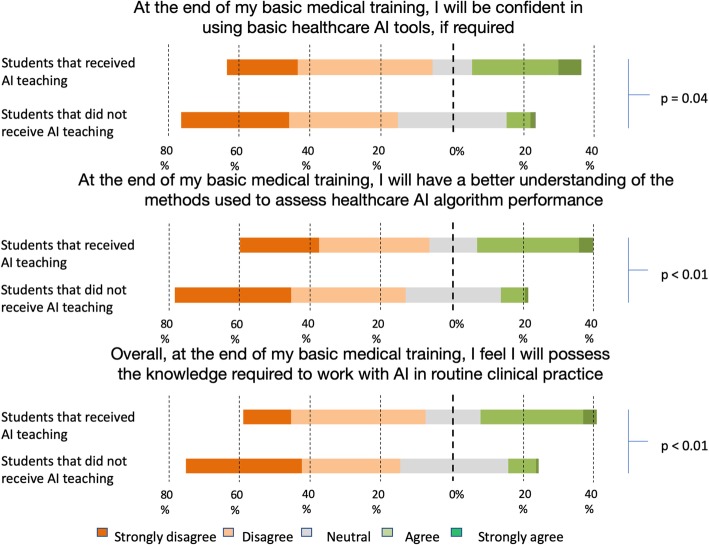
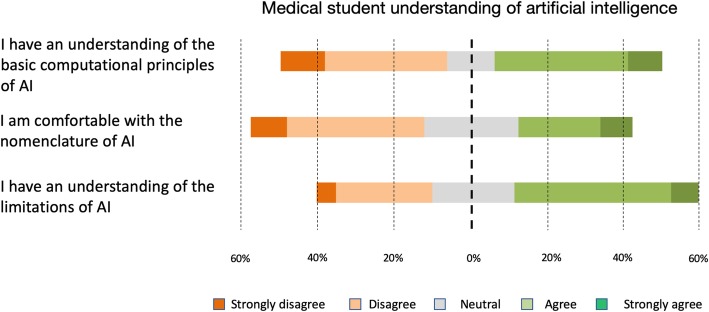
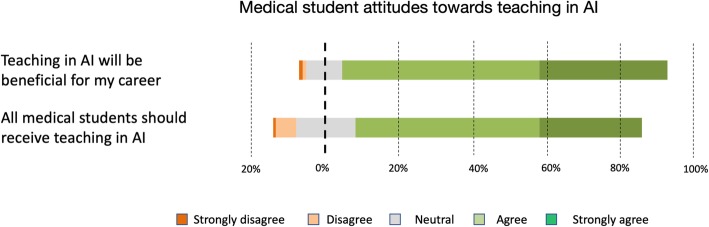
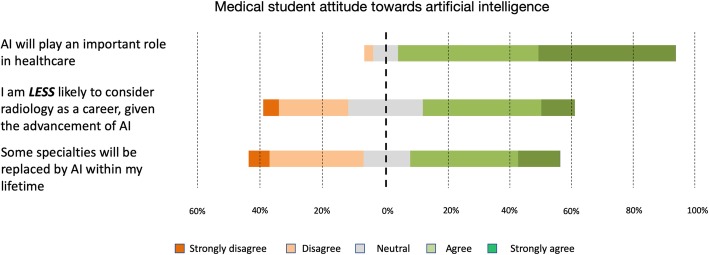
Four hundred eighty-four responses were received from 19 UK medical schools. Eighty-eight percent of students believed that AI will play an important role in healthcare, and 49% reported they were less likely to consider a career in radiology due to AI. Eighty-nine percent of students believed that teaching in AI would be beneficial for their careers, and 78% agreed that students should receive training in AI as part of their medical degree. Only 45 students received any teaching on AI; none of the students received such teaching as part of their compulsory curriculum. Statistically, students that did receive teaching in AI were more likely to consider radiology (p = 0.01) and rated more positively to the questions relating to the perceived competence in the post-graduation use of AI (p = 0.01-0.04); despite this, a large proportion of students in the taught group reported a lack of confidence and understanding required for the critical use of healthcare AI tools.

CONCLUSIONS

UK medical students understand the importance of AI and are keen to engage. Medical school training on AI should be expanded and improved. Realistic use cases and limitations of AI must be presented to students so they will not feel discouraged from pursuing radiology.

摘要

目的

探讨英国医学生对人工智能(AI)的态度、他们对放射学的理解以及职业意向。我们还研究了这一群体中与人工智能相关的教育状况。

方法

邀请英国医学生完成一项由李克特量表和二分法问题组成的匿名电子调查。

结果

从英国19所医学院收到了484份回复。88%的学生认为人工智能将在医疗保健中发挥重要作用,49%的学生表示由于人工智能,他们不太可能考虑从事放射学职业。89%的学生认为人工智能教学对他们的职业有益,78%的学生同意学生应该在医学学位课程中接受人工智能培训。只有45名学生接受过任何关于人工智能的教学;没有学生将此类教学作为必修课程的一部分。从统计学角度来看,接受过人工智能教学的学生更有可能考虑从事放射学(p = 0.01),并且对与毕业后使用人工智能的感知能力相关问题的评分更高(p = 0.01 - 0.04);尽管如此,接受教学组中的很大一部分学生表示缺乏对医疗保健人工智能工具进行批判性使用所需的信心和理解。

结论

英国医学生理解人工智能的重要性并渴望参与其中。医学院校关于人工智能的培训应予以扩展和改进。必须向学生展示人工智能的实际应用案例和局限性,以免他们在考虑从事放射学职业时感到气馁。
https://cdn.ncbi.nlm.nih.gov/pmc/blobs/7646/7002761/c12617cc34b6/13244_2019_830_Fig5_HTML.jpg
https://cdn.ncbi.nlm.nih.gov/pmc/blobs/7646/7002761/e6d191953f47/13244_2019_830_Fig1_HTML.jpg
https://cdn.ncbi.nlm.nih.gov/pmc/blobs/7646/7002761/06853e5ad1bf/13244_2019_830_Fig2_HTML.jpg
https://cdn.ncbi.nlm.nih.gov/pmc/blobs/7646/7002761/b59aaf095ff1/13244_2019_830_Fig3_HTML.jpg
https://cdn.ncbi.nlm.nih.gov/pmc/blobs/7646/7002761/5a3d107210ee/13244_2019_830_Fig4_HTML.jpg
https://cdn.ncbi.nlm.nih.gov/pmc/blobs/7646/7002761/c12617cc34b6/13244_2019_830_Fig5_HTML.jpg
https://cdn.ncbi.nlm.nih.gov/pmc/blobs/7646/7002761/e6d191953f47/13244_2019_830_Fig1_HTML.jpg
https://cdn.ncbi.nlm.nih.gov/pmc/blobs/7646/7002761/06853e5ad1bf/13244_2019_830_Fig2_HTML.jpg
https://cdn.ncbi.nlm.nih.gov/pmc/blobs/7646/7002761/b59aaf095ff1/13244_2019_830_Fig3_HTML.jpg
https://cdn.ncbi.nlm.nih.gov/pmc/blobs/7646/7002761/5a3d107210ee/13244_2019_830_Fig4_HTML.jpg
https://cdn.ncbi.nlm.nih.gov/pmc/blobs/7646/7002761/c12617cc34b6/13244_2019_830_Fig5_HTML.jpg

相似文献

1
Attitudes and perceptions of UK medical students towards artificial intelligence and radiology: a multicentre survey.英国医学生对人工智能与放射学的态度和认知:一项多中心调查
Insights Imaging. 2020 Feb 5;11(1):14. doi: 10.1186/s13244-019-0830-7.
2
Attitude and Understanding of Artificial Intelligence Among Saudi Medical Students: An Online Cross-Sectional Study.沙特医学生对人工智能的态度与理解:一项在线横断面研究。
J Multidiscip Healthc. 2024 Apr 29;17:1887-1899. doi: 10.2147/JMDH.S455260. eCollection 2024.
3
Knowledge, attitude, and perception of Arab medical students towards artificial intelligence in medicine and radiology: A multi-national cross-sectional study.阿拉伯医学专业学生对医学和放射学人工智能的知识、态度和看法:一项多国横断面研究。
Eur Radiol. 2024 Jul;34(7):1-14. doi: 10.1007/s00330-023-10509-2. Epub 2023 Dec 27.
4
Western Australian medical students' attitudes towards artificial intelligence in healthcare.西澳大利亚州医学生对医疗保健领域人工智能的态度。
PLoS One. 2023 Aug 31;18(8):e0290642. doi: 10.1371/journal.pone.0290642. eCollection 2023.
5
Malaysian Medical Students' Attitudes and Readiness Toward AI (Artificial Intelligence): A Cross-Sectional Study.马来西亚医学生对人工智能的态度及准备情况:一项横断面研究。
J Med Educ Curric Dev. 2023 Sep 13;10:23821205231201164. doi: 10.1177/23821205231201164. eCollection 2023 Jan-Dec.
6
Global cross-sectional student survey on AI in medical, dental, and veterinary education and practice at 192 faculties.全球医学、牙科和兽医学教育和实践中的人工智能学生横断面调查,涉及 192 个学院。
BMC Med Educ. 2024 Sep 28;24(1):1066. doi: 10.1186/s12909-024-06035-4.
7
Medical Student Perspectives on the Impact of Artificial Intelligence on the Practice of Medicine.医学生对人工智能对医学实践影响的看法。
Curr Probl Diagn Radiol. 2021 Sep-Oct;50(5):614-619. doi: 10.1067/j.cpradiol.2020.06.011. Epub 2020 Jun 27.
8
Influence of Artificial Intelligence on Canadian Medical Students' Preference for Radiology Specialty: ANational Survey Study.人工智能对加拿大医学生放射科专业偏好的影响:一项全国调查研究。
Acad Radiol. 2019 Apr;26(4):566-577. doi: 10.1016/j.acra.2018.10.007. Epub 2018 Nov 11.
9
Medical students' attitude towards artificial intelligence: a multicentre survey.医学生对人工智能的态度:一项多中心调查。
Eur Radiol. 2019 Apr;29(4):1640-1646. doi: 10.1007/s00330-018-5601-1. Epub 2018 Jul 6.
10
Impact of artificial intelligence on US medical students' choice of radiology.人工智能对美国医学生选择放射科的影响。
Clin Imaging. 2022 Jan;81:67-71. doi: 10.1016/j.clinimag.2021.09.018. Epub 2021 Oct 2.

引用本文的文献

1
Evolving Medical Students' Digital Health Perceptions and Intentions: Insights From a Prepandemic and Postpandemic Survey Study.医学生对数字健康的认知与意愿的演变:一项疫情前与疫情后调查研究的见解
J Med Internet Res. 2025 Sep 3;27:e64804. doi: 10.2196/64804.
2
Exploring AI literacy, attitudes toward AI, and intentions to use AI in clinical contexts among healthcare students in Korea: a cross-sectional study.探索韩国医学生的人工智能素养、对人工智能的态度以及在临床环境中使用人工智能的意图:一项横断面研究。
BMC Med Educ. 2025 Aug 30;25(1):1233. doi: 10.1186/s12909-025-07766-8.
3
Preparedness of the Local Population for the Uptake of Artificial Intelligence and Digital One Health for Home Healthcare of Emerging and Reemerging Infectious Diseases in Southwest and Littoral Regions of Cameroon.

本文引用的文献

1
Will Artificial Intelligence Replace Radiologists?人工智能会取代放射科医生吗?
Radiol Artif Intell. 2019 May 15;1(3):e190058. doi: 10.1148/ryai.2019190058. eCollection 2019 May.
2
Artificial Intelligence in Dermatology-Where We Are and the Way to the Future: A Review.人工智能在皮肤科领域的应用——现状与未来展望:综述。
Am J Clin Dermatol. 2020 Feb;21(1):41-47. doi: 10.1007/s40257-019-00462-6.
3
Digital pathology and artificial intelligence.数字病理学与人工智能。
喀麦隆西南和滨海地区当地居民对采用人工智能和数字一体化健康技术进行新兴和再发传染病家庭医疗保健的准备情况。
J Trop Med. 2025 Aug 19;2025:8896234. doi: 10.1155/jotm/8896234. eCollection 2025.
4
Preparing Generation Z of Health Professions for Artificial Intelligence Revolution Through Hacking Education: An Interventional Study.通过黑客教育让Z世代健康专业人员为人工智能革命做好准备:一项干预性研究。
Health Sci Rep. 2025 Aug 18;8(8):e71169. doi: 10.1002/hsr2.71169. eCollection 2025 Aug.
5
Medical and Paramedical Students' Perspectives on Artificial Intelligence in a Low- and Middle-Income Country: A Cross-Sectional Study.低收入和中等收入国家医学及准医学专业学生对人工智能的看法:一项横断面研究
Health Sci Rep. 2025 Aug 4;8(8):e71046. doi: 10.1002/hsr2.71046. eCollection 2025 Aug.
6
Te Oranga Pūkahukahu research programme: intentional steps towards a national equity-focused lung cancer screening programme in Aotearoa New Zealand.蒂奥朗加·普卡胡卡胡研究项目:在新西兰奥特亚罗瓦朝着以公平为重点的全国肺癌筛查项目迈出的有意步骤。
J R Soc N Z. 2025 Feb 12;55(5):1322-1337. doi: 10.1080/03036758.2025.2458037. eCollection 2025.
7
Refining AI perspectives: assessing the impact of ai curricular on medical students' attitudes towards artificial intelligence.优化人工智能视角:评估人工智能课程对医学生对人工智能态度的影响。
BMC Med Educ. 2025 Jul 25;25(1):1115. doi: 10.1186/s12909-025-07669-8.
8
Attitudes and Awareness of Medical Students Toward Teleradiology and the Application of Artificial Intelligence in Diagnostic Radiology: A Cross-Sectional Study.医学生对远程放射学及人工智能在诊断放射学中应用的态度与认知:一项横断面研究
J Med Educ Curric Dev. 2025 Jul 20;12:23821205251358005. doi: 10.1177/23821205251358005. eCollection 2025 Jan-Dec.
9
Knowledge and perception of artificial lntelligence education among undergraduate healthcare students.本科医学生对人工智能教育的了解与认知
BMC Med Educ. 2025 Jul 16;25(1):1066. doi: 10.1186/s12909-025-07577-x.
10
Medical undergraduate students' awareness and perspectives on artificial intelligence: A developing nation's context.医学本科生对人工智能的认识与看法:以一个发展中国家的情况为例。
BMC Med Educ. 2025 Jul 15;25(1):1060. doi: 10.1186/s12909-025-07223-6.
Lancet Oncol. 2019 May;20(5):e253-e261. doi: 10.1016/S1470-2045(19)30154-8.
4
Automated Triaging of Adult Chest Radiographs with Deep Artificial Neural Networks.利用深度人工智能神经网络对成人胸部 X 光片进行自动分诊。
Radiology. 2019 Apr;291(1):196-202. doi: 10.1148/radiol.2018180921. Epub 2019 Jan 22.
5
High-performance medicine: the convergence of human and artificial intelligence.高性能医学:人机智能融合。
Nat Med. 2019 Jan;25(1):44-56. doi: 10.1038/s41591-018-0300-7. Epub 2019 Jan 7.
6
Deep learning for chest radiograph diagnosis: A retrospective comparison of the CheXNeXt algorithm to practicing radiologists.深度学习在胸片诊断中的应用:CheXNeXt 算法与临床放射科医生的回顾性比较。
PLoS Med. 2018 Nov 20;15(11):e1002686. doi: 10.1371/journal.pmed.1002686. eCollection 2018 Nov.
7
Influence of Artificial Intelligence on Canadian Medical Students' Preference for Radiology Specialty: ANational Survey Study.人工智能对加拿大医学生放射科专业偏好的影响:一项全国调查研究。
Acad Radiol. 2019 Apr;26(4):566-577. doi: 10.1016/j.acra.2018.10.007. Epub 2018 Nov 11.
8
Artificial intelligence and deep learning in ophthalmology.人工智能和深度学习在眼科学中的应用。
Br J Ophthalmol. 2019 Feb;103(2):167-175. doi: 10.1136/bjophthalmol-2018-313173. Epub 2018 Oct 25.
9
Deep learning algorithms for detection of critical findings in head CT scans: a retrospective study.深度学习算法在头部 CT 扫描中关键发现检测的应用:一项回顾性研究。
Lancet. 2018 Dec 1;392(10162):2388-2396. doi: 10.1016/S0140-6736(18)31645-3. Epub 2018 Oct 11.
10
Deep Learning-A Technology With the Potential to Transform Health Care.深度学习——一项具有变革医疗保健潜力的技术。
JAMA. 2018 Sep 18;320(11):1101-1102. doi: 10.1001/jama.2018.11100.