• 文献检索
  • 文档翻译
  • 深度研究
  • 学术资讯
  • Suppr Zotero 插件Zotero 插件
  • 邀请有礼
  • 套餐&价格
  • 历史记录
应用&插件
Suppr Zotero 插件Zotero 插件浏览器插件Mac 客户端Windows 客户端微信小程序
定价
高级版会员购买积分包购买API积分包
服务
文献检索文档翻译深度研究API 文档MCP 服务
关于我们
关于 Suppr公司介绍联系我们用户协议隐私条款
关注我们

Suppr 超能文献

核心技术专利:CN118964589B侵权必究
粤ICP备2023148730 号-1Suppr @ 2026

文献检索

告别复杂PubMed语法,用中文像聊天一样搜索,搜遍4000万医学文献。AI智能推荐,让科研检索更轻松。

立即免费搜索

文件翻译

保留排版,准确专业,支持PDF/Word/PPT等文件格式,支持 12+语言互译。

免费翻译文档

深度研究

AI帮你快速写综述,25分钟生成高质量综述,智能提取关键信息,辅助科研写作。

立即免费体验

西澳大利亚州医学生对医疗保健领域人工智能的态度。

Western Australian medical students' attitudes towards artificial intelligence in healthcare.

机构信息

School of Medicine, The University of Western Australia, Crawley, Western Australia, Australia.

Harry Perkins Institute of Medical Research, Murdoch, Western Australia, Australia.

出版信息

PLoS One. 2023 Aug 31;18(8):e0290642. doi: 10.1371/journal.pone.0290642. eCollection 2023.

DOI:10.1371/journal.pone.0290642
PMID:37651380
原文链接:https://pmc.ncbi.nlm.nih.gov/articles/PMC10470885/
Abstract

INTRODUCTION

Surveys conducted internationally have found widespread interest in artificial intelligence (AI) amongst medical students. No similar surveys have been conducted in Western Australia (WA) and it is not known how medical students in WA feel about the use of AI in healthcare or their understanding of AI. We aim to assess WA medical students' attitudes towards AI in general, AI in healthcare, and the inclusion of AI education in the medical curriculum.

METHODS

A digital survey instrument was developed based on a review of available literature and consultation with subject matter experts. The survey was piloted with a group of medical students and refined based on their feedback. We then sent this anonymous digital survey to all medical students in WA (approximately 1539 students). Responses were open from the 7th of September 2021 to the 7th of November 2021. Students' categorical responses were qualitatively analysed, and free text comments from the survey were qualitatively analysed using open coding techniques.

RESULTS

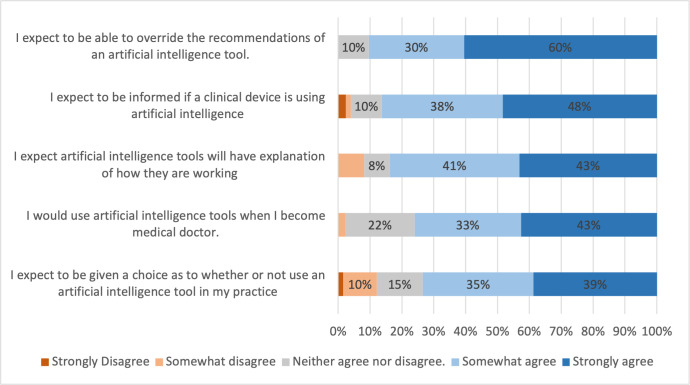
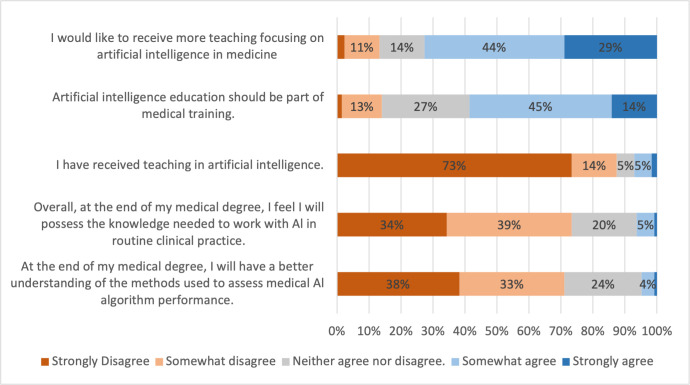
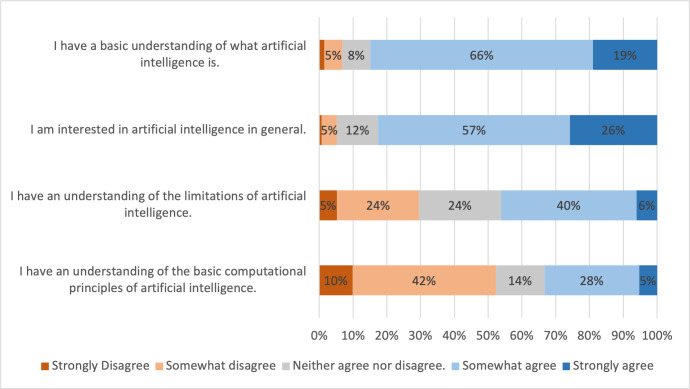
Overall, 134 students answered one or more questions (8.9% response rate). The majority of students (82.0%) were 20-29 years old, studying medicine as a postgraduate degree (77.6%), and had started clinical rotations (62.7%). Students were interested in AI (82.6%), self-reported having a basic understanding of AI (84.8%), but few agreed that they had an understanding of the basic computational principles of AI (33.3%) or the limitations of AI (46.2%). Most students (87.5%) had not received teaching in AI. The majority of students (58.6%) agreed that AI should be part of medical training and most (72.7%) wanted more teaching focusing on AI in medicine. Medical students appeared optimistic regarding the role of AI in medicine, with most (74.4%) agreeing with the statement that AI will improve medicine in general. The majority (56.6%) of medical students were not concerned about the impact of AI on their job security as a doctor. Students selected radiology (72.6%), pathology (58.2%), and medical administration (44.8%) as the specialties most likely to be impacted by AI, and psychiatry (61.2%), palliative care (48.5%), and obstetrics and gynaecology (41.0%) as the specialties least likely to be impacted by AI. Qualitative analysis of free text comments identified the use of AI as a tool, and that doctors will not be replaced as common themes.

CONCLUSION

Medical students in WA appear to be interested in AI. However, they have not received education about AI and do not feel they understand its basic computational principles or limitations. AI appears to be a current deficit in the medical curriculum in WA, and most students surveyed were supportive of its introduction. These results are consistent with previous surveys conducted internationally.

摘要

简介

国际调查发现,医学生对人工智能(AI)普遍感兴趣。在西澳大利亚(WA)尚未进行类似的调查,也不知道 WA 的医学生对 AI 在医疗保健中的应用有何看法,以及他们对 AI 的理解程度。我们旨在评估 WA 医学生对 AI 的总体态度、AI 在医疗保健中的应用,以及在医学课程中纳入 AI 教育。

方法

根据现有文献的回顾和主题专家的咨询,我们开发了一个数字调查工具。我们对一组医学生进行了试点调查,并根据他们的反馈进行了改进。然后,我们向 WA 的所有医学生(约 1539 名学生)发送了这份匿名数字调查。从 2021 年 9 月 7 日到 11 月 7 日,学生可以回复。学生的分类回答进行了定性分析,调查中的自由文本评论也使用开放式编码技术进行了定性分析。

结果

总的来说,有 134 名学生回答了一个或多个问题(8.9%的回复率)。大多数学生(82.0%)年龄在 20-29 岁之间,攻读研究生医学学位(77.6%),并开始临床轮转(62.7%)。学生对 AI 感兴趣(82.6%),自我报告对 AI 有基本的了解(84.8%),但只有少数人认为自己了解 AI 的基本计算原理(33.3%)或 AI 的局限性(46.2%)。大多数学生(87.5%)没有接受过 AI 教学。大多数学生(58.6%)认为 AI 应该成为医学培训的一部分,大多数学生(72.7%)希望更多地教授医学领域的 AI。医学生对 AI 在医学中的作用表现出乐观态度,大多数学生(74.4%)同意 AI 将普遍改善医学的说法。大多数医学生(56.6%)并不担心 AI 对他们作为医生的工作安全的影响。学生们选择放射科(72.6%)、病理学(58.2%)和医疗管理(44.8%)作为最有可能受到 AI 影响的专业,而精神病学(61.2%)、姑息治疗(48.5%)和妇产科(41.0%)作为最不可能受到 AI 影响的专业。对自由文本评论的定性分析确定了将 AI 用作工具,以及医生不会被取代是常见主题。

结论

WA 的医学生似乎对 AI 感兴趣。然而,他们没有接受过 AI 教育,也不认为自己了解其基本计算原理或局限性。AI 似乎是 WA 医学课程中的一个当前缺陷,大多数接受调查的学生都支持引入 AI。这些结果与之前在国际上进行的调查一致。
https://cdn.ncbi.nlm.nih.gov/pmc/blobs/f1f6/10470885/b0808e6a07fa/pone.0290642.g004.jpg
https://cdn.ncbi.nlm.nih.gov/pmc/blobs/f1f6/10470885/0b9392575c81/pone.0290642.g001.jpg
https://cdn.ncbi.nlm.nih.gov/pmc/blobs/f1f6/10470885/e799a171afd2/pone.0290642.g002.jpg
https://cdn.ncbi.nlm.nih.gov/pmc/blobs/f1f6/10470885/ae2f9964c87d/pone.0290642.g003.jpg
https://cdn.ncbi.nlm.nih.gov/pmc/blobs/f1f6/10470885/b0808e6a07fa/pone.0290642.g004.jpg
https://cdn.ncbi.nlm.nih.gov/pmc/blobs/f1f6/10470885/0b9392575c81/pone.0290642.g001.jpg
https://cdn.ncbi.nlm.nih.gov/pmc/blobs/f1f6/10470885/e799a171afd2/pone.0290642.g002.jpg
https://cdn.ncbi.nlm.nih.gov/pmc/blobs/f1f6/10470885/ae2f9964c87d/pone.0290642.g003.jpg
https://cdn.ncbi.nlm.nih.gov/pmc/blobs/f1f6/10470885/b0808e6a07fa/pone.0290642.g004.jpg

相似文献

1
Western Australian medical students' attitudes towards artificial intelligence in healthcare.西澳大利亚州医学生对医疗保健领域人工智能的态度。
PLoS One. 2023 Aug 31;18(8):e0290642. doi: 10.1371/journal.pone.0290642. eCollection 2023.
2
Knowledge, attitude, and perception of Arab medical students towards artificial intelligence in medicine and radiology: A multi-national cross-sectional study.阿拉伯医学专业学生对医学和放射学人工智能的知识、态度和看法:一项多国横断面研究。
Eur Radiol. 2024 Jul;34(7):1-14. doi: 10.1007/s00330-023-10509-2. Epub 2023 Dec 27.
3
Medical students' attitude towards artificial intelligence: a multicentre survey.医学生对人工智能的态度:一项多中心调查。
Eur Radiol. 2019 Apr;29(4):1640-1646. doi: 10.1007/s00330-018-5601-1. Epub 2018 Jul 6.
4
Perceptions of undergraduate medical students on artificial intelligence in medicine: mixed-methods survey study from Palestine.巴勒斯坦的一项混合方法调查研究:医学生对人工智能的看法。
BMC Med Educ. 2024 May 7;24(1):507. doi: 10.1186/s12909-024-05465-4.
5
AI Education for Fourth-Year Medical Students: Two-Year Experience of a Web-Based, Self-Guided Curriculum and Mixed Methods Study.面向四年级医学生的人工智能教育:基于网络的自主学习课程的两年经验及混合方法研究
JMIR Med Educ. 2024 Feb 20;10:e46500. doi: 10.2196/46500.
6
Medical Student Perspectives on the Impact of Artificial Intelligence on the Practice of Medicine.医学生对人工智能对医学实践影响的看法。
Curr Probl Diagn Radiol. 2021 Sep-Oct;50(5):614-619. doi: 10.1067/j.cpradiol.2020.06.011. Epub 2020 Jun 27.
7
Global cross-sectional student survey on AI in medical, dental, and veterinary education and practice at 192 faculties.全球医学、牙科和兽医学教育和实践中的人工智能学生横断面调查,涉及 192 个学院。
BMC Med Educ. 2024 Sep 28;24(1):1066. doi: 10.1186/s12909-024-06035-4.
8
Radiography students' perceptions of artificial intelligence in medical imaging.放射医学专业学生对医学影像人工智能的认知。
J Med Imaging Radiat Sci. 2024 Jun;55(2):258-263. doi: 10.1016/j.jmir.2024.02.014. Epub 2024 Feb 24.
9
Attitudes and perceptions of UK medical students towards artificial intelligence and radiology: a multicentre survey.英国医学生对人工智能与放射学的态度和认知:一项多中心调查
Insights Imaging. 2020 Feb 5;11(1):14. doi: 10.1186/s13244-019-0830-7.
10
Artificial intelligence in medical education - perception among medical students.人工智能在医学教育中的应用——医学生的认知。
BMC Med Educ. 2024 Jul 27;24(1):804. doi: 10.1186/s12909-024-05760-0.

引用本文的文献

1
Use and perception of generative artificial intelligence in traditional Korean medicine education: A cross-sectional survey of undergraduate students in Korea.韩国传统医学教育中生成式人工智能的使用与认知:韩国本科生的横断面调查
Integr Med Res. 2025 Dec;14(4):101216. doi: 10.1016/j.imr.2025.101216. Epub 2025 Aug 6.
2
Exploring Undergraduate Medical Students' Perspectives towards Artificial Intelligence in Healthcare: A Qualitative Study from India.探索本科医学生对医疗保健领域人工智能的看法:一项来自印度的定性研究
JMA J. 2025 Jul 15;8(3):718-729. doi: 10.31662/jmaj.2024-0402. Epub 2025 Jun 27.
3
AI ethics for the everyday intensivist.

本文引用的文献

1
Attitudes, knowledge, and skills towards artificial intelligence among healthcare students: A systematic review.医学生对人工智能的态度、知识和技能:一项系统综述。
Health Sci Rep. 2023 Mar 12;6(3):e1138. doi: 10.1002/hsr2.1138. eCollection 2023 Mar.
2
Systematic Review of Radiologist and Medical Student Attitudes on the Role and Impact of AI in Radiology.系统评价放射科医生和医学生对人工智能在放射学中的作用和影响的态度。
Acad Radiol. 2022 Nov;29(11):1748-1756. doi: 10.1016/j.acra.2021.12.032. Epub 2022 Jan 31.
3
Trustworthy Augmented Intelligence in Health Care.
面向日常工作中的重症监护医生的人工智能伦理
Crit Care Resusc. 2025 Jun 26;27(2):100115. doi: 10.1016/j.ccrj.2025.100115. eCollection 2025 Jun.
4
Future-ready medicine: Assessing the need for A.I. education in Indian undergraduate medical curriculum: A mixed method survey of student perspectives.面向未来的医学:评估印度本科医学课程中人工智能教育的必要性:一项关于学生观点的混合方法调查。
J Educ Health Promot. 2025 May 30;14:215. doi: 10.4103/jehp.jehp_1030_24. eCollection 2025.
5
Status and perceptions of ChatGPT utilization among medical students: a survey-based study.医学生对ChatGPT应用的现状与认知:一项基于调查的研究。
BMC Med Educ. 2025 Jun 4;25(1):831. doi: 10.1186/s12909-025-07438-7.
6
Artificial intelligence in focus: assessing awareness and perceptions among medical students in three private Syrian universities.聚焦人工智能:评估叙利亚三所私立大学医学生的认知与看法
BMC Med Educ. 2025 May 29;25(1):801. doi: 10.1186/s12909-025-07396-0.
7
Perception and Impact of AI on Education Journey of Medical Students and Interns in Western Region, KSA: A Cross-Sectional Study.沙特阿拉伯西部地区人工智能对医学生和实习生教育历程的认知与影响:一项横断面研究
J Med Educ Curric Dev. 2025 May 14;12:23821205251340129. doi: 10.1177/23821205251340129. eCollection 2025 Jan-Dec.
8
Health Care Professionals' Concerns About Medical AI and Psychological Barriers and Strategies for Successful Implementation: Scoping Review.医疗保健专业人员对医疗人工智能的担忧、心理障碍及成功实施的策略:范围综述
J Med Internet Res. 2025 Apr 23;27:e66986. doi: 10.2196/66986.
9
Artificial Intelligence Literacy Levels of Perioperative Nurses: The Case of Türkiye.围手术期护士的人工智能素养水平:以土耳其为例。
Nurs Health Sci. 2025 Mar;27(1):e70059. doi: 10.1111/nhs.70059.
10
Assessing the disconnect between student interest and education in artificial intelligence in medicine in Saudi Arabia.评估沙特阿拉伯医学领域学生对人工智能的兴趣与教育之间的脱节情况。
BMC Med Educ. 2025 Jan 30;25(1):150. doi: 10.1186/s12909-024-06446-3.
可信的医疗增强人工智能。
J Med Syst. 2022 Jan 12;46(2):12. doi: 10.1007/s10916-021-01790-z.
4
Educating Future Physicians in Artificial Intelligence (AI): An Integrative Review and Proposed Changes.培养未来人工智能领域的医生:一项综合综述及建议变革
J Med Educ Curric Dev. 2021 Sep 6;8:23821205211036836. doi: 10.1177/23821205211036836. eCollection 2021 Jan-Dec.
5
Medical student knowledge and critical appraisal of machine learning: a multicentre international cross-sectional study.医学生对机器学习的知识和批判性评价:一项多中心国际横断面研究。
Intern Med J. 2021 Sep;51(9):1539-1542. doi: 10.1111/imj.15479.
6
Are We Ready to Integrate Artificial Intelligence Literacy into Medical School Curriculum: Students and Faculty Survey.我们准备好将人工智能素养纳入医学院课程了吗:学生和教师调查。
J Med Educ Curric Dev. 2021 Jun 23;8:23821205211024078. doi: 10.1177/23821205211024078. eCollection 2021 Jan-Dec.
7
Medical students need artificial intelligence and machine learning training.医学生需要人工智能和机器学习培训。
Nat Biotechnol. 2021 Mar;39(3):388-389. doi: 10.1038/s41587-021-00846-2.
8
The need for health AI ethics in medical school education.在医学院校教育中需要健康人工智能伦理。
Adv Health Sci Educ Theory Pract. 2021 Oct;26(4):1447-1458. doi: 10.1007/s10459-021-10040-3. Epub 2021 Mar 3.
9
Artificial intelligence in radiology: does it impact medical students preference for radiology as their future career?放射学中的人工智能:它会影响医学生将放射学作为未来职业的偏好吗?
BJR Open. 2020 Dec 11;2(1):20200037. doi: 10.1259/bjro.20200037. eCollection 2020.
10
The importance of introducing artificial intelligence to the medical curriculum - assessing practitioners' perspectives.将人工智能引入医学课程的重要性——评估从业者的观点。
Croat Med J. 2020 Oct 31;61(5):457-464. doi: 10.3325/cmj.2020.61.457.