Department of Virology, Institute of Tropical Medicine, Nagasaki University, Nagasaki 852-8523, Japan.
Leading Graduate School Program, Nagasaki University, Nagasaki 852-8523, Japan.
Viruses. 2020 Feb 3;12(2):169. doi: 10.3390/v12020169.
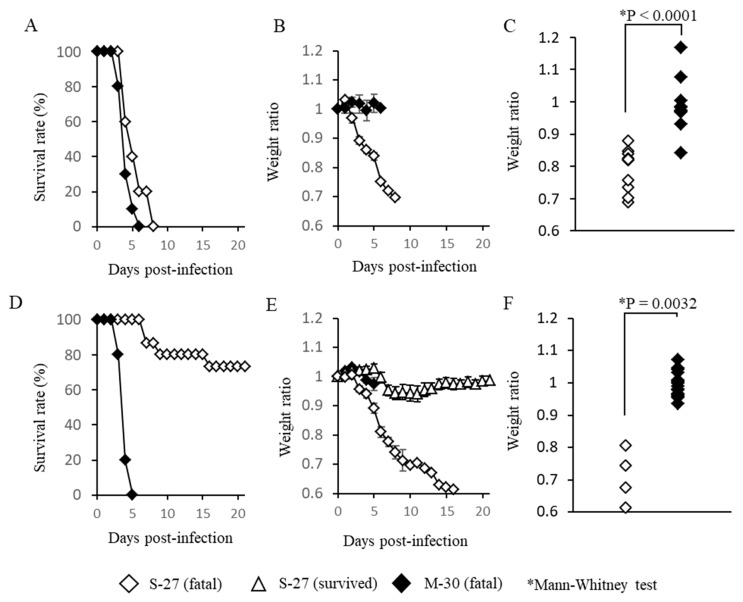
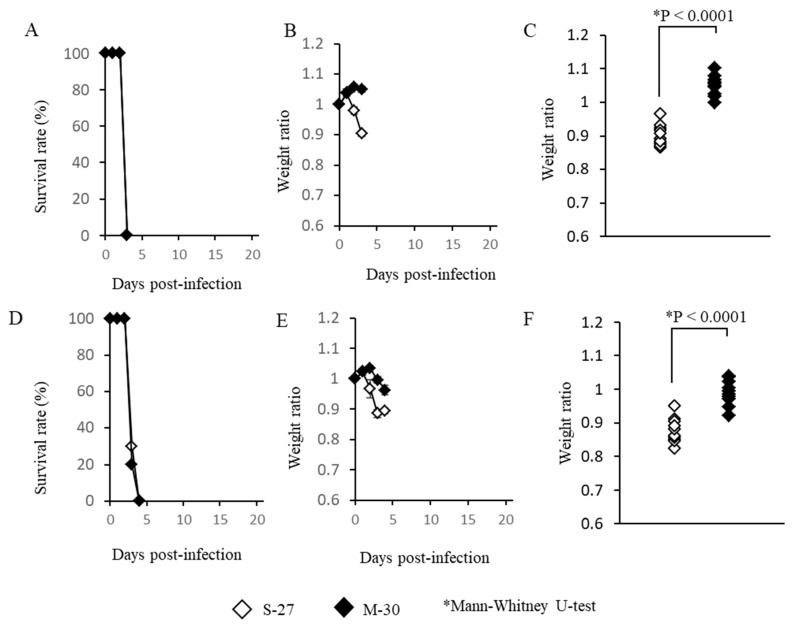
Epidemics of the Chikungunya virus (CHIKV) from 2004 onwards were caused by the East/Central/South African (ECSA) genotype. However, the pathogenesis of the genotype infection has not been fully explained. In this study, we examined the pathogenic potential of CHIKV ECSA genotype M-30 (M-30) by comparing it with that of African genotype S-27 (S-27) in mice. Following low titer infections in type-I IFN receptor KO (A129) mice, we found that the M-30 infection caused high and acute fatality compared with the S-27 infection. M-30-infected A129 mice showed higher viral loads in their central nervous systems and peripheral organs, and increased levels of IFN-γ responses in their brains. Interestingly, M-30-infected mice did not show the hypophagia and reductions in weight which were observed in S-27-infected mice. Our observations provide a novel explanation of the pathogenic mechanisms attributed to virus proliferation, anti-type-II IFN response and metabolic activity in the CHIKV ECSA virus in mice.
自 2004 年以来,基孔肯雅病毒(CHIKV)的流行是由东/中非/南非(ECSA)基因型引起的。然而,该基因型感染的发病机制尚未得到充分解释。在这项研究中,我们通过比较 ECSA 基因型 M-30(M-30)与非洲基因型 S-27(S-27)在小鼠中的致病潜力,研究了 CHIKV ECSA 基因型的致病潜力。在 I 型 IFN 受体 KO(A129)小鼠的低滴度感染后,我们发现与 S-27 感染相比,M-30 感染导致高且急性致死率。M-30 感染的 A129 小鼠其中枢神经系统和外周器官中的病毒载量更高,大脑中的 IFN-γ 反应水平也更高。有趣的是,与 S-27 感染的小鼠不同,M-30 感染的小鼠没有出现厌食和体重减轻的现象。我们的观察结果为病毒增殖、抗 II 型 IFN 反应和代谢活性在 ECSA 病毒感染小鼠中的致病机制提供了新的解释。