Department of Chemical Physiology and Biochemistry, Oregon Health and Science University, Portland, Oregon 97210, USA.
Genes Dev. 2020 Mar 1;34(5-6):254-262. doi: 10.1101/gad.335109.119. Epub 2020 Feb 6.
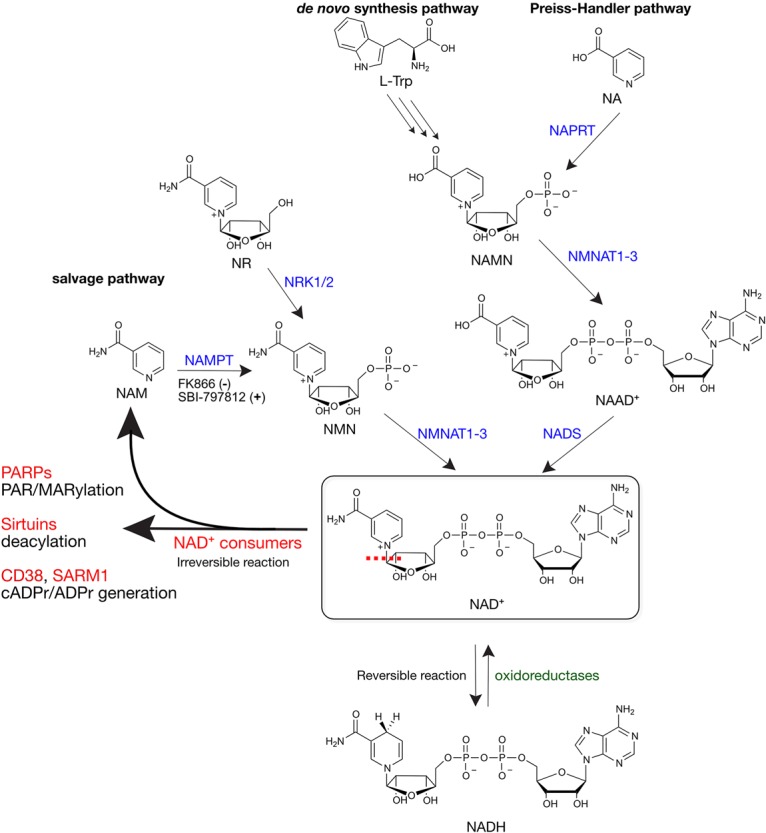
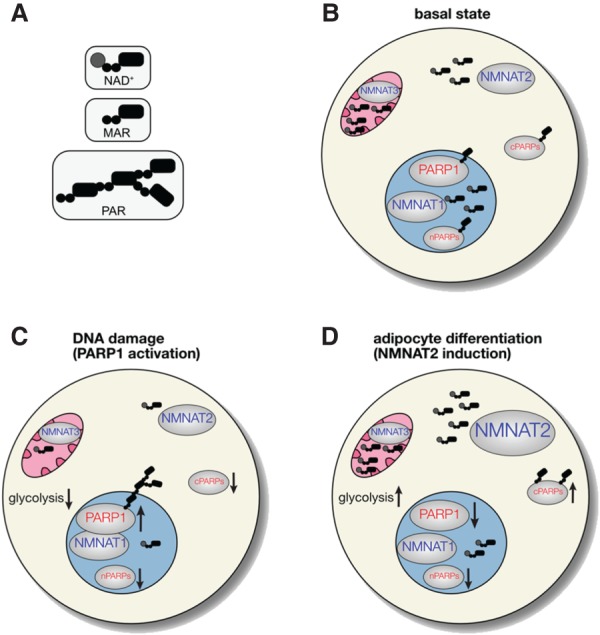
Nicotinamide adenine dinucleotide (NAD) is an essential cofactor for redox enzymes, but also moonlights as a substrate for signaling enzymes. When used as a substrate by signaling enzymes, it is consumed, necessitating the recycling of NAD consumption products (i.e., nicotinamide) via a salvage pathway in order to maintain NAD homeostasis. A major family of NAD consumers in mammalian cells are poly-ADP-ribose-polymerases (PARPs). PARPs comprise a family of 17 enzymes in humans, 16 of which catalyze the transfer of ADP-ribose from NAD to macromolecular targets (namely, proteins, but also DNA and RNA). Because PARPs and the NAD biosynthetic enzymes are subcellularly localized, an emerging concept is that the activity of PARPs and other NAD consumers are regulated in a compartmentalized manner. In this review, I discuss NAD metabolism, how different subcellular pools of NAD are established and regulated, and how free NAD levels can control signaling by PARPs and redox metabolism.
烟酰胺腺嘌呤二核苷酸 (NAD) 是氧化还原酶的必需辅助因子,但也兼职作为信号酶的底物。当信号酶将 NAD 作为底物使用时,NAD 被消耗,需要通过补救途径回收 NAD 消耗产物(即烟酰胺),以维持 NAD 体内平衡。哺乳动物细胞中 NAD 的主要消耗者是聚 ADP-核糖聚合酶 (PARP)。PARP 由人类中的 17 种酶组成,其中 16 种酶催化 ADP-核糖从 NAD 转移到大分子靶标(即蛋白质,也包括 DNA 和 RNA)。由于 PARP 和 NAD 生物合成酶在细胞内定位,一个新出现的概念是 PARP 和其他 NAD 消耗酶的活性以区室化的方式进行调节。在这篇综述中,我将讨论 NAD 代谢、不同的 NAD 亚细胞池是如何建立和调节的,以及游离 NAD 水平如何控制 PARP 和氧化还原代谢的信号转导。