Graduate Program in Cellular and Molecular Pharmacology and Physiology, Rochester, United States.
Biomedical Engineering Program, University of Rochester, New York, United States.
Elife. 2020 Feb 7;9:e51111. doi: 10.7554/eLife.51111.
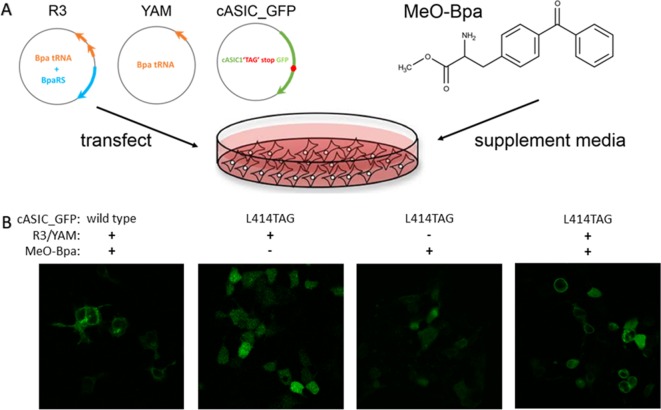
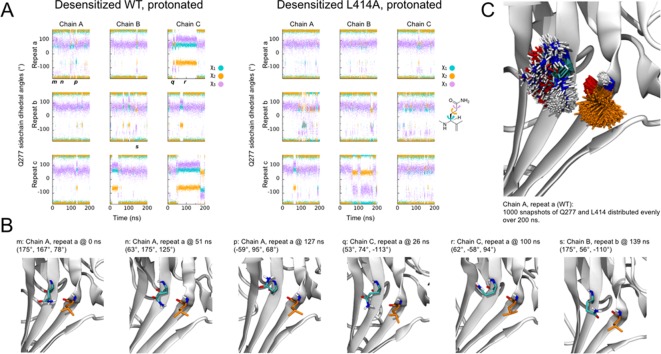
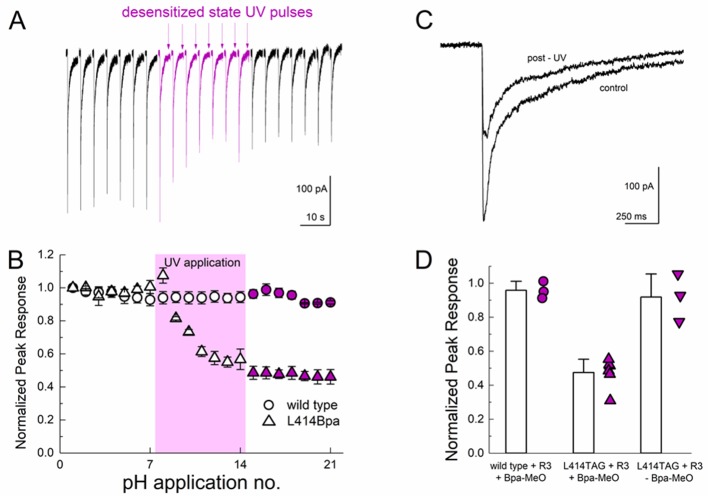
Acid-sensing ion channels (ASICs) are neuronal sodium-selective channels activated by reductions in extracellular pH. Structures of the three presumptive functional states, high-pH resting, low-pH desensitized, and toxin-stabilized open, have all been solved for chicken ASIC1. These structures, along with prior functional data, suggest that the isomerization or flipping of the β11-12 linker in the extracellular, ligand-binding domain is an integral component of the desensitization process. To test this, we combined fast perfusion electrophysiology, molecular dynamics simulations and state-dependent non-canonical amino acid cross-linking. We find that both desensitization and recovery can be accelerated by orders of magnitude by mutating resides in this linker or the surrounding region. Furthermore, desensitization can be suppressed by trapping the linker in the resting state, indicating that isomerization of the β11-12 linker is not merely a consequence of, but a necessity for the desensitization process in ASICs.
酸敏离子通道(ASICs)是一种神经元钠离子选择性通道,可被细胞外 pH 值降低激活。鸡 ASIC1 的三种假定功能状态(高 pH 值静息状态、低 pH 值脱敏状态和毒素稳定开放状态)的结构都已被解决。这些结构以及之前的功能数据表明,β11-12 连接子在细胞外配体结合域中的异构化或翻转是脱敏过程的一个组成部分。为了验证这一点,我们结合了快速灌注电生理学、分子动力学模拟和状态依赖性非规范氨基酸交联。我们发现,通过突变该连接子或周围区域的残基,可以使脱敏和恢复速度提高几个数量级。此外,通过将连接子固定在静息状态下,可以抑制脱敏,这表明β11-12 连接子的异构化不仅仅是脱敏过程的结果,而是其必需条件。