Department of Psychiatry, University of Oxford, Oxford, UK.
Department of Psychiatry, University of Oxford, Oxford, UK.
Lancet Public Health. 2020 Feb;5(2):e99-e106. doi: 10.1016/S2468-2667(19)30245-2.
Calls for increased funding for mental health services require many lines of evidence in support, including estimates of economic impact. One understudied source of cost is violence perpetrated by individuals with severe mental illness. Estimating this economic impact can inform budget planning across several government sectors and emphasise the importance of violence prevention. Therefore, we aimed to provide a comprehensive estimate of the economic costs of violence perpetrated by people with severe mental illness.
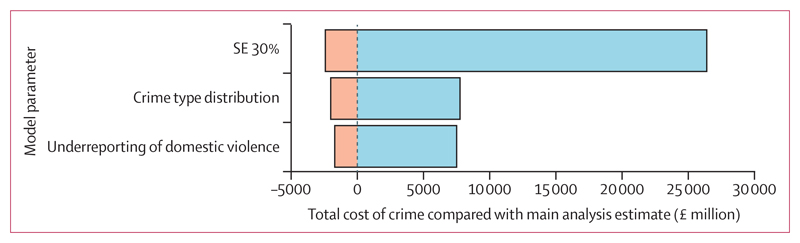
For this retrospective analysis, we used a prevalence-based modelling approach to estimate the annual economic cost of violent incidents committed by people with severe mental illness in England and Wales during 2015-16. The model was based on secondary data, including the association between violence and severe mental illness, illness prevalence, recidivism, absolute numbers of violent incidents in 2015-16, and costs to society per violent crime, by area of spending. Uncertainty was addressed with probabilistic and deterministic sensitivity analyses that tested the effect of underreporting of domestic violence and distributions of crime types in individuals with severe mental illness.
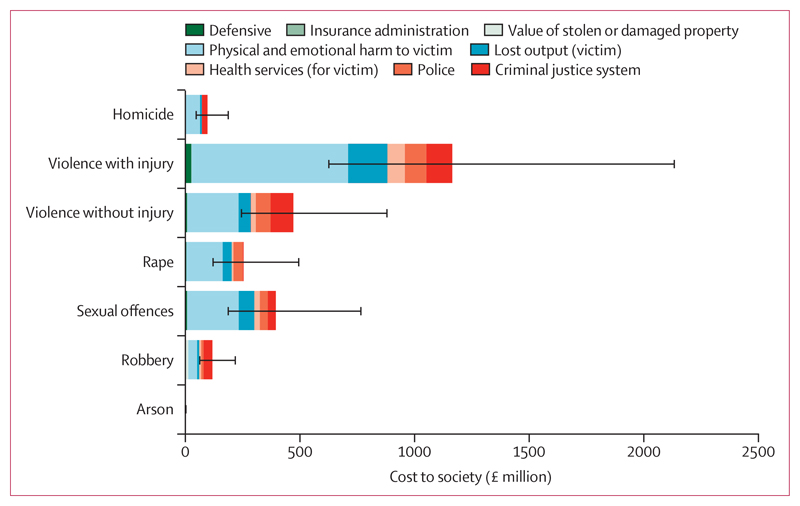
The estimated annual economic impact of violence perpetrated by people with severe mental illness was £2·5 (95% CI 1·4-4·5) billion in England and Wales in 2015-16, or 5·3% of the total estimated societal cost of violence. The largest contributors to the cost of violent crime perpetrated by individuals with severe mental illness were the cost of physical and emotional harm to victims (£1·4 [95% CI 0·8-2·5] billion), followed by lost productivity of victims (£348.0 [190·0-628·8] million), while the combined cost to the police and criminal justice system was £561·3 (305·9-1009·2) million and the cost to health services was £136·7 [74·3-246·3] million. The additional cost to secure forensic care was estimated to be £487·7 (302·0-709·1) million.
The economic impact of violence perpetrated by individuals with severe mental illness is potentially important. Preventing violence, especially through services for individuals with comorbid substance misuse, and reducing recidivism might lead to cost savings at a governmental and individual level, in addition to the clinical and societal benefits.
Wellcome Trust, National Institute for Health Research (NIHR) Oxford Biomedical Research Centre, and NIHR Applied Research Collaboration Oxford and Thames Valley.
呼吁增加精神卫生服务资金需要提供多方面的证据支持,包括对经济影响的评估。一个研究较少的成本来源是严重精神疾病患者实施的暴力行为。估计这种经济影响可以为多个政府部门的预算规划提供信息,并强调预防暴力的重要性。因此,我们旨在提供严重精神疾病患者实施暴力行为的经济成本的综合估计。
对于这项回顾性分析,我们使用基于患病率的建模方法来估计 2015-16 年在英格兰和威尔士,严重精神疾病患者实施暴力行为的年度经济成本。该模型基于二次数据,包括暴力行为与严重精神疾病之间的关联、疾病流行率、累犯率、2015-16 年暴力事件的绝对数量以及按支出领域计算的每起暴力犯罪的社会成本。通过概率和确定性敏感性分析来解决不确定性问题,这些分析测试了家庭暴力报告不足和严重精神疾病患者犯罪类型分布的影响。
2015-16 年,在英格兰和威尔士,严重精神疾病患者实施暴力行为的估计年度经济影响为 25 亿英镑(95%CI 14-45 亿英镑),占暴力行为总社会成本的 5.3%。严重精神疾病患者实施暴力犯罪的最大成本贡献者是对受害者身体和情感伤害的成本(14 亿英镑(95%CI 8-25 亿英镑)),其次是受害者生产力损失(3.480 亿英镑(1.900-6.288 亿英镑)),而警察和刑事司法系统的总成本为 5.613 亿英镑(305.9-1009.2 万英镑),卫生服务成本为 1.367 亿英镑(7430-2.463 亿英镑)。用于确保法医护理的额外成本估计为 4.877 亿英镑(302.0-709.1 万英镑)。
严重精神疾病患者实施暴力行为的经济影响可能很重要。预防暴力行为,特别是通过为患有合并物质使用障碍的患者提供服务,并降低累犯率,可能会在政府和个人层面上带来成本节约,此外还会带来临床和社会效益。
惠康信托基金会、英国国民健康保险制度(NHS)牛津生物医学研究中心、英国国民健康保险制度(NHS)牛津应用研究合作组织和牛津和泰晤士河谷。