Department of Psychiatry, University of Oxford, Warneford Hospital, Oxford, United Kingdom.
Department of Medical Epidemiology and Biostatistics, Karolinska Institutet, Stockholm, Sweden.
JAMA Psychiatry. 2016 Aug 1;73(8):796-803. doi: 10.1001/jamapsychiatry.2016.1349.
Absolute and relative risks of violence are increased in patients with psychotic disorders, but the contribution of triggers for violent acts to these risks is uncertain.
To examine whether a range of triggers for violent acts are associated with risks of violence in patients diagnosed with psychotic disorders and in individuals without a psychiatric diagnosis.
DESIGN, SETTING, AND PARTICIPANTS: Using a sample of all individuals born in Sweden between 1958 and 1988 (N = 3 123 724), we identified patients in the National Patient Register who were diagnosed with schizophrenia spectrum disorders (n = 34 903) and bipolar disorder (n = 29 692), as well as unaffected controls (n = 2 763 012). We then identified, within each subsample, persons who had experienced any of the following triggers for violent acts between January 1, 2001, and December 15, 2013: exposure to violence, parental bereavement, self-harm, traumatic brain injury, unintentional injuries, and substance intoxication. By using within-individual models, we conducted conditional logistic regression to compare the risk of the individual engaging in violent acts in the week following the exposure to a trigger with the risk during earlier periods of equivalent length. All time-invariant confounders (eg, genetic and early environmental influences) were controlled for by this research design and we further adjusted for time-varying sociodemographic factors.
Adjusted odds ratios (aORs) of violent crime occurring in the week following the exposure to a trigger event compared with earlier periods.
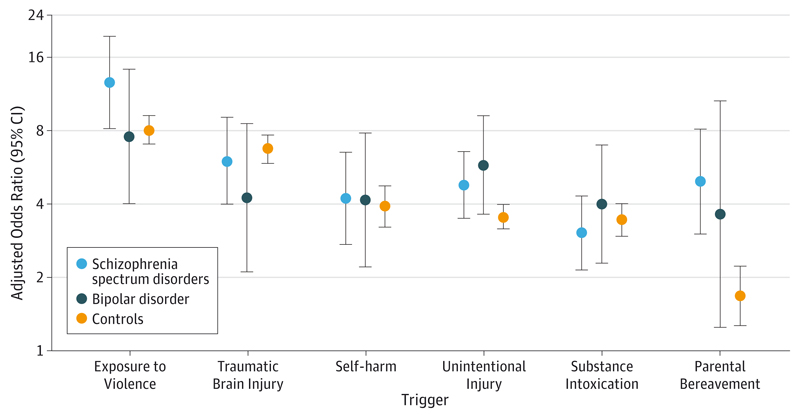
Among the sample of 2 827 607 individuals (1 492 186 male and 1 335 421 female), all of the examined trigger events were associated with increased risk of violent crime in the week following exposure. The largest 1-week absolute risk of violent crime was observed following exposure to violence (70-177 violent crimes per 10 000 persons). For most triggers, the relative risks did not vary significantly by diagnosis, including unintentional injuries (aOR range, 3.5-4.8), self-harm (aOR range, 3.9-4.2), and substance intoxication (aOR range, 3.0-4.0). Differences by diagnosis included parental bereavement, which was significantly higher in patients with schizophrenia spectrum disorders (aOR, 5.0; 95% CI, 3.0-8.1) compared with controls (aOR, 1.7; 95% CI, 1.3-2.2).
In addition to identifying risk factors for violence, clarifying the timing of the triggers may provide opportunities to improve risk assessment and management in individuals with psychotic disorders.
精神病患者的暴力行为的绝对和相对风险增加,但暴力行为的触发因素对这些风险的贡献尚不确定。
研究一系列暴力行为触发因素是否与精神障碍患者和无精神疾病诊断个体的暴力风险相关。
设计、设置和参与者:我们使用瑞典在 1958 年至 1988 年间出生的所有个体的样本(N=3123724),在国家患者登记册中确定了被诊断患有精神分裂症谱系障碍(n=34903)和双相情感障碍(n=29692)的患者,以及未受影响的对照者(n=2763012)。然后,我们在每个子样本中确定了在 2001 年 1 月 1 日至 2013 年 12 月 15 日期间经历过以下任何暴力行为触发因素的人:暴露于暴力、父母丧亲、自残、创伤性脑损伤、意外伤害和物质中毒。通过使用个体内模型,我们进行了条件逻辑回归,比较了个体在接触触发因素后的一周内从事暴力行为的风险与之前同等长度时期的风险。这种研究设计控制了所有时间不变的混杂因素(例如遗传和早期环境影响),我们进一步调整了时间变化的社会人口因素。
与之前的时间段相比,接触触发因素后的一周内发生暴力犯罪的调整后优势比(aOR)。
在 2827607 名样本个体中(1492186 名男性和 1335421 名女性),所有检查的触发事件都与接触后的一周内暴力犯罪风险增加有关。观察到的暴力犯罪的最大 1 周绝对风险是在暴露于暴力之后(每 10000 人中有 70-177 人发生暴力犯罪)。对于大多数触发因素,相对风险在诊断上没有显著差异,包括意外伤害(aOR 范围,3.5-4.8)、自残(aOR 范围,3.9-4.2)和物质中毒(aOR 范围,3.0-4.0)。诊断差异包括父母丧亲,在精神分裂症谱系障碍患者中明显高于对照组(aOR,5.0;95%CI,3.0-8.1),而对照组为(aOR,1.7;95%CI,1.3-2.2)。
除了确定暴力风险因素外,阐明触发因素的时间可能为改善精神障碍患者的风险评估和管理提供机会。