Department of Psychosis Studies, Institute of Psychiatry, Psychology and Neuroscience, King's College London, De Crespigny Park, London SE5 8AF, UK.
Department of Psychosis Studies, Institute of Psychiatry, Psychology and Neuroscience, King's College London, De Crespigny Park, London SE5 8AF, UK; Department of Psychiatry, School of Medicine, Pontificia Universidad Católica de Chile, Diagonal Paraguay 362, Santiago 8330077, Chile.
Neuroimage Clin. 2020;25:102169. doi: 10.1016/j.nicl.2020.102169. Epub 2020 Jan 11.
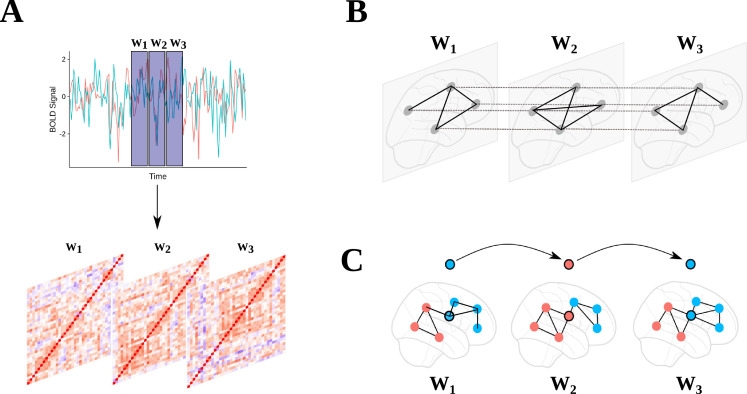
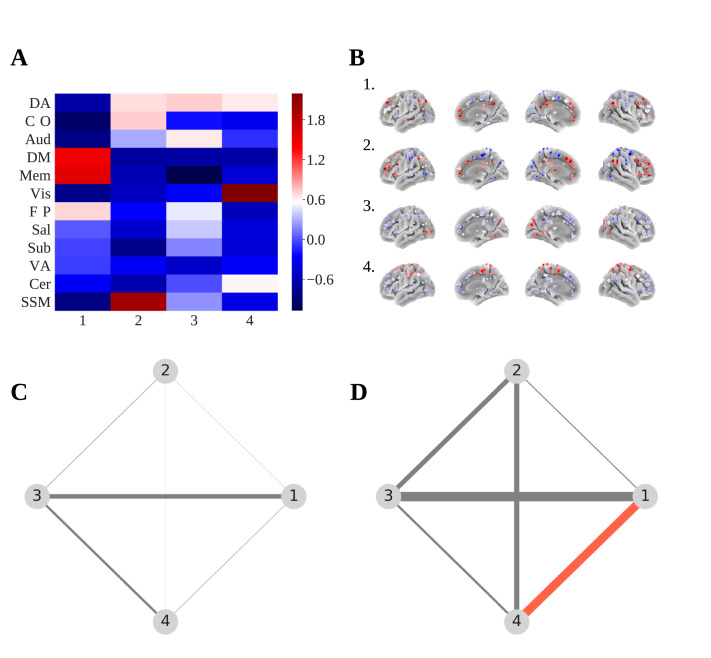
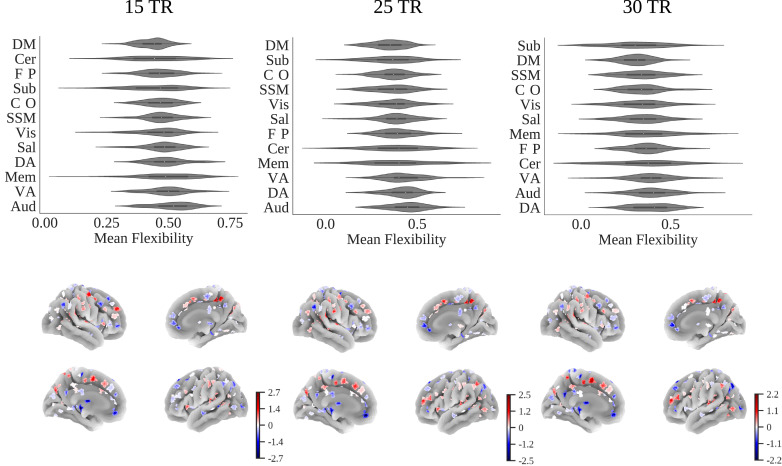
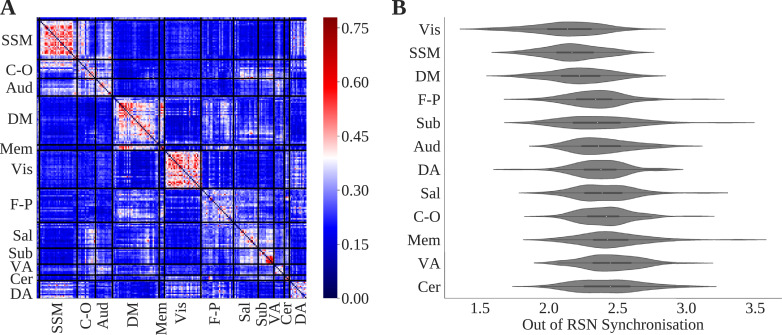
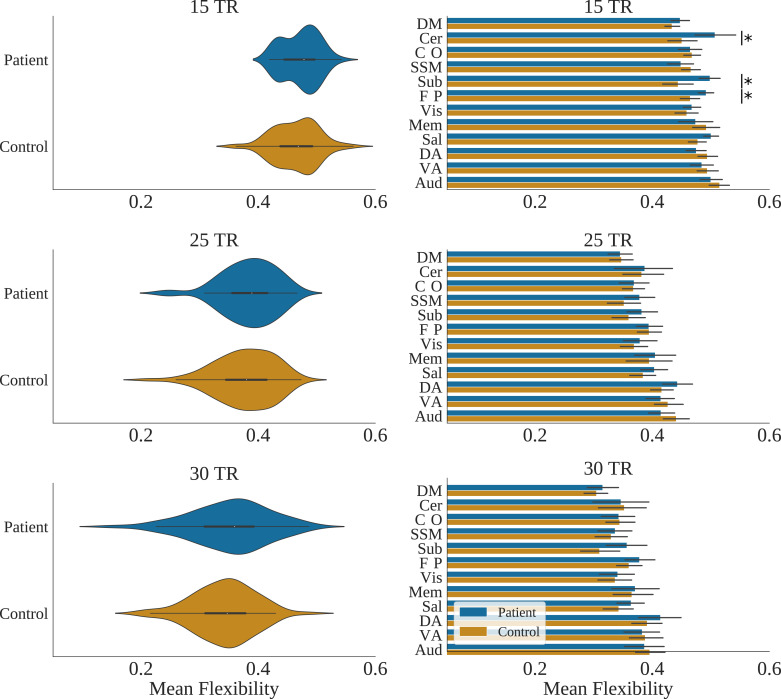
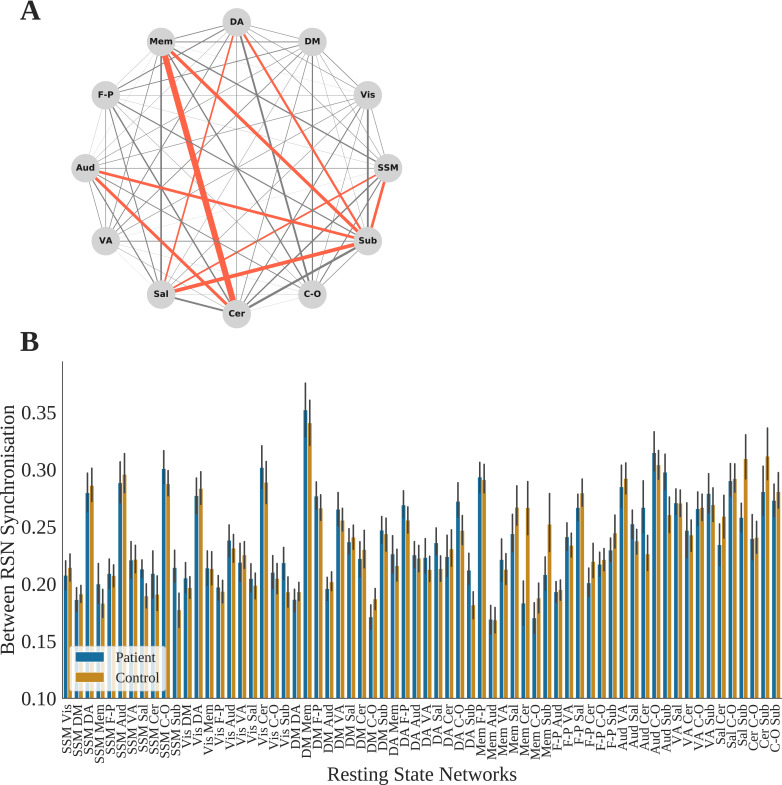
Novel methods for measuring large-scale dynamic brain organisation are needed to provide new biomarkers of schizophrenia. Using a method for modelling dynamic modular organisation (Mucha et al., 2010), evidence suggests higher 'flexibility' (switching between multilayer network communities) to be a feature of schizophrenia (Braun et al., 2016). The current study compared flexibility between 55 patients with schizophrenia and 72 controls (the COBRE Dataset). In addition, novel methods of 'between resting state network synchronisation' (BRSNS) and the probability of transition from one community to another were used to further describe group differences in dynamic community structure. There was significantly higher schizophrenia group flexibility scores in cerebellar (F (1124) = 9.33, p (FDR) = 0.017), subcortical (F (1124) = 13.14, p (FDR) = 0.005), and fronto-parietal task control (F (1124) = 7.19, p (FDR) = 0.033) resting state networks (RSNs), as well as in the left thalamus (MNI XYZ: -2, -13, 12; F(1, 124) = 17.1, p (FDR) < 0.001) and the right crus I (MNI XYZ: 35, -67, -34; F (1, 124) = 19.65, p (FDR) < 0.001). Flexibility in the left thalamus reflected transitions between communities covering default mode and sensory-somatomotor RSNs. BRSNS scores suggested altered dynamic inter-RSN modular configuration in schizophrenia. This study suggests less stable community structure in a schizophrenia group at an RSN and node level and provides novel methods of exploring dynamic community structure. Mediation of group differences by mean time window correlation did however suggest flexibility to be no better as a schizophrenia biomarker than simpler measures and a range of methodological choices affected results.
需要新的方法来测量大规模的大脑动态组织,以提供精神分裂症的新生物标志物。使用一种建模动态模块组织的方法(Mucha 等人,2010),有证据表明更高的“灵活性”(在多层网络社区之间切换)是精神分裂症的一个特征(Braun 等人,2016)。本研究比较了 55 名精神分裂症患者和 72 名对照组(COBRE 数据集)之间的灵活性。此外,还使用了新的“静息状态网络间同步”(BRSNS)和从一个社区到另一个社区的转移概率的方法,进一步描述了动态社区结构的组间差异。小脑(F(1124)= 9.33,p(FDR)= 0.017)、皮质下(F(1124)= 13.14,p(FDR)= 0.005)和额顶任务控制(F(1124)= 7.19,p(FDR)= 0.033)静息态网络(RSNs)以及左丘脑(MNI XYZ:-2,-13,12;F(1,124)= 17.1,p(FDR)<0.001)和右 Crus I(MNI XYZ:35,-67,-34;F(1,124)= 19.65,p(FDR)<0.001)中,精神分裂症组的灵活性更高。左丘脑的灵活性反映了默认模式和感觉运动 RSN 之间的社区之间的转换。BRSNS 分数表明精神分裂症患者的动态 RSN 间模块配置发生了变化。本研究表明,在 RSN 和节点水平上,精神分裂症组的社区结构不太稳定,并提供了探索动态社区结构的新方法。然而,组间差异的中介由平均时间窗口相关性表明,灵活性作为精神分裂症的生物标志物并不比更简单的测量方法更好,并且一系列方法选择影响了结果。