Standage Dominic I, Gale Daniel J, Nashed Joseph Y, Flanagan J Randall, Gallivan Jason P
Department of Biomedical and Molecular Sciences, Queen's University, Kingston, Canada.
Centre for Neuroscience Studies, Queen's University, Kingston, Canada.
Netw Neurosci. 2025 May 8;9(2):631-660. doi: 10.1162/netn_a_00420. eCollection 2025.
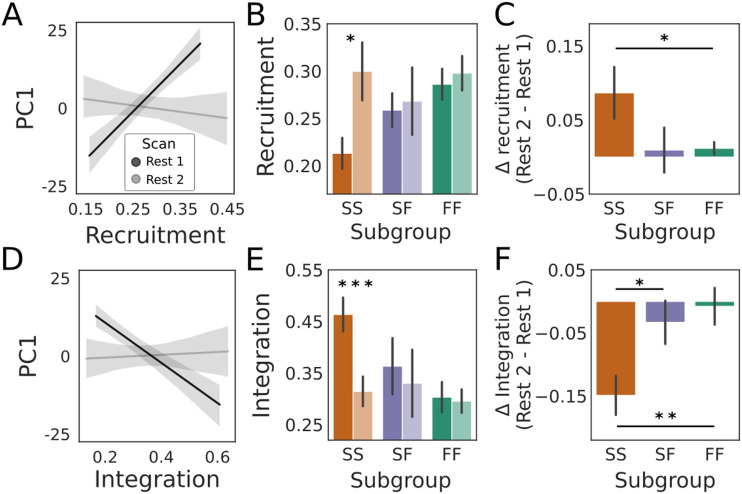
Neural measures that predict cognitive performance are informative about the mechanisms underlying cognitive phenomena, with diagnostic potential for neuropathologies with cognitive symptoms. Among such markers, the modularity (subnetwork composition) of whole-brain functional networks is especially promising due to its longstanding theoretical foundations and recent success in predicting clinical outcomes. We used functional magnetic resonance imaging to identify whole-brain modules at rest, calculating metrics of their spatiotemporal dynamics before and after a sensorimotor learning task on which fast learning is widely believed to be supported by a cognitive strategy. We found that participants' learning performance was predicted by the degree of coordination of modular reconfiguration and the strength of recruitment and integration of networks derived during the task itself. Our findings identify these whole-brain metrics as promising network-based markers of cognition, with relevance to basic neuroscience and the potential for clinical application.
能够预测认知表现的神经测量方法有助于了解认知现象背后的机制,对具有认知症状的神经病理学具有诊断潜力。在这类标志物中,全脑功能网络的模块化(子网组成)尤其具有前景,这得益于其长期的理论基础以及近期在预测临床结果方面的成功。我们使用功能磁共振成像来识别静息状态下的全脑模块,计算在一项感觉运动学习任务前后它们的时空动力学指标,人们普遍认为快速学习是由一种认知策略支持的。我们发现,参与者的学习表现可通过模块化重新配置的协调程度以及任务期间所衍生网络的募集和整合强度来预测。我们的研究结果表明,这些全脑指标有望成为基于网络的认知标志物,与基础神经科学相关且具有临床应用潜力。