
感热通量在评估首尔(韩国)的热脆弱性方面是否有用?
Is Sensible Heat Flux Useful for the Assessment of Thermal Vulnerability in Seoul (Korea)?
机构信息
Interdisciplinary Program in Landscape Architecture, Seoul National University, Seoul 08826, Korea.
Department of Landscape Architecture and Rural System Engineering, Seoul National University, Seoul 08826, Korea.
出版信息
Int J Environ Res Public Health. 2020 Feb 4;17(3):963. doi: 10.3390/ijerph17030963.
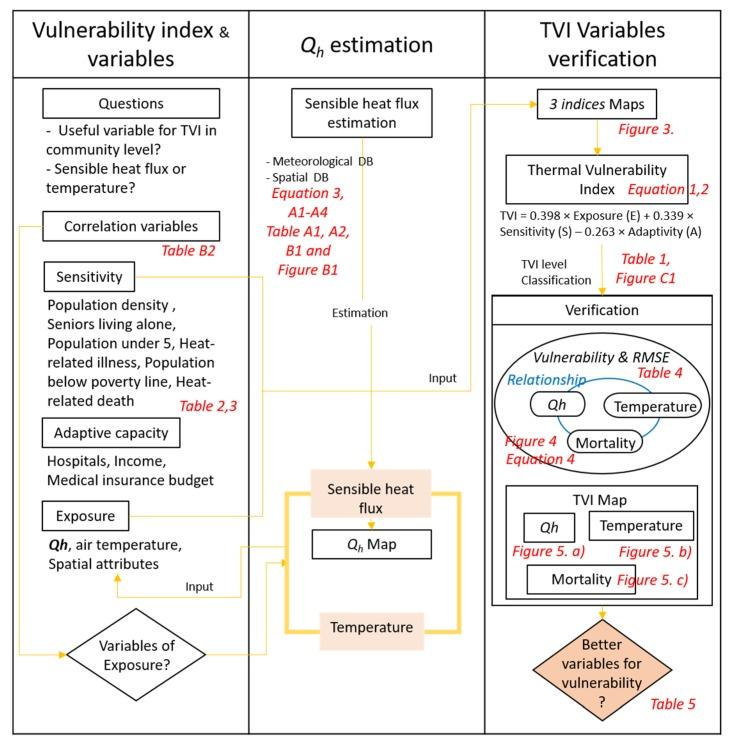
Climate change has led to increases in global temperatures, raising concerns regarding the threat of lethal heat waves and deterioration of the thermal environment. In the present study, we adopted two methods for spatial modelling of the thermal environment based on sensible heat and temperature. A vulnerability map reflecting daytime temperature was derived to plot thermal vulnerability based on sensible heat and climate change exposure factors. The correlation (0.73) between spatial distribution of sensible heat vulnerability and mortality rate was significantly greater than that (0.30) between the spatial distribution of temperature vulnerability and mortality rate. These findings indicate that deriving thermally vulnerable areas based on sensible heat are more objective than thermally vulnerable areas based on existing temperatures. Our findings support the notion that the distribution of sensible heat vulnerability at the community level is useful for evaluating the thermal environment in specific neighbourhoods. Thus, our results may aid in establishing spatial planning standards to improve environmental sustainability in a metropolitan community.
气候变化导致全球气温上升,引发了人们对致命热浪威胁和热环境恶化的担忧。在本研究中,我们采用了基于显热和温度的两种热环境空间建模方法。基于显热和气候变化暴露因素,得出了反映日间温度的脆弱性图,以绘制热脆弱性图。显热脆弱性的空间分布与死亡率之间的相关性(0.73)明显大于温度脆弱性的空间分布与死亡率之间的相关性(0.30)。这些发现表明,基于显热得出的热脆弱区域比基于现有温度得出的热脆弱区域更客观。我们的研究结果支持这样一种观点,即在社区层面上,显热脆弱性的分布对于评估特定社区的热环境是有用的。因此,我们的研究结果可能有助于制定空间规划标准,以提高大都市社区的环境可持续性。




 Zotero 插件