Universitat Rovira i Virgili, Department of Biochemistry and Biotechnology, Nutrigenomics Research Group, 43007 Tarragona, Spain.
Eurecat, Centre Tecnològic de Catalunya, Centre for Omic Sciences (COS), Joint Unit Universitat Rovira i Virgili-EURECAT, Unique Scientific and Technical Infrastructures (ICTS), 43204 Reus, Spain.
Nutrients. 2020 Feb 4;12(2):408. doi: 10.3390/nu12020408.
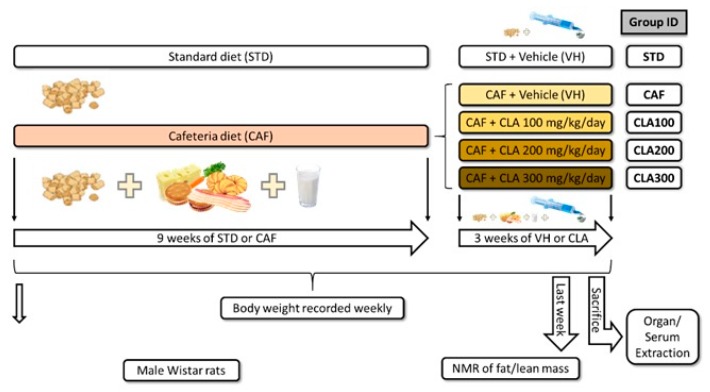
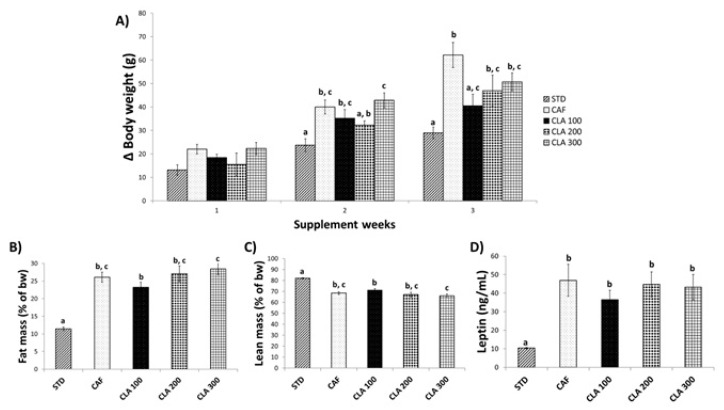
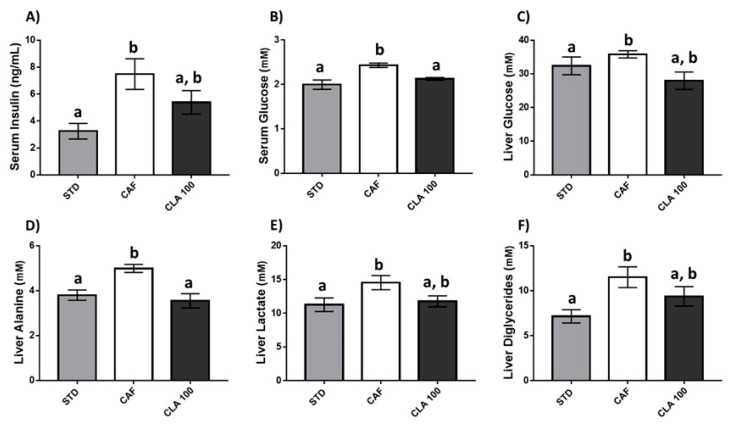
Conjugated linoleic acid (CLA) is a dietary supplement that has been shown to improve obesity. However, some authors have associated high doses of CLA supplementation with liver impairment and insulin resistance. The aim of this study was to assess whether the consumption of low doses of CLA maintained the beneficial effects on the main metabolic disturbances associated with metabolic syndrome (MetS) but prevented the occurrence of non-desirable outcomes associated with its consumption. Male Wistar rats, fed standard or cafeteria (CAF) diet for 12 weeks, were supplemented with three different low doses of CLA in the last three weeks. Both biochemical and H NMR-based metabolomics profiles were analysed in serum and liver. The consumption of 100 mg/kg CLA, but not doses of 200 and 300 mg/kg, ameliorated the increase in body weight gain as well as the serum concentrations of glucose, insulin, cholesterol, triglyceride, diglyceride, and total phospholipid induced by a CAF diet. In turn, CLA reverted the increase in lactate, alanine, and glucose concentrations in the liver of these animals, but enhanced hepatic cholesterol accumulation without any detrimental effect on liver function. In conclusion, a low dose of CLA corrected the adverse effects associated with MetS without compromising other metabolic parameters.
共轭亚油酸(CLA)是一种膳食补充剂,已被证明可以改善肥胖。然而,一些作者认为 CLA 补充剂的高剂量与肝损伤和胰岛素抵抗有关。本研究旨在评估低剂量 CLA 的摄入是否能保持对与代谢综合征(MetS)相关的主要代谢紊乱的有益影响,同时防止与 CLA 摄入相关的不良后果的发生。雄性 Wistar 大鼠在标准饮食或 cafeteria(CAF)饮食下喂养 12 周,在最后 3 周内补充三种不同剂量的 CLA。分析血清和肝脏中的生化和基于 1 H NMR 的代谢组学图谱。100mg/kg CLA 的摄入,而不是 200 和 300mg/kg CLA 的摄入,改善了 CAF 饮食引起的体重增加以及血清中葡萄糖、胰岛素、胆固醇、甘油三酯、二甘油酯和总磷脂的浓度增加。反过来,CLA 逆转了这些动物肝脏中乳酸、丙氨酸和葡萄糖浓度的增加,但增加了胆固醇在肝脏中的积累,而对肝功能没有任何不利影响。总之,低剂量的 CLA 纠正了与 MetS 相关的不良反应,而不会影响其他代谢参数。