Rollins School of Public Health, Emory University; Atlanta, GA 30322, USA.
Winship Cancer Institute of Emory University; Atlanta, GA 30322, USA.
Int J Environ Res Public Health. 2020 Feb 4;17(3):977. doi: 10.3390/ijerph17030977.
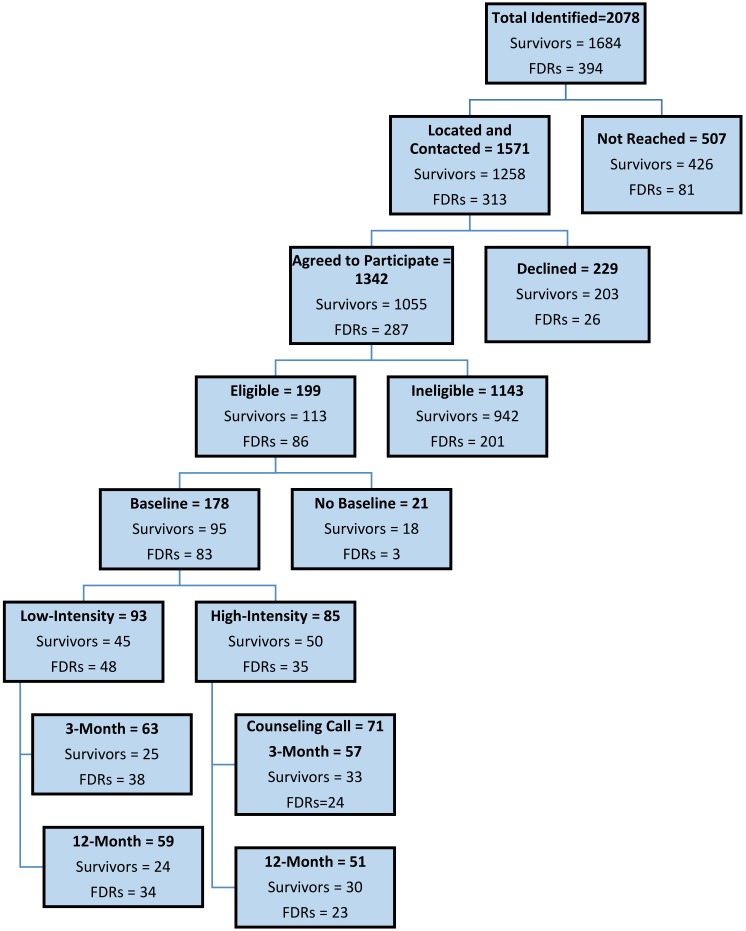
Women diagnosed with breast cancer at a relatively early age (≤45 years) or with bilateral disease at any age are at elevated risk for additional breast cancer, as are their female first-degree relatives (FDRs). We report on a randomized trial to increase adherence to mammography screening guidelines among survivors and FDRs. From the Georgia Cancer Registry, breast cancer survivors diagnosed during 2000-2009 at six Georgia cancer centers underwent phone interviews about their breast cancer screening behaviors and their FDRs. Nonadherent survivors and FDRs meeting all inclusion criteria were randomized to high-intensity (evidence-based brochure, phone counseling, mailed reminders, and communications with primary care providers) or low-intensity interventions (brochure only). Three and 12-month follow-up questionnaires were completed. Data analyses used standard statistical approaches. Among 1055 survivors and 287 FDRs who were located, contacted, and agreed to participate, 59.5% and 62.7%, respectively, reported breast cancer screening in the past 12 months and were thus ineligible. For survivors enrolled at baseline ( = 95), the proportion reporting adherence to guideline screening by 12 months post-enrollment was similar in the high and low-intensity arms (66.7% vs. 79.2%, = 0.31). Among FDRs enrolled at baseline ( = 83), screening was significantly higher in the high-intensity arm at 12 months (60.9% vs. 32.4%, = 0.03). Overall, about 72% of study-eligible survivors (all of whom were screening nonadherent at baseline) reported screening within 12 months of study enrollment. For enrolled FDRs receiving the high-intensity intervention, over 60% reported guideline screening by 12 months. A major conclusion is that using high-quality central cancer registries to identify high-risk breast cancer survivors and then working closely with these survivors to identify their FDRs represents a feasible and effective strategy to promote guideline cancer screening.
被诊断为乳腺癌的女性(≤45 岁)或任何年龄的双侧疾病患者,以及她们的女性一级亲属(FDRs),乳腺癌发病风险升高。我们报告了一项随机试验,旨在提高幸存者和 FDRs 对乳腺癌筛查指南的依从性。从佐治亚癌症登记处,在六个佐治亚癌症中心诊断为 2000-2009 年期间的乳腺癌幸存者接受了电话采访,询问他们的乳腺癌筛查行为及其 FDRs。不符合标准的幸存者和符合所有纳入标准的 FDRs 被随机分为高强度(基于证据的小册子、电话咨询、邮寄提醒以及与初级保健提供者的沟通)或低强度干预(仅小册子)。完成了 3 个月和 12 个月的随访问卷。数据分析采用了标准的统计方法。在联系到并同意参与的 1055 名幸存者和 287 名 FDRs 中,分别有 59.5%和 62.7%报告在过去 12 个月内进行了乳腺癌筛查,因此不符合条件。在基线时入组的幸存者(n=95)中,在入组后 12 个月报告遵循指南筛查的比例在高强度和低强度组之间相似(66.7%与 79.2%,=0.31)。在基线时入组的 FDRs(n=83)中,在 12 个月时高强度组的筛查率显著更高(60.9%与 32.4%,=0.03)。总体而言,约 72%的符合研究条件的幸存者(所有幸存者在基线时都未进行筛查)在研究入组后 12 个月内报告了筛查。对于接受高强度干预的入组 FDRs,超过 60%的人在 12 个月内报告了符合指南的筛查。一个主要结论是,使用高质量的中央癌症登记处来识别高危乳腺癌幸存者,然后与这些幸存者密切合作来识别他们的 FDRs,代表了一种可行且有效的策略,可以促进癌症筛查指南的应用。