State Key Laboratory of Food Science and Technology, Jiangnan University, Wuxi, China.
Key Laboratory of Industrial Biotechnology, Ministry of Education, Jiangnan University, Wuxi, China.
Appl Environ Microbiol. 2020 Apr 1;86(8). doi: 10.1128/AEM.02911-19.
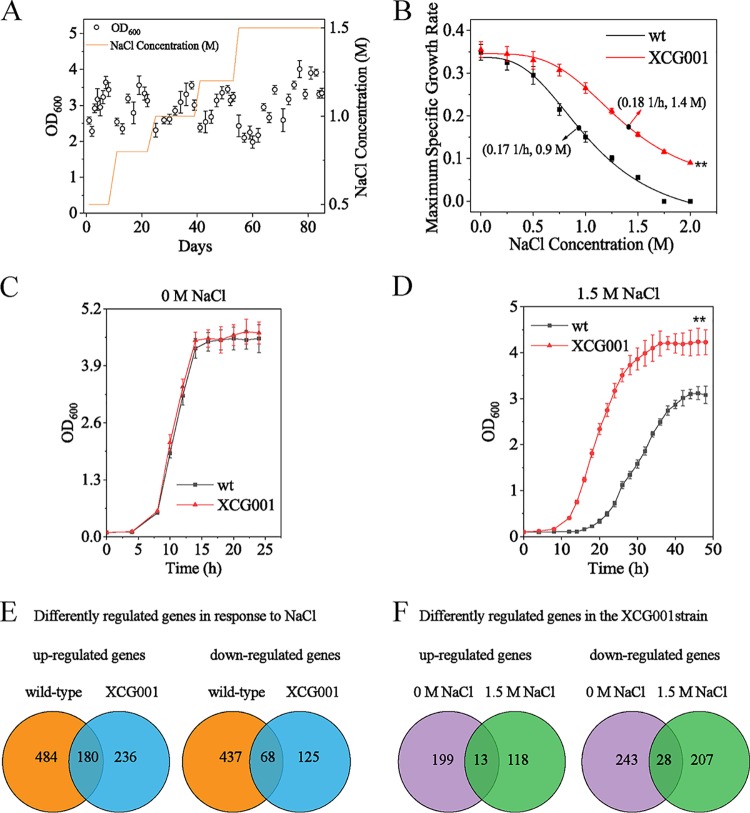
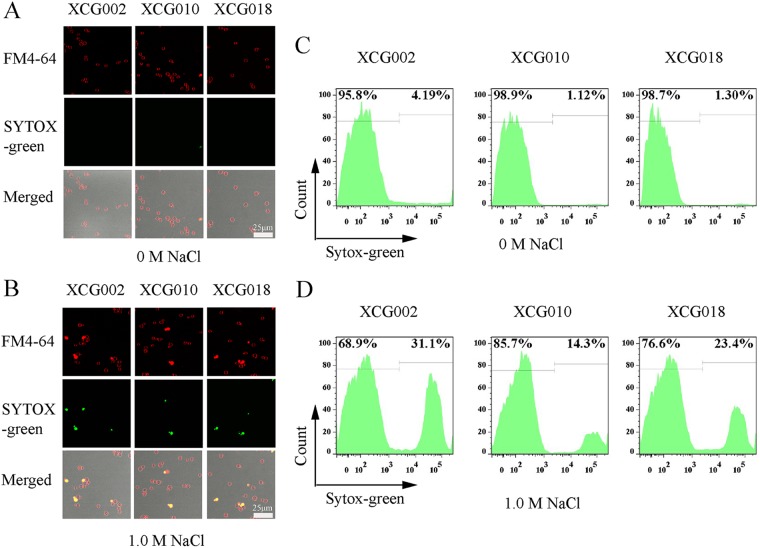
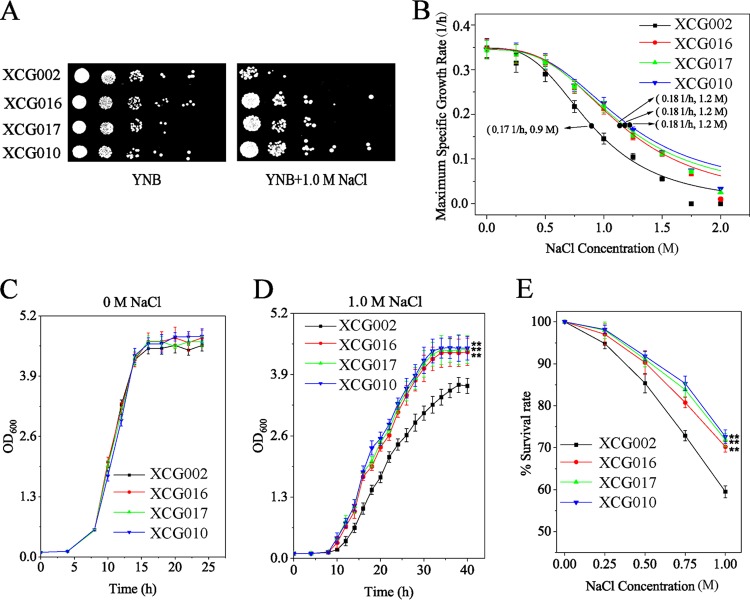
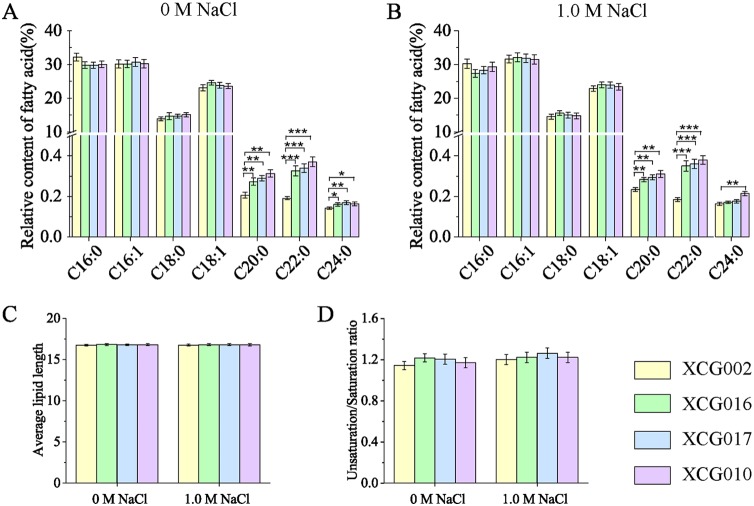
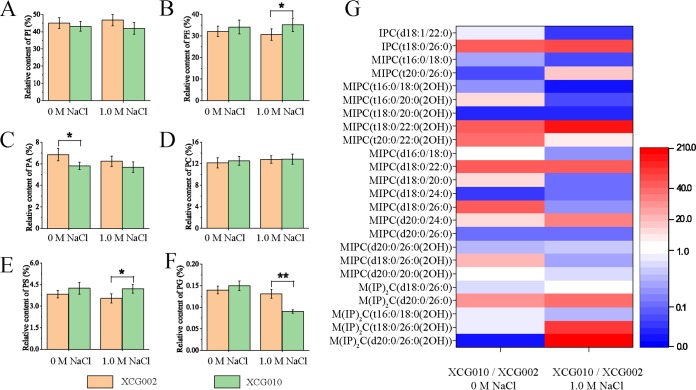
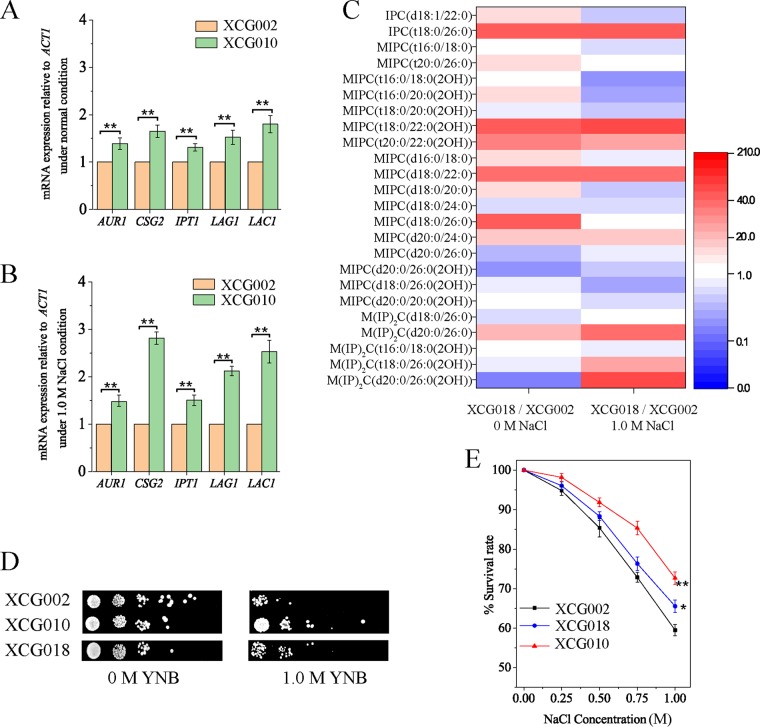
To enhance the growth performance of under osmotic stress, mutant XCG001, which tolerates up to 1.5 M NaCl, was isolated through adaptive laboratory evolution (ALE). Comparisons of the transcriptome data of mutant XCG001 and the wild-type strain identified as being associated with osmotic tolerance. In the overexpression strain (XCG010), the contents of inositol phosphorylceramide (IPC; t18:0/26:0), mannosylinositol phosphorylceramide [MIPC; t18:0/22:0(2OH)], MIPC (d18:0/22:0), MIPC (d20:0/24:0), mannosyldiinositol phosphorylceramide [M(IP)C; d20:0/26:0], M(IP)C [t18:0/26:0(2OH)], and M(IP)C [d20:0/26:0(2OH)] increased by 88.3 times, 167 times, 63.3 times, 23.9 times, 27.9 times, 114 times, and 208 times at 1.0 M NaCl, respectively, compared with the corresponding values of the control strain XCG002. As a result, the membrane integrity, cell growth, and cell survival rate of strain XCG010 increased by 24.4% ± 1.0%, 21.9% ± 1.5%, and 22.1% ± 1.1% at 1.0 M NaCl, respectively, compared with the corresponding values of the control strain XCG002 (wild-type strain with a control plasmid). These findings provided a novel strategy for engineering complex sphingolipids to enhance osmotic tolerance. This study demonstrated a novel strategy for the manipulation of membrane complex sphingolipids to enhance tolerance to osmotic stress. Elo2, a sphingolipid acyl chain elongase, was related to osmotic tolerance through transcriptome analysis of the wild-type strain and an osmosis-tolerant strain generated from ALE. Overexpression of increased the content of complex sphingolipid with longer acyl chain; thus, membrane integrity and osmotic tolerance improved.
为了提高 在渗透胁迫下的生长性能,通过适应性实验室进化(ALE)分离出耐受高达 1.5 M NaCl 的突变体 XCG001。比较突变体 XCG001 和野生型菌株的转录组数据,鉴定出 与渗透耐受相关。在 过表达菌株(XCG010)中,肌醇磷酸神经酰胺(IPC;t18:0/26:0)、甘露糖基肌醇磷酸神经酰胺[MIPC;t18:0/22:0(2OH)]、MIPC(d18:0/22:0)、MIPC(d20:0/24:0)、甘露糖二肌醇磷酸神经酰胺[M(IP)C;d20:0/26:0]、M(IP)C [t18:0/26:0(2OH)] 和 M(IP)C [d20:0/26:0(2OH)] 的含量分别比对照菌株 XCG002 增加了 88.3 倍、167 倍、63.3 倍、23.9 倍、27.9 倍、114 倍和 208 倍在 1.0 M NaCl 下,结果,菌株 XCG010 的膜完整性、细胞生长和细胞存活率分别比对照菌株 XCG002(带有对照质粒的野生型菌株)增加了 24.4%±1.0%、21.9%±1.5%和 22.1%±1.1%。这些发现为工程复杂神经酰胺以提高渗透耐受性提供了一种新策略。本研究通过对野生型菌株和 ALE 产生的耐渗菌株的转录组分析,证明了一种通过操纵膜复合神经酰胺来提高 对渗透压应激的耐受性的新策略。Elo2 是一种鞘脂酰基链延长酶,通过对野生型菌株和耐渗菌株的转录组分析,发现它与渗透压耐受有关。 的过表达增加了具有更长酰链的复合神经酰胺的含量;因此,膜完整性和渗透压耐受性得到改善。