School of Physical Science and Technology, ShanghaiTech University, Shanghai, 201210, China.
Department of Chemistry, National Central University, Taoyuan, 32001, Taiwan.
Nat Commun. 2019 Nov 1;10(1):5002. doi: 10.1038/s41467-019-12966-0.
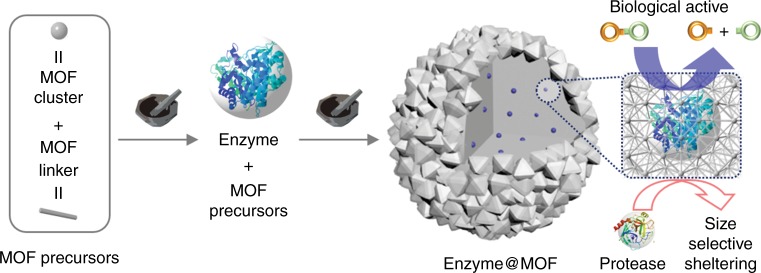
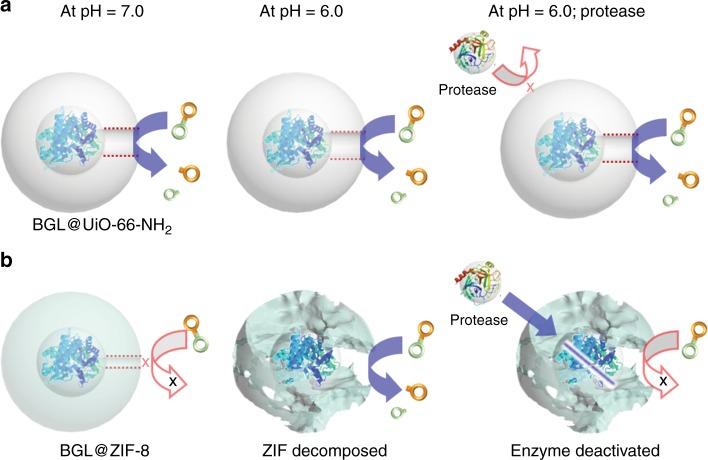
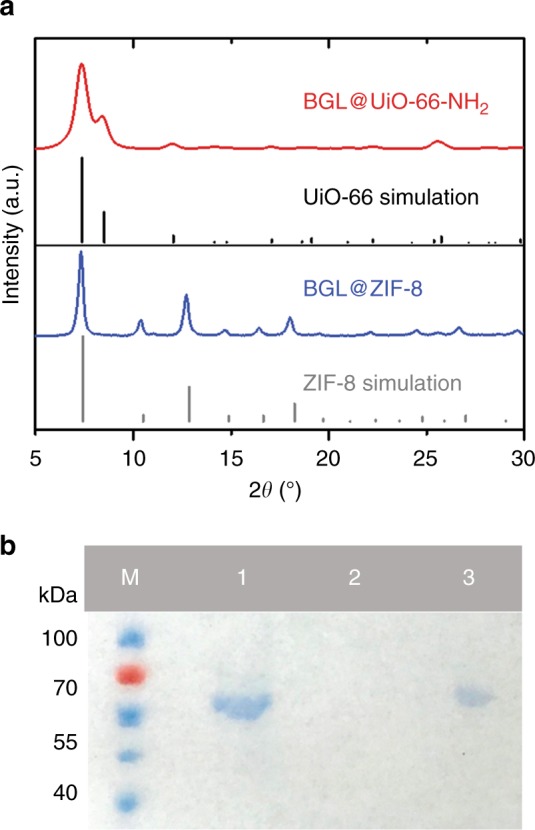
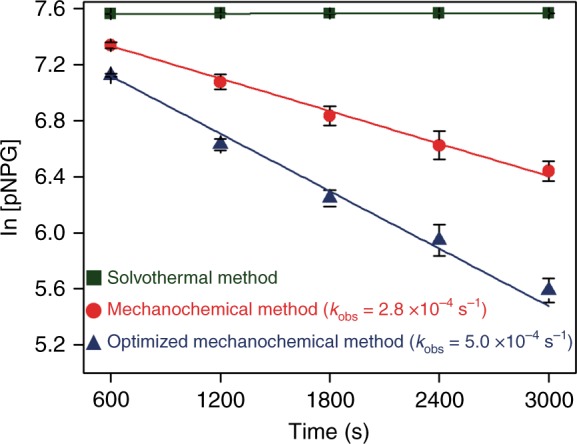
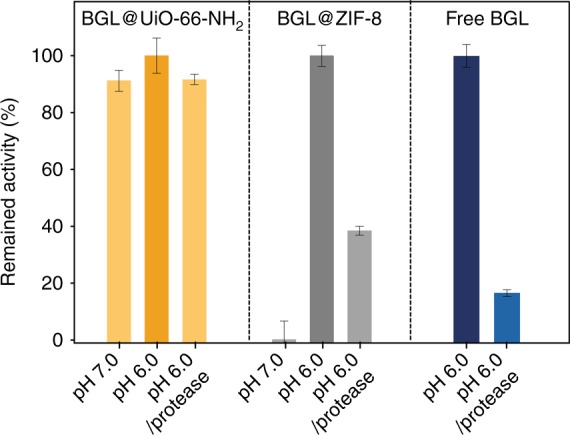
Metal-organic frameworks (MOFs) have recently garnered consideration as an attractive solid substrate because the highly tunable MOF framework can not only serve as an inert host but also enhance the selectivity, stability, and/or activity of the enzymes. Herein, we demonstrate the advantages of using a mechanochemical strategy to encapsulate enzymes into robust MOFs. A range of enzymes, namely β-glucosidase, invertase, β-galactosidase, and catalase, are encapsulated in ZIF-8, UiO-66-NH, or Zn-MOF-74 via a ball milling process. The solid-state mechanochemical strategy is rapid and minimizes the use of organic solvents and strong acids during synthesis, allowing the encapsulation of enzymes into three prototypical robust MOFs while maintaining enzymatic biological activity. The activity of encapsulated enzyme is demonstrated and shows increased resistance to proteases, even under acidic conditions. This work represents a step toward the creation of a suite of biomolecule-in-MOF composites for application in a variety of industrial processes.
金属-有机骨架(MOFs)最近因其作为一种有吸引力的固体基质而受到关注,因为高度可调谐的 MOF 骨架不仅可以作为惰性主体,而且可以提高酶的选择性、稳定性和/或活性。在此,我们展示了使用机械化学策略将酶封装在坚固的 MOF 中的优势。一系列酶,即β-葡萄糖苷酶、转化酶、β-半乳糖苷酶和过氧化氢酶,通过球磨过程被封装在 ZIF-8、UiO-66-NH 或 Zn-MOF-74 中。固态机械化学策略快速且在合成过程中最小化使用有机溶剂和强酸,允许将酶封装在三种典型的坚固 MOF 中,同时保持酶的生物活性。封装酶的活性得到了证明,并显示出对蛋白酶的抵抗力增强,即使在酸性条件下也是如此。这项工作代表着朝着创建一系列生物分子-MOF 复合材料迈出了一步,这些复合材料可应用于各种工业过程。