Zhu Chao, Yu Maolin, Zhou Jiadong, He Yongmin, Zeng Qingsheng, Deng Ya, Guo Shasha, Xu Mingquan, Shi Jinan, Zhou Wu, Sun Litao, Wang Lin, Hu Zhili, Zhang Zhuhua, Guo Wanlin, Liu Zheng
School of Materials Science and Engineering, Nanyang Technological University, Singapore, 639798, Singapore.
School of Physical Sciences, CAS Key Laboratory of Vacuum Physics, University of Chinese Academy of Sciences, Beijing, 100049, China.
Nat Commun. 2020 Feb 7;11(1):772. doi: 10.1038/s41467-020-14521-8.
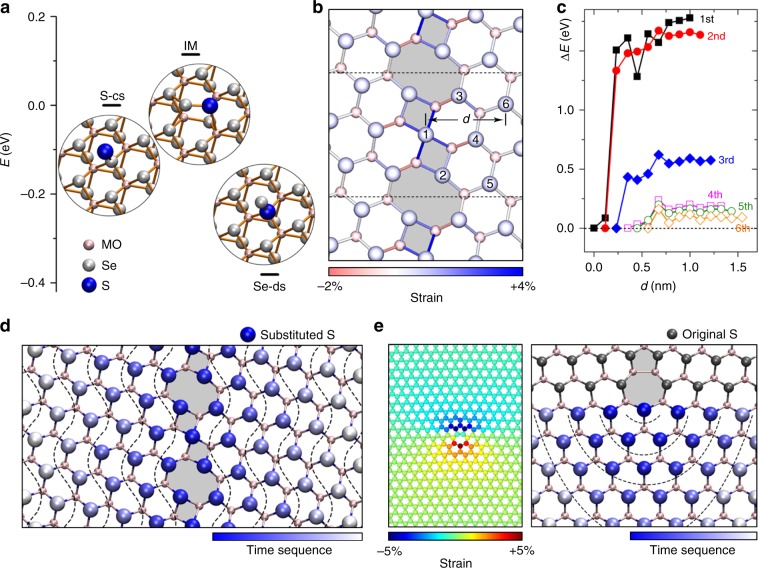
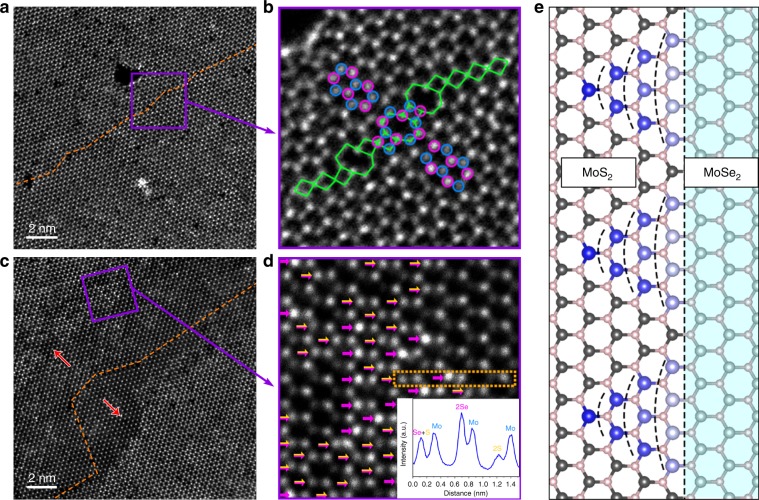
Lateral heterostructures of two-dimensional transition metal dichalcogenides (TMDs) have offered great opportunities in the engineering of monolayer electronics, catalysis and optoelectronics. To explore the full potential of these materials, developing methods to precisely control the spatial scale of the heterostructure region is crucial. Here, we report the synthesis of ultra-long MoS nano-channels with several micrometer length and 2-30 nanometer width within the MoSe monolayers, based on intrinsic grain boundaries (GBs). First-principles calculations disclose that the strain fields near the GBs not only lead to the preferred substitution of selenium by sulfur but also drive coherent extension of the MoS channel from the GBs. Such a strain-driven synthesis mechanism is further shown applicable to other topological defects. We also demonstrate that the spontaneous strain of MoS nano-channels can further improve the hydrogen production activity of GBs, paving the way for designing GB based high-efficient TMDs in the catalytic application.
二维过渡金属二硫属化物(TMDs)的横向异质结构在单层电子学、催化和光电子学工程中提供了巨大机遇。为了探索这些材料的全部潜力,开发精确控制异质结构区域空间尺度的方法至关重要。在此,我们报告基于本征晶界(GBs)在MoSe单层内合成具有几微米长度和2 - 30纳米宽度的超长MoS纳米通道。第一性原理计算表明,晶界附近的应变场不仅导致硒被硫优先取代,还驱动MoS通道从晶界处的相干延伸。这种应变驱动的合成机制进一步表明适用于其他拓扑缺陷。我们还证明,MoS纳米通道的自发应变可进一步提高晶界的产氢活性,为在催化应用中设计基于晶界的高效TMDs铺平道路。