Department of Geoinformatics, Paris Lodron University of Salzburg, Salzburg, Austria.
University Institute of Sports Medicine, Prevention and Rehabilitation and Research Institute of Molecular Sports Medicine and Rehabilitation, Paracelsus Medical University, Salzburg, Austria.
Scand J Med Sci Sports. 2020 Aug;30 Suppl 1(Suppl 1):41-49. doi: 10.1111/sms.13636.
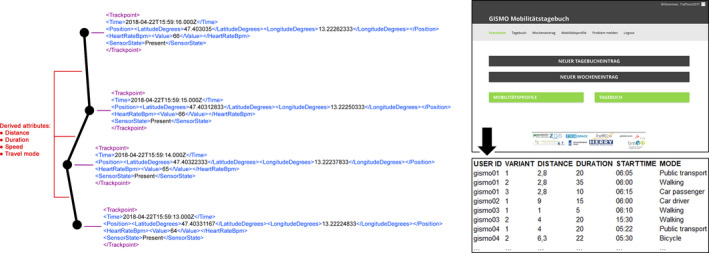
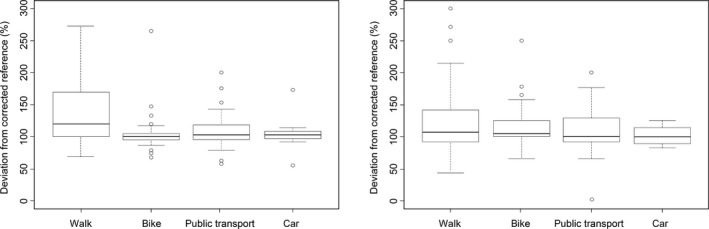
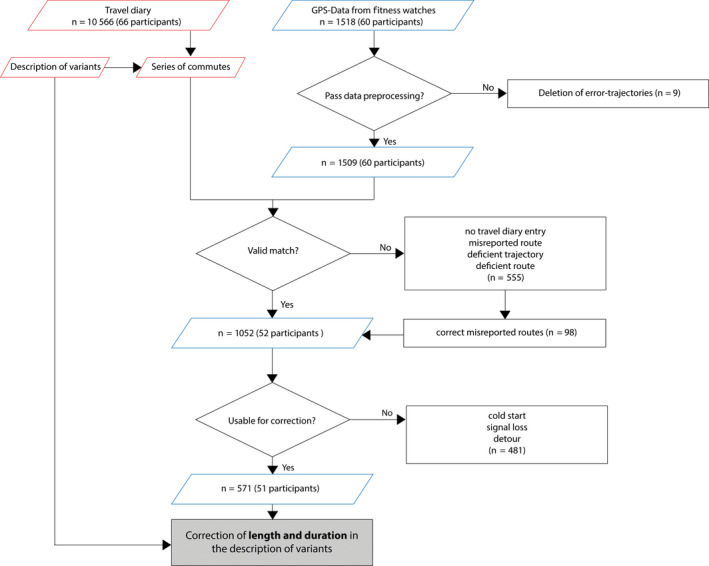
Sound exposure data are central for any intervention study. In the case of utilitarian mobility, where studies cannot be conducted in controlled environments, exposure data are commonly self-reported. For short-term intervention studies, wearable devices with location sensors are increasingly employed. We aimed to combine self-reported and technically sensed mobility data, in order to provide more accurate and reliable exposure data for GISMO, a long-term intervention study. Through spatio-temporal data matching procedures, we are able to determine the amount of mobility for all modes at the best possible accuracy level. Self-reported data deviate ±10% from the corrected reference. Derived modal split statistics prove high compliance to the respective recommendations for the control group (CG) and the two intervention groups (IG-PT, IG-C). About 73.7% of total mileage was travelled by car in CG. This share was 10.3% (IG-PT) and 9.7% (IG-C), respectively, in the intervention groups. Commuting distances were comparable in CG and IG, but annual mean travel times differ between = 8,458 min (σ = 6,427 min) for IG-PT, = 8,444 min (σ = 5,961 min) for IG-C, and = 5,223 min (σ = 5,463 min) for CG. Seasonal variabilities of modal split statistics were observable. However, in IG-PT and IG-C no shift toward the car occurred during winter months. Although no perfect single-method solution for acquiring exposure data in mobility-related, naturalistic intervention studies exists, we achieved substantially improved results by combining two data sources, based on spatio-temporal matching procedures.
声音暴露数据是任何干预研究的核心。在功利性移动性的情况下,由于无法在受控环境中进行研究,因此通常会自我报告暴露数据。对于短期干预研究,越来越多地使用带有位置传感器的可穿戴设备。我们旨在结合自我报告和技术感知的移动性数据,以便为 GISMO 提供更准确和可靠的暴露数据,GISMO 是一项长期干预研究。通过时空数据匹配程序,我们能够以尽可能高的准确性水平确定所有模式的移动性。自我报告的数据与校正后的参考值相差±10%。推导的模态划分统计数据证明了对对照组(CG)和两个干预组(IG-PT、IG-C)的各自建议的高度合规性。CG 中总里程的 73.7%是乘汽车出行的。在干预组中,IG-PT 的这一比例为 10.3%,IG-C 为 9.7%。CG 和 IG 中的通勤距离相当,但 IG-PT 的年平均旅行时间为 8458 分钟(σ=6427 分钟),IG-C 为 8444 分钟(σ=5961 分钟),而 CG 为 5223 分钟(σ=5463 分钟)。可以观察到模态划分统计数据的季节性变化。然而,在 IG-PT 和 IG-C 中,冬季月份没有向汽车转移的趋势。尽管在与移动性相关的自然主义干预研究中获取暴露数据没有完美的单一方法解决方案,但我们通过基于时空匹配程序结合两种数据源,取得了实质性的改进结果。