Department of Psychiatry, University of North Carolina at Chapel Hill, Chapel Hill, North Carolina.
Carolina Center for Neurostimulation, University of North Carolina at Chapel Hill, Chapel Hill, North Carolina.
Brain Behav. 2020 Mar;10(3):e01557. doi: 10.1002/brb3.1557. Epub 2020 Feb 9.
Autism spectrum disorder (ASD) is a pervasive neurodevelopmental disorder that emerges in the beginning years of life (12-48 months). Yet, an early diagnosis of ASD is challenging as it relies on the consistent presence of behavioral symptomatology, and thus, many children are diagnosed later in development, which prevents early interventions that could benefit cognitive and social outcomes. As a result, there is growing interest in detecting early brain markers of ASD, such as in the electroencephalogram (EEG) to elucidate divergence in early development. Here, we examine the EEG of nonrapid eye movement (NREM) sleep in the transition from infancy to toddlerhood, a period of rapid development and pronounced changes in early brain function. NREM features exhibit clear developmental trajectories, are related to social and cognitive development, and may be altered in neurodevelopmental disorders. Yet, spectral features of NREM sleep are poorly understood in infants/toddlers with or at high risk for ASD.
The present pilot study is the first to examine NREM sleep in 13- to 30-month-olds with ASD in comparison with age-matched healthy controls (TD). EEG was recorded during a daytime nap with high-density array EEG.
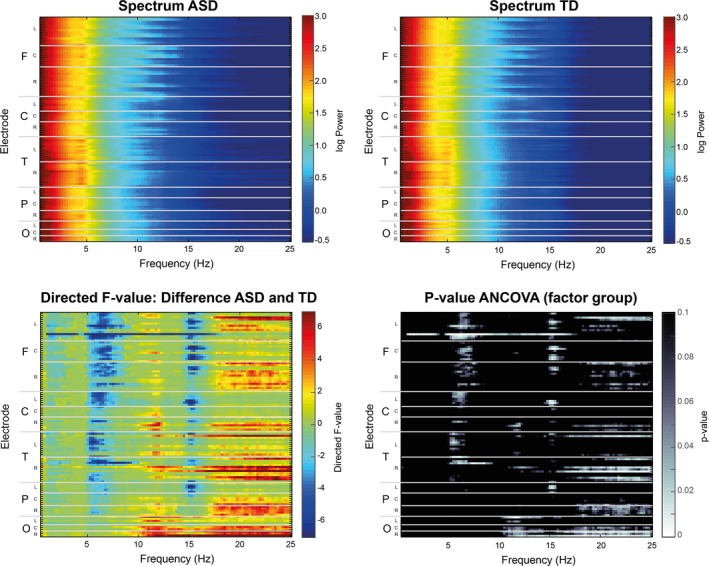
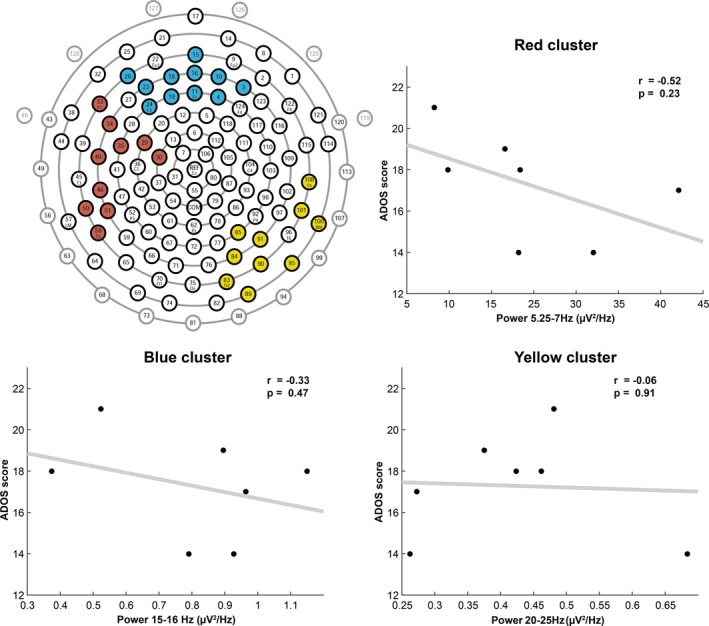
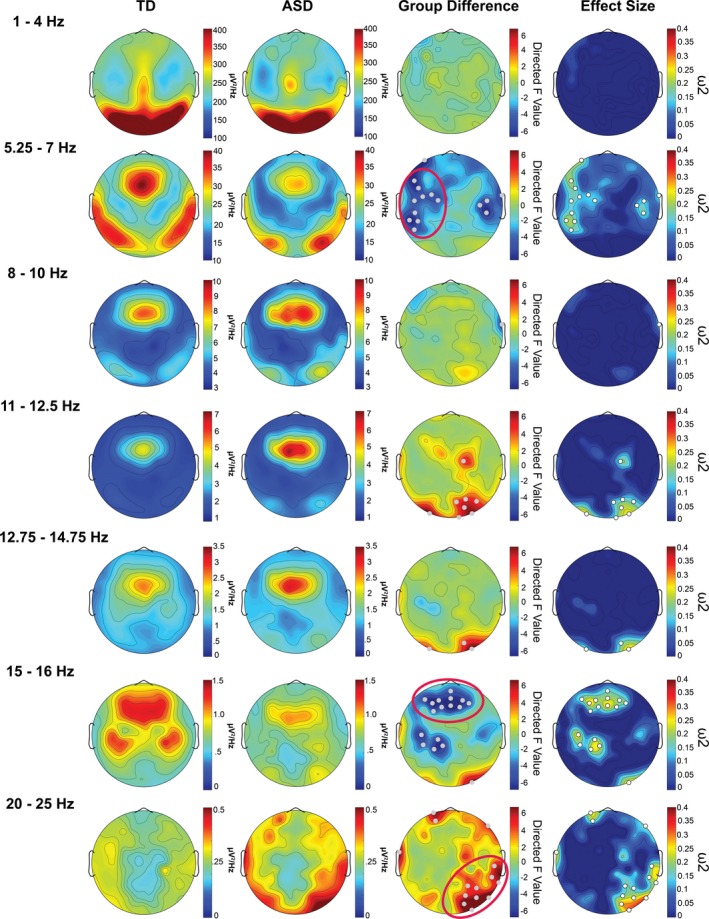
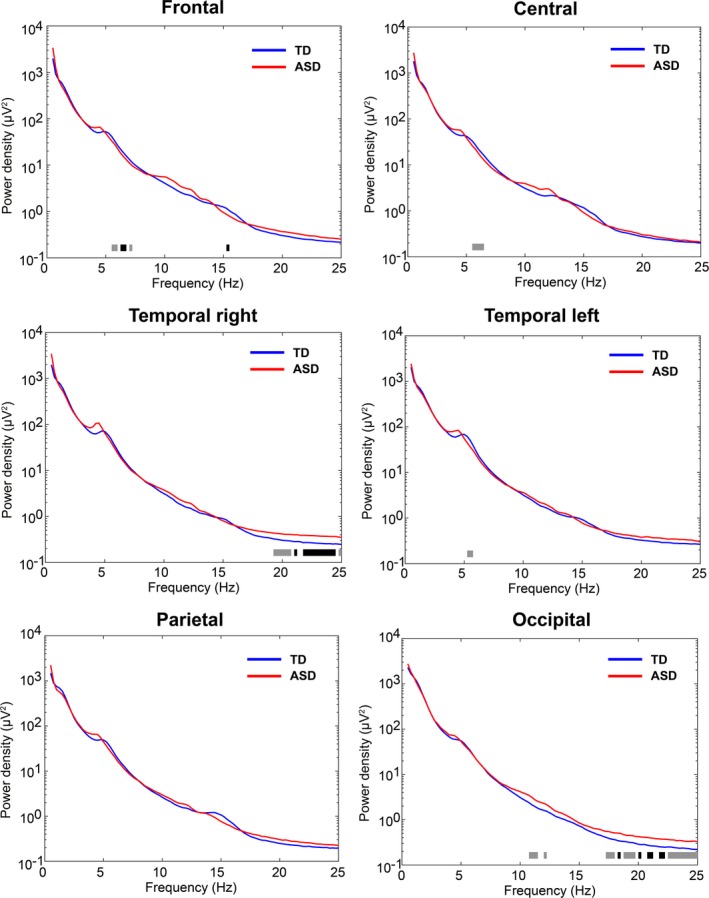
We found topographically distinct decreased fast theta oscillations (5-7.25 Hz), decreased fast sigma (15-16 Hz), and increased beta oscillations (20-25 Hz) in ASD compared to TD.
These findings suggest a possible functional role of NREM sleep during this important developmental period and provide support for NREM sleep to be a potential early marker for ASD.
自闭症谱系障碍(ASD)是一种普遍存在的神经发育障碍,通常在生命的早期(12-48 个月)出现。然而,ASD 的早期诊断具有挑战性,因为它依赖于行为症状的持续存在,因此,许多儿童在发育后期才被诊断出来,这阻碍了可能有益于认知和社会结果的早期干预。因此,人们越来越感兴趣的是在自闭症中检测早期大脑标志物,例如脑电图(EEG)以阐明早期发育中的差异。在这里,我们研究了从婴儿期到幼儿期的非快速眼动(NREM)睡眠中的 EEG,这是一个快速发育和早期大脑功能发生显著变化的时期。NREM 特征表现出明显的发展轨迹,与社会和认知发展有关,并且在神经发育障碍中可能会发生改变。然而,在 ASD 或有 ASD 高风险的婴儿/幼儿中,NREM 睡眠的光谱特征知之甚少。
本研究是第一个比较 ASD 儿童和年龄匹配的健康对照组(TD)在 13-30 个月时的 NREM 睡眠的研究。脑电图(EEG)是在白天小睡时用高密度 EEG 记录的。
我们发现 ASD 与 TD 相比,存在明显的额区快速 theta 振荡(5-7.25Hz)减少、快速 sigma(15-16Hz)减少和 beta 振荡(20-25Hz)增加。
这些发现表明 NREM 睡眠在这个重要的发育时期可能具有功能作用,并支持 NREM 睡眠作为自闭症的潜在早期标志物。