Nguyen Jennifer, Zhang Bo, Hanson Ellen, Mylonas Dimitrios, Maski Kiran
Department of Neurology, Division of Child Neurology, University of Rochester Medical Center, Rochester, NY 14642, USA.
Department of Pediatrics, Division of Developmental and Behavioral Pediatrics, University of Rochester Medical Center, Rochester, NY 14642, USA.
Children (Basel). 2022 Aug 30;9(9):1322. doi: 10.3390/children9091322.
Insomnia and daytime behavioral problems are common issues in pediatric autism spectrum disorder (ASD), yet specific underlying relationships with NonRapid Eye Movement sleep (NREM) and Rapid Eye Movement (REM) sleep architecture are understudied. We hypothesize that REM sleep alterations (REM%, REM EEG power) are associated with more internalizing behaviors and NREM sleep deficits (N3%; slow wave activity (SWA) 0.5-3 Hz EEG power) are associated with increased externalizing behaviors in children with ASD vs. typical developing controls (TD).
In an age- and gender-matched pediatric cohort of = 23 ASD and = 20 TD participants, we collected macro/micro sleep architecture with overnight home polysomnogram and daytime behavior scores with Child Behavior Checklist (CBCL) scores.
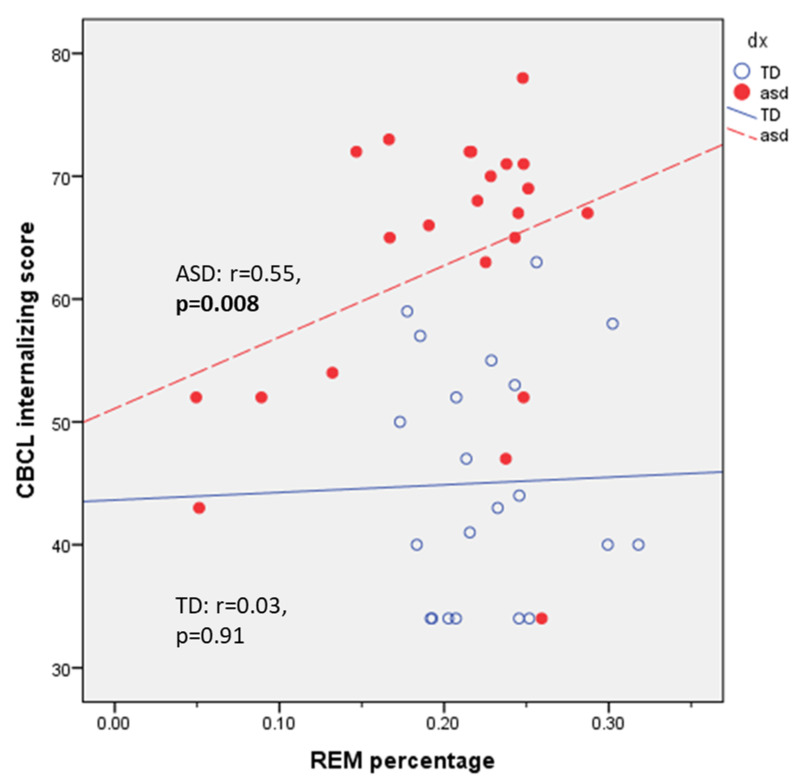
Controlling for non-verbal IQ and medication use, ASD and TD children have similar REM and NREM sleep architecture. Only ASD children show positive relationships between REM%, REM theta power and REM beta power with internalizing scores. Only TD participants showed an inverse relationship between NREM SWA and externalizing scores.
REM sleep measures reflect concerning internalizing behaviours in ASD and could serve as a biomarker for mood disorders in this population. While improving deep sleep may help externalizing behaviours in TD, we do not find evidence of this relationship in ASD.
失眠和日间行为问题是儿童自闭症谱系障碍(ASD)中的常见问题,但与非快速眼动睡眠(NREM)和快速眼动(REM)睡眠结构的具体潜在关系尚未得到充分研究。我们假设,与典型发育对照(TD)儿童相比,ASD儿童的快速眼动睡眠改变(快速眼动睡眠百分比、快速眼动脑电图功率)与更多内化行为相关,而非快速眼动睡眠缺陷(N3%;慢波活动(SWA)0.5 - 3赫兹脑电图功率)与外化行为增加相关。
在一个年龄和性别匹配的儿科队列中,纳入23名ASD参与者和20名TD参与者,我们通过夜间家庭多导睡眠图收集宏观/微观睡眠结构,并通过儿童行为检查表(CBCL)分数获得日间行为评分。
在控制非言语智商和药物使用的情况下,ASD儿童和TD儿童具有相似的快速眼动和非快速眼动睡眠结构。只有ASD儿童的快速眼动睡眠百分比、快速眼动θ波功率和快速眼动β波功率与内化分数呈正相关。只有TD参与者的非快速眼动慢波活动与外化分数呈负相关。
快速眼动睡眠指标反映了ASD中令人担忧的内化行为,可作为该人群情绪障碍的生物标志物。虽然改善深度睡眠可能有助于TD儿童的外化行为,但我们在ASD中未发现这种关系的证据。