Wisniewski Benedikt, Zierer Klaus, Hattie John
Department of School Pedagogy, University of Augsburg, Augsburg, Germany.
Melbourne Graduate School of Education, University of Melbourne, Parkville, VIC, Australia.
Front Psychol. 2020 Jan 22;10:3087. doi: 10.3389/fpsyg.2019.03087. eCollection 2019.
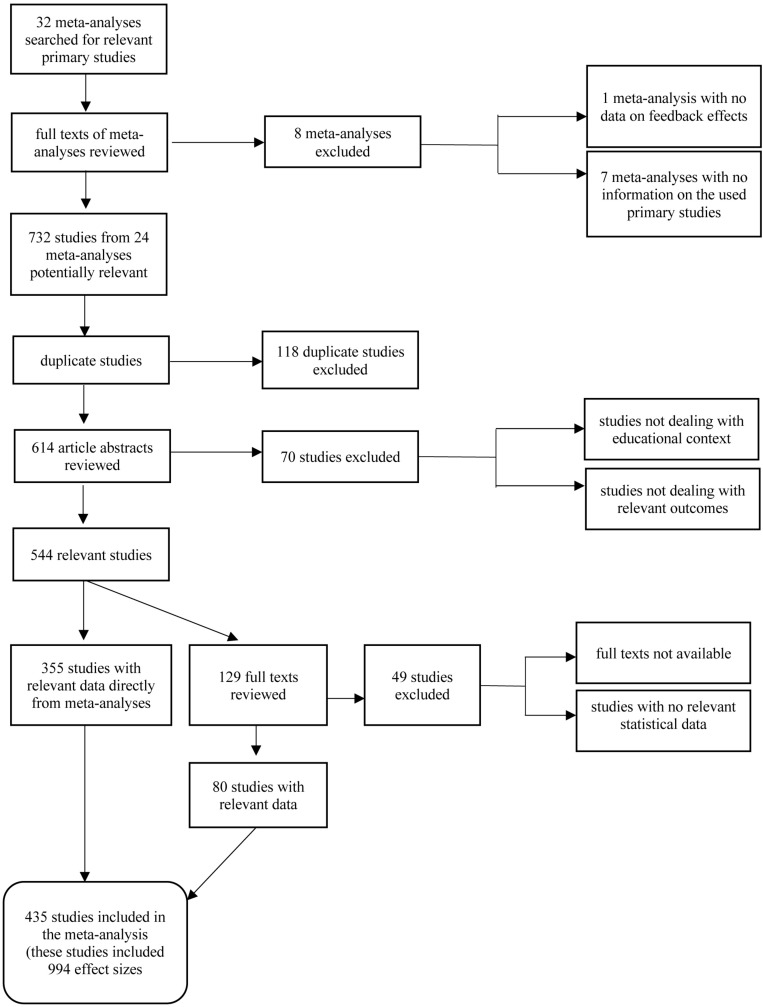
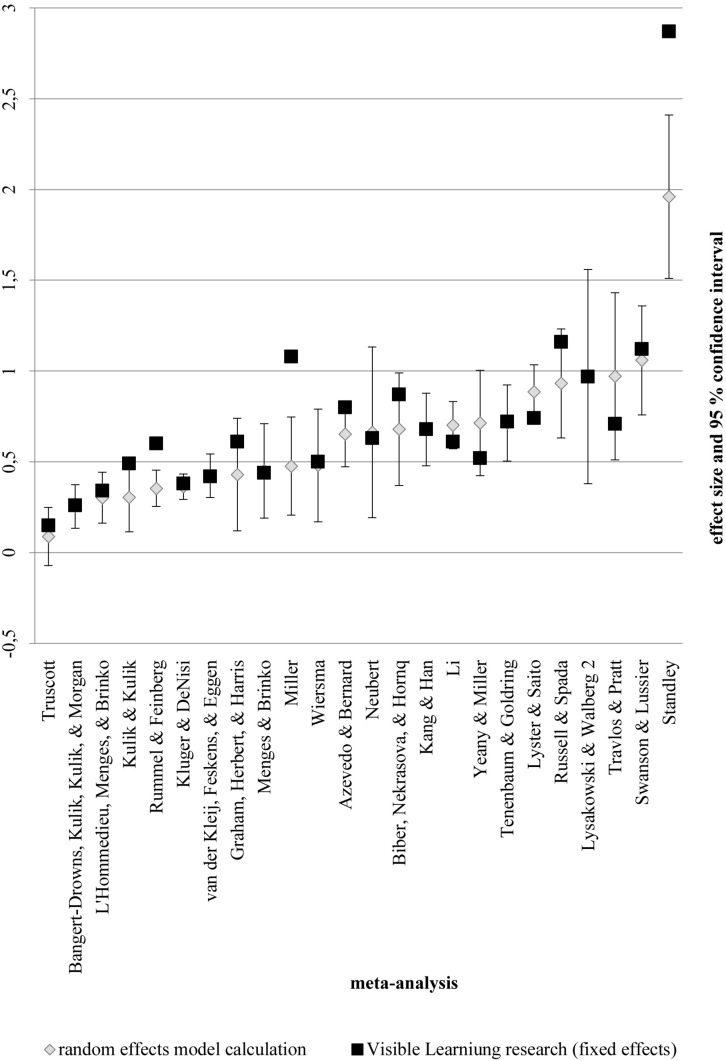
A meta-analysis (435 studies, = 994, > 61,000) of empirical research on the effects of feedback on student learning was conducted with the purpose of replicating and expanding the research (Hattie and Timperley, 2007; Hattie, 2009; Hattie and Zierer, 2019) from meta-synthesis. Overall results based on a random-effects model indicate a medium effect ( = 0.48) of feedback on student learning, but the significant heterogeneity in the data shows that feedback cannot be understood as a single consistent form of treatment. A moderator analysis revealed that the impact is substantially influenced by the information content conveyed. Furthermore, feedback has higher impact on cognitive and motor skills outcomes than on motivational and behavioral outcomes. We discuss these findings in the light of the assumptions made in (Hattie and Timperley, 2007). In general, the results suggest that feedback has rightly become a focus of teaching research and practice. However, they also point toward the necessity of interpreting different forms of feedback as independent measures.
我们进行了一项关于反馈对学生学习影响的实证研究的元分析(435项研究,n = 994,N>61000),目的是重复并扩展元综合研究(哈蒂和廷珀利,2007;哈蒂,2009;哈蒂和齐勒尔,2019)。基于随机效应模型的总体结果表明,反馈对学生学习有中等效应(g = 0.48),但数据中的显著异质性表明,反馈不能被理解为一种单一的、一致的处理形式。调节分析表明,这种影响在很大程度上受到所传达信息内容的影响。此外,反馈对认知和运动技能结果的影响比对动机和行为结果的影响更大。我们根据(哈蒂和廷珀利,2007)中的假设来讨论这些发现。总体而言,结果表明反馈已恰当地成为教学研究和实践的重点。然而,它们也指出有必要将不同形式的反馈解释为独立的措施。