Armistead Blair, Whidbey Christopher, Iyer Lakshminarayan M, Herrero-Foncubierta Pilar, Quach Phoenicia, Haidour Ali, Aravind L, Cuerva Juan Manuel, Jaspan Heather B, Rajagopal Lakshmi
Department of Global Health, University of Washington, Seattle, WA, United States.
Center for Global Infectious Disease Research, Seattle Children's Research Institute, Seattle, WA, United States.
Front Microbiol. 2020 Jan 21;10:3123. doi: 10.3389/fmicb.2019.03123. eCollection 2019.
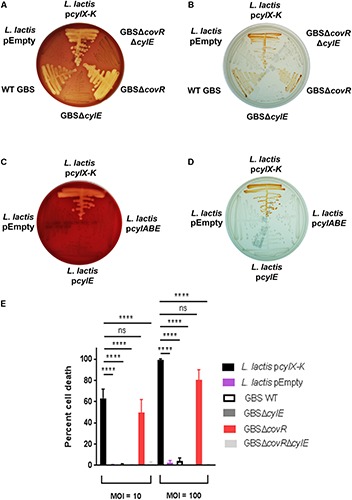
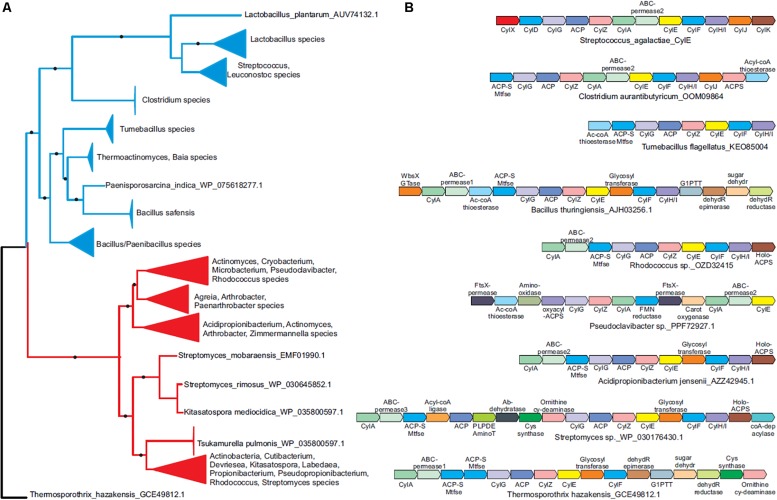
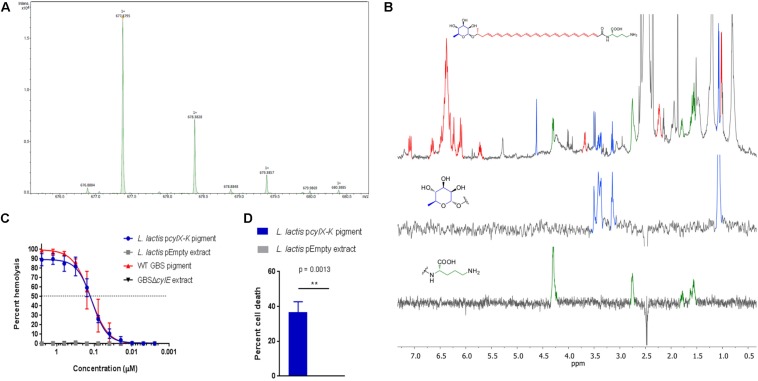
Group B (GBS) is a β-hemolytic, Gram-positive bacterium that commonly colonizes the female lower genital tract and is associated with fetal injury, preterm birth, spontaneous abortion, and neonatal infections. A major factor promoting GBS virulence is the β-hemolysin/cytolysin, which is cytotoxic to several host cells. We recently showed that the ornithine rhamnolipid pigment, Granadaene, produced by the gene products of the operon, is hemolytic. Here, we demonstrate that heterologous expression of the GBS operon conferred hemolysis, pigmentation, and cytoxicity to , a model non-hemolytic Gram-positive bacterium. Similarly, pigment purified from is hemolytic, cytolytic, and identical in structure to Granadaene extracted from GBS, indicating the operon is sufficient for Granadaene production in a heterologous host. Using a systematic survey of phyletic patterns and contextual associations of the genes, we identify homologs of the operon in physiologically diverse Gram-positive bacteria and propose undescribed functions of gene products. Together, these findings bring greater understanding to the biosynthesis and evolutionary foundations of a key GBS virulence factor and suggest that such potentially toxic lipids may be encoded by other bacteria.
B组链球菌(GBS)是一种β溶血、革兰氏阳性细菌,通常定殖于女性下生殖道,与胎儿损伤、早产、自然流产和新生儿感染有关。促进GBS毒力的一个主要因素是β溶血素/细胞溶素,它对几种宿主细胞具有细胞毒性。我们最近发现,由该操纵子的基因产物产生的鸟氨酸鼠李糖脂色素Granadaene具有溶血作用。在此,我们证明GBS操纵子的异源表达赋予了模型非溶血革兰氏阳性细菌溶血、色素沉着和细胞毒性。同样,从该细菌中纯化的色素具有溶血、细胞溶解作用,并且在结构上与从GBS中提取的Granadaene相同,这表明该操纵子足以在异源宿主中产生Granadaene。通过对该基因的系统发育模式和上下文关联进行调查,我们在生理上不同的革兰氏阳性细菌中鉴定出该操纵子的同源物,并提出该基因产物的未描述功能。这些发现共同为GBS关键毒力因子的生物合成和进化基础带来了更深入的理解,并表明其他细菌可能编码这种潜在有毒的脂质。