Samimi Fatemeh, Baazm Maryam, Eftekhar Ebrahim, Rajabi Sadegh, Goodarzi Mohammad Taghi, Jalali Mashayekhi Farideh
Department of Biochemistry and Genetics, School of Medicine, Arak University of Medical Sciences, Arak, I.R. Iran.
Department of Anatomy, School of Medicine, Arak University of Medical Sciences, Arak, I.R. Iran.
Res Pharm Sci. 2019 Dec 11;14(6):524-533. doi: 10.4103/1735-5362.272561. eCollection 2019 Dec.
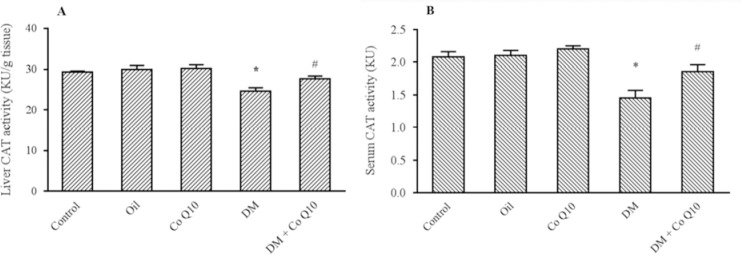
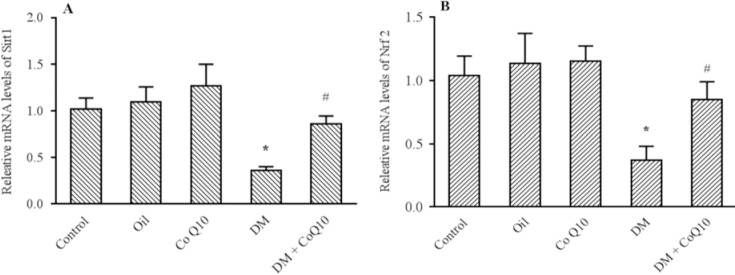
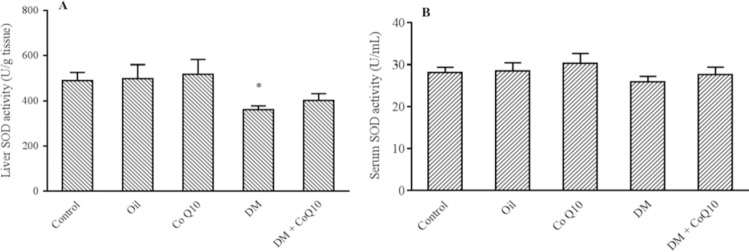
Oxidative stress is a major complication in diabetes mellitus. The aim of this study was to investigate potential antioxidant activity of coenzyme Q10 (Co Q10) against hyperglycemia-induced oxidative stress in diabetic rat and unraveling its mechanism of action by focusing on silent information regulator 1 (Sirt1) and nuclear factor E2-related factor 2 (Nrf2) mRNA expression level. Furthermore, the activity of two Nrf2-dependent antioxidant enzymes (superoxide dismutase and catalase) in the liver of diabetic rats was studied. After induction of diabetes in rats using streptozotocin (55 mg/kg), rats were divided into five groups of six each. Groups 1 and 2 (healthy control groups) were injected with isotonic saline or sesame oil; group 3 received Co Q10 (10 mg /Kg /day), group 4, as a diabetic control, received sesame oil; and group 5 was diabetic rats treated with Co Q10. Afterwards, serum and liver samples were collected, and oxidative stress markers, lipid profile, as well as the expression of Sirt1 and Nrf2 genes were measured. Diabetes induction significantly reduced expression level of Sirt1 and Nrf2 mRNAs and also declined catalase, superoxide dismutase activities, and total thiol groups levels in diabetic group in comparison to healthy controls, while a significant increase was found in the levels of malondialdehyde and lipid profile. Co Q10 treatment significantly up-regulated Sirt1 and Nrf2 mRNA levels along with an increase in catalase activity in diabetic group as compared with untreated diabetic rats. Furthermore, Co Q10 caused a marked decrease in malondialdehyde levels and significantly improved lipid profile. Our data demonstrated that Co Q10 may exert its antioxidant activity in diabetes through the induction of Sirt1/Nrf2 gene expression.
氧化应激是糖尿病的主要并发症。本研究旨在探讨辅酶Q10(Co Q10)对糖尿病大鼠高血糖诱导的氧化应激的潜在抗氧化活性,并通过关注沉默信息调节因子1(Sirt1)和核因子E2相关因子2(Nrf2)的mRNA表达水平来阐明其作用机制。此外,还研究了糖尿病大鼠肝脏中两种Nrf2依赖性抗氧化酶(超氧化物歧化酶和过氧化氢酶)的活性。使用链脲佐菌素(55 mg/kg)诱导大鼠糖尿病后,将大鼠分为五组,每组六只。第1组和第2组(健康对照组)注射等渗盐水或芝麻油;第3组接受Co Q10(10 mg /Kg /天),第4组作为糖尿病对照组接受芝麻油;第5组是用Co Q10治疗的糖尿病大鼠。之后,收集血清和肝脏样本,测量氧化应激标志物、血脂谱以及Sirt1和Nrf2基因的表达。与健康对照组相比,糖尿病诱导显著降低了糖尿病组中Sirt1和Nrf2 mRNA的表达水平,同时过氧化氢酶、超氧化物歧化酶活性以及总硫醇基团水平也下降,而丙二醛水平和血脂谱显著升高。与未治疗的糖尿病大鼠相比,Co Q10治疗显著上调了糖尿病组中Sirt1和Nrf2 mRNA水平,并增加了过氧化氢酶活性。此外,Co Q10使丙二醛水平显著降低,并显著改善了血脂谱。我们的数据表明,Co Q10可能通过诱导Sirt1/Nrf2基因表达在糖尿病中发挥其抗氧化活性。