Swayden Mirna, Soubeyran Philippe, Iovanna Juan
Centre de Recherche en Cancérologie de Marseille (CRCM), INSERM U1068, CNRS UMR 7258, Aix-Marseille Université and Institut Paoli-Calmettes, Parc Scientifique et Technologique de Luminy, Marseille, France.
Front Oncol. 2020 Jan 22;9:1443. doi: 10.3389/fonc.2019.01443. eCollection 2019.
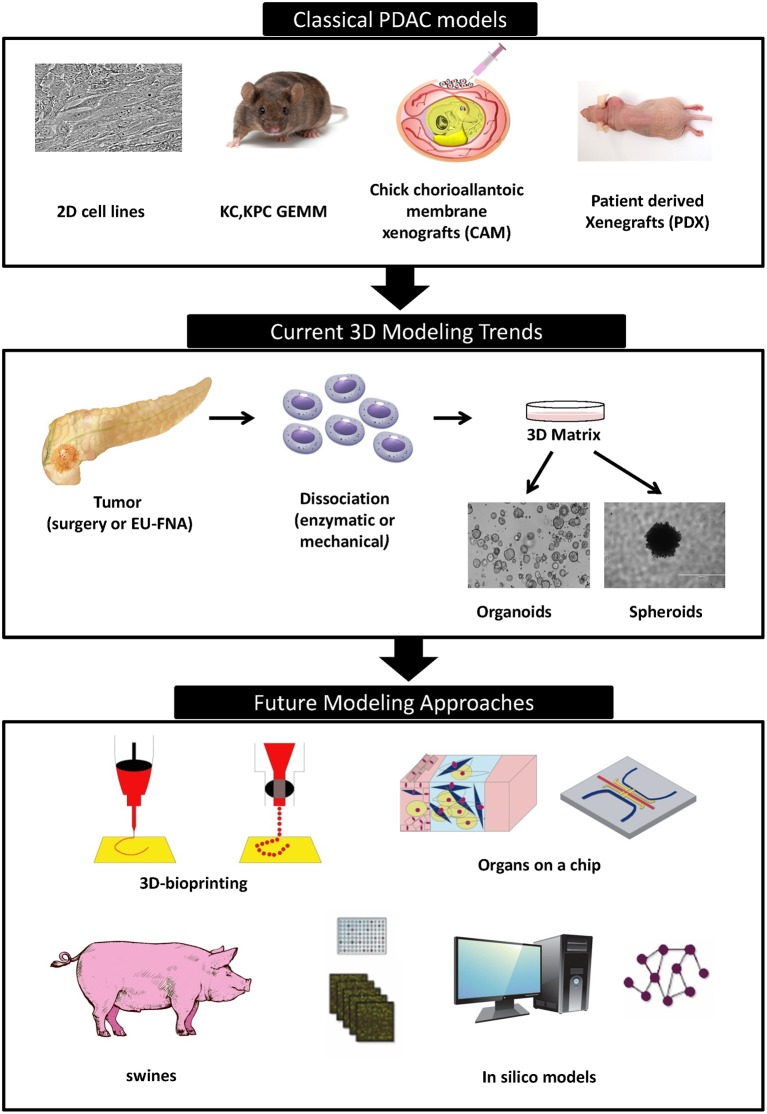
To date, PDAC remains the cancer having the worst prognosis with mortality rates constantly on the rise. Efficient cures are still absent, despite all attempts to understand the aggressive physiopathology underlying this disease. A major stumbling block is the outdated preclinical modeling strategies applied in assessing effectiveness of novel anticancer therapeutics. Current preclinical models have a low fidelity to mimic the exact architectural and functional complexity of PDAC tumor found in human set, due to the lack of major components such as immune system and tumor microenvironment with its associated chemical and mechanical signals. The existing PDAC preclinical platforms are still far from being reliable and trustworthy to guarantee the success of a drug in clinical trials. Therefore, there is an urgent demand to innovate novel preclinical models that mirrors with precision tumor-microenvironment interface, pressure of immune system, and molecular and morphological aspects of the PDAC normally experienced within the living organ. This review outlines the traditional preclinical models of PDAC namely 2D cell lines, genetically engineered mice, and xenografts, and describing the present famous approach of 3D organoids. We offer a detailed narration of the pros and cons of each model system. Finally, we suggest the incorporation of two off-center newly born techniques named 3D bio-printing and organs-on-chip and discuss the potentials of swine models and tools, as powerful new tools able to transform PDAC preclinical modeling to a whole new level and open new gates in personalized medicine.
迄今为止,胰腺导管腺癌(PDAC)仍然是预后最差的癌症,死亡率持续上升。尽管人们试图了解这种疾病潜在的侵袭性病理生理学,但仍然没有有效的治疗方法。一个主要的绊脚石是在评估新型抗癌疗法有效性时应用的过时的临床前建模策略。由于缺乏免疫系统和肿瘤微环境及其相关化学和机械信号等主要成分,目前的临床前模型在模拟人类胰腺导管腺癌肿瘤确切的结构和功能复杂性方面保真度较低。现有的胰腺导管腺癌临床前平台在保证药物临床试验成功方面仍远不可靠且不值得信赖。因此,迫切需要创新新型临床前模型,精确反映肿瘤-微环境界面、免疫系统压力以及在活体器官中通常会出现的胰腺导管腺癌的分子和形态学方面。本综述概述了胰腺导管腺癌的传统临床前模型,即二维细胞系、基因工程小鼠和异种移植,并描述了当前著名的三维类器官方法。我们详细叙述了每个模型系统的优缺点。最后,我们建议纳入两种新兴技术,即三维生物打印和芯片器官,并讨论猪模型和工具的潜力,它们作为强大的新工具能够将胰腺导管腺癌临床前建模提升到一个全新水平,并为个性化医疗打开新的大门。