Fujimoto Yosuke, Sakai Toshinori, Sairyo Koichi
Fujimoto Prosthesis and Orthosis Supply Co. Ltd., Tokushima, Japan.
Department of Orthopedics, Institute of Biomedical Sciences, Tokushima University Graduate School, Tokushima, Japan.
Spine Surg Relat Res. 2019 Oct 20;4(1):74-80. doi: 10.22603/ssrr.2019-0018. eCollection 2020.
To analyze the extent to which various types of orthoses can restrict motion of the lumbar spine and provide basic evidence regarding the optimal orthosis for conservative treatment of lumbar spondylolysis (LS), particularly. Although several orthoses have been developed and applied for LS with better outcomes for bony healing, basic data regarding which is optimal are still lacking.
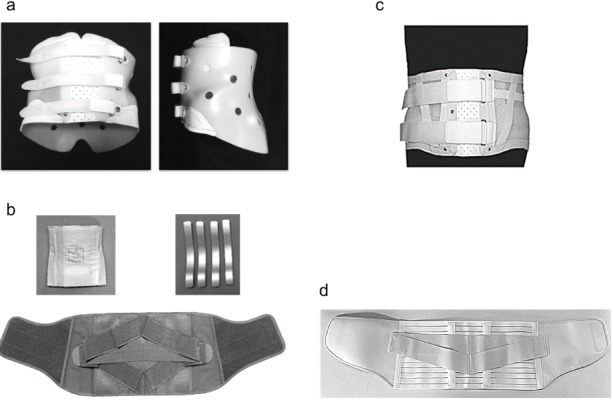
Ten healthy voluntary participants were included in this study. Lumbar spine range of motion (ROM) was analyzed using a three-dimensional motion capture system (NEXUS 2.2, Vicon Motion Systems Ltd., UK) under five conditions wearing no orthosis (NB) and four types of lumbar-sacral orthoses (LSO): custom-made hard LSO (HO), soft LSO supported by four aluminum stays and a custom-molded back cast-panel named "Return to Sports" braces (RS), custom-made soft LSO known as Damen type elasticity corset (DC), and off-the-shelf soft LSO.
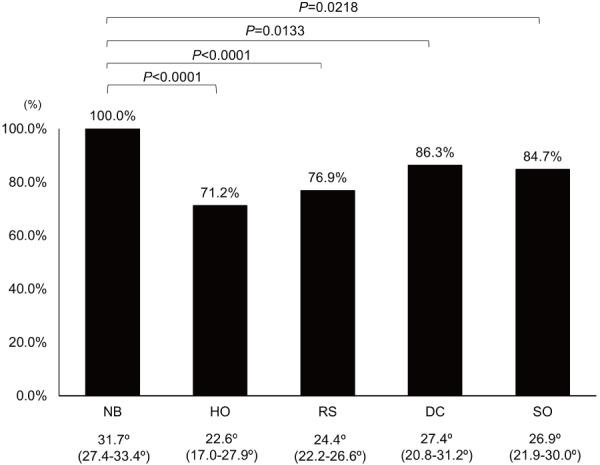
HO showed the highest restriction of motion in all directions than the others. Especially, ROM of rotation and side bending were reduced to 58.3% and 63.6% compared with NB, respectively. The other three LSOs showed significantly higher restriction in extension, rotation, and side bending than NB. In flexion and side bending, DC showed significantly higher restriction than NB.
HO showed high restriction in all directions. RS showed higher restriction in extension than NB and less restriction in flexion and side bending than other custom-made LSOs. DC was the only soft LSO showing higher restriction than NB in flexion.
分析各类矫形器对腰椎活动的限制程度,尤其为腰椎峡部裂(LS)保守治疗的最佳矫形器提供基础证据。尽管已研发出多种用于LS的矫形器且在促进骨愈合方面取得了更好的效果,但关于哪种矫形器最佳的基础数据仍然缺乏。
本研究纳入了10名健康志愿者。使用三维运动捕捉系统(NEXUS 2.2,英国Vicon Motion Systems有限公司)在五种条件下分析腰椎活动范围(ROM),这五种条件分别是不佩戴矫形器(NB)以及佩戴四种腰骶矫形器(LSO):定制硬式LSO(HO)、由四根铝条支撑的软式LSO以及一种名为“恢复运动”支具的定制模制背托板(RS)、名为达门型弹性束腹带的定制软式LSO(DC)和现成的软式LSO。
HO在各个方向上的运动限制均高于其他矫形器。特别是,与NB相比,旋转和侧屈的ROM分别降低至58.3%和63.6%。其他三种LSO在伸展、旋转和侧屈方面的限制明显高于NB。在屈曲和侧屈方面,DC的限制明显高于NB。
HO在各个方向上均表现出较高的限制。RS在伸展方面的限制高于NB,在屈曲和侧屈方面的限制低于其他定制LSO。DC是唯一一种在屈曲方面限制高于NB的软式LSO。