Wright Ronda, Roberson Kristina, Onsomu Elijah O, Johnson Yolanda, Dearman Cathy, Carr Loneke T Blackman, Price Amanda Alise, Duren-Winfield Vanessa
Division of Nursing, Winston-Salem State University, Winston-Salem, North Carolina.
Health Services, North Carolina A&T State University, Greensboro, North Carolina.
J Best Pract Health Prof Divers. 2018 Spring;11(1):13-30.
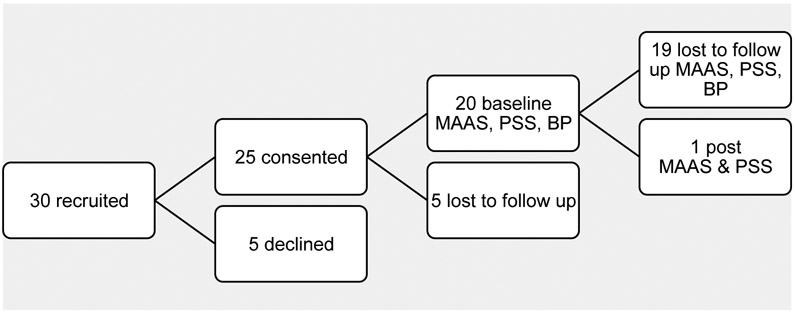
College students are prone to stress, making them vulnerable to cardiovascular disease (CVD). Harmful health behaviors, such as tobacco or alcohol use, further predispose students to hypertension (HTN). African-Americans (AA) experience increased blood pressure reactivity, and weathering, due to race-related stressors. This interplay makes AA college students good targets for strategies to prevent stress and HTN disease risk. This project examined the relationship between mindfulness, perceived stress and blood pressure among a group of AA college students enrolled in an HBCU healthy heart course. Participants' systolic and diastolic blood pressure averaged 122 mmHg and 76 mmHg, respectively. The Spearman correlation revealed a negative strong relationship between mindfulness and perceived stress (r = -0.61, = 0.004). The coefficient of determination indicated that 37% of the variance in mindfulness was explained by perceived stress. College health practitioners should consider integrating mindfulness into course activities and expanding its treatment modality.
大学生容易产生压力,这使他们易患心血管疾病(CVD)。吸烟或饮酒等有害健康行为,会进一步使学生易患高血压(HTN)。非裔美国人(AA)由于与种族相关的压力源,血压反应性增加且出现健康问题。这种相互作用使非裔美国大学生成为预防压力和高血压疾病风险策略的理想目标。本项目研究了参加一所历史上黑人创办的大学(HBCU)健康心脏课程的一组非裔美国大学生中,正念、感知压力与血压之间的关系。参与者的收缩压和舒张压平均分别为122毫米汞柱和76毫米汞柱。斯皮尔曼相关性分析显示,正念与感知压力之间存在强烈的负相关关系(r = -0.61,P = 0.004)。决定系数表明,感知压力解释了正念中37%的方差。大学健康从业者应考虑将正念融入课程活动并扩大其治疗方式。