Division of Comprehensive Geriatrics in Community, Niigata University Graduate School of Medical and Dental Sciences, 1-757 Asahimachi, Chuo-ku, Niigata, 951-8510, Japan.
Division of Clinical Nephrology and Rheumatology, Niigata University Graduate School of Medical and Dental Sciences, Niigata, Japan.
Clin Exp Nephrol. 2020 Jun;24(6):518-525. doi: 10.1007/s10157-020-01860-5. Epub 2020 Feb 10.
Lifetime risk is an epidemiologic measure that expresses the probability of disease in the remaining lifetime for an index age. It is also an easily understandable statistical measure used to communicate the absolute risk of disease to the lay population. The lifetime risk of end-stage kidney disease (ESKD) has never been reported for the Japanese population. Here, we used data from the Japanese Society of Dialysis Therapy (JSDT) to estimate the lifetime risk of ESKD by sex in Japan.
The lifetime risk of ESKD was estimated using life-table methods. We defined an incident case of ESKD as a patient with loss of kidney function that resulted in maintenance dialysis therapy. The number of incident cases of ESKD and number of ESKD deaths in 2017 were obtained from data published by the JSDT. The population and total number of deaths in Japan for the same year were obtained from National Vital Statistics. By including all-cause mortality, risks were adjusted for competing causes of death.
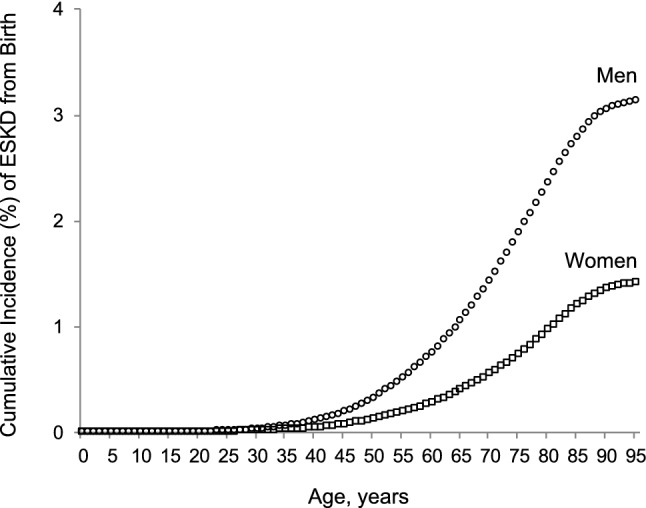
The cumulative incidence of ESKD from birth until age 95 years was 3.14% [95% confidence interval (CI) 3.10-3.18] for men and 1.42% (1.39-1.44) for women. These probabilities illustrate that approximately 1 in 32 men and 1 in 71 women in Japan will develop ESKD that results in maintenance dialysis therapy in their lifetime.
Considerable sex differences were found in the lifetime risk of ESKD in Japan. This easily understandable information could be used to assist in public health education and planning.
终生风险是一种流行病学指标,用于表示指数年龄人群剩余寿命内患病的概率。它也是一种易于理解的统计指标,用于向非专业人群传达疾病的绝对风险。日本人群终末期肾病(ESKD)的终生风险从未有过报道。在这里,我们使用日本透析治疗学会(JSDT)的数据,按性别估计了日本 ESKD 的终生风险。
使用寿命表法估计 ESKD 的终生风险。我们将 ESKD 的一个发病病例定义为肾功能丧失导致维持性透析治疗的患者。2017 年 ESKD 的发病病例数和 ESKD 死亡人数,以及同年日本的人口和总死亡人数,均来自 JSDT 公布的数据。通过包括全因死亡率,调整了竞争死亡原因的风险。
从出生到 95 岁,男性发生 ESKD 的累积发病率为 3.14%(95%可信区间 3.10-3.18),女性为 1.42%(1.39-1.44)。这些概率表明,日本大约每 32 名男性和每 71 名女性中就有 1 人会在一生中患上需要维持透析治疗的 ESKD。
日本 ESKD 的终生风险存在显著的性别差异。这种易于理解的信息可用于辅助公共卫生教育和规划。