Institute of Population Health Sciences, University of Liverpool, United Kingdom.
Clatterbridge Cancer Centre, Wirral, United Kingdom.
Oncologist. 2020 Apr;25(4):e691-e700. doi: 10.1634/theoncologist.2019-0571. Epub 2020 Feb 11.
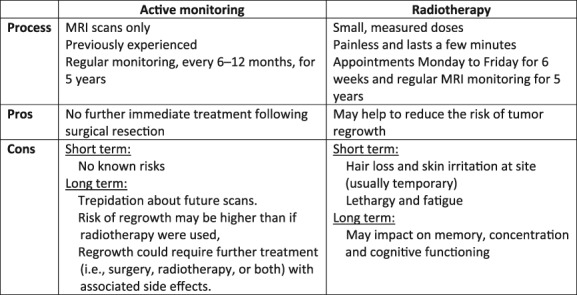
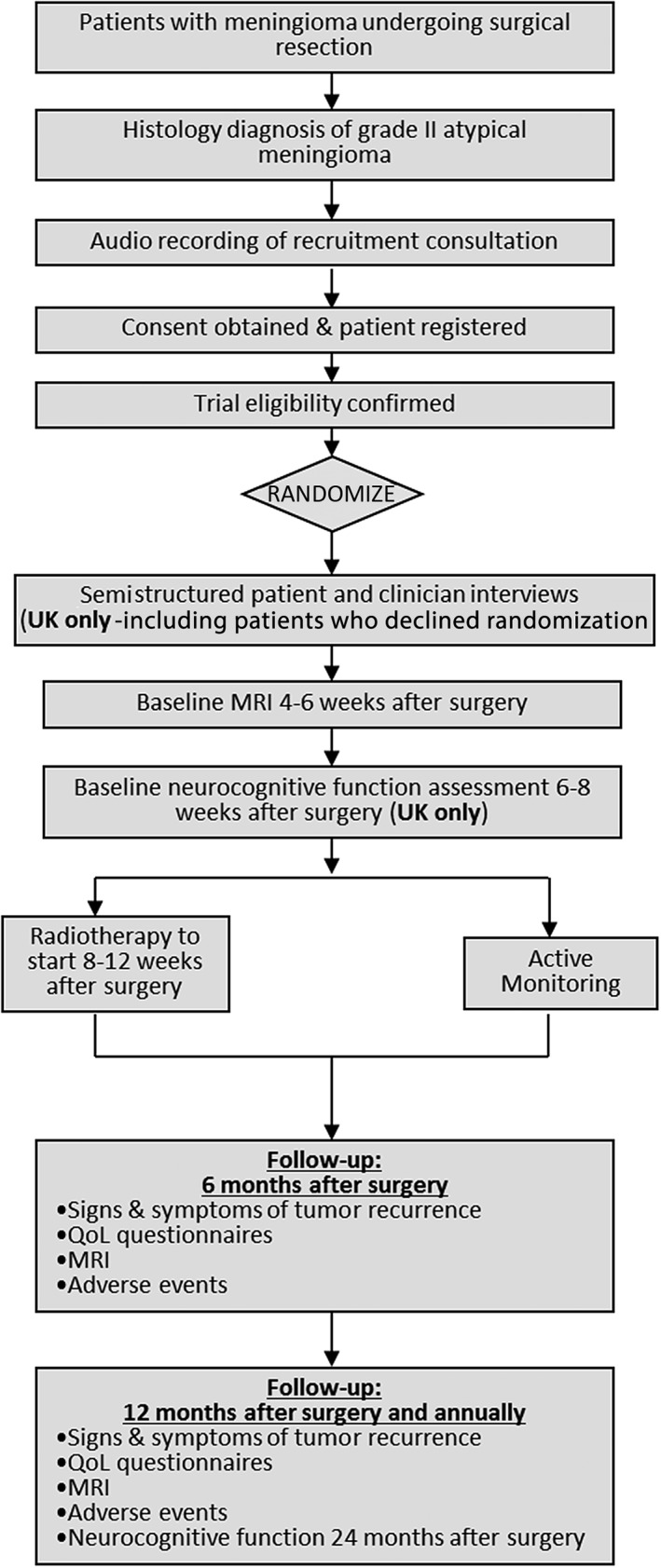
Providing balanced information that emphasizes clinical equipoise (i.e., uncertainty regarding the relative merits of trial interventions) and exploring patient treatment preferences can improve informed consent and trial recruitment. Within a trial comparing adjuvant radiotherapy versus active monitoring following surgical resection for an atypical meningioma (ROAM/EORTC-1308), we explored patterns in communication and reasons why health practitioners may find it challenging to convey equipoise and explore treatment preferences.
Qualitative study embedded within ROAM/EORTC-1308. Data were collected on 40 patients and 18 practitioners from 13 U.K. sites, including audio recordings of 39 patients' trial consultations, 23 patient interviews, and 18 practitioner interviews. Qualitative analysis drew on argumentation theory.
Practitioners acknowledged the importance of the research question that the trial aimed to answer. However, they often demonstrated a lack of equipoise in consultations, particularly with eligible patients who practitioners believed to be susceptible to side effects (e.g., cognitive impairment) or inconvenienced by radiotherapy. Practitioners elicited but rarely explored patient treatment preferences, especially if a patient expressed an initial preference for active monitoring. Concerns about coercing patients, loss of practitioner agency, and time constraints influenced communication in ways that were loaded against trial participation.
We identified several challenges that practitioners face in conveying equipoise and exploring patient treatment preferences in oncology, and particularly neuro-oncology, trials with distinct management pathways. The findings informed communication about ROAM/EORTC-1308 and will be relevant to enhancing trial communication in future oncology trials. Qualitative studies embedded within trials can address difficulties with communication, thus improving informed consent and recruitment. ROAM/EORTC-1308 RCT: ISRCTN71502099.
Oncology trials can be challenging to recruit to, especially those that compare treatment versus monitoring. Conveying clinical equipoise and exploring patient treatment preferences can enhance recruitment and patient understanding. This study focused on the challenges that practitioners encounter in trying to use such communication strategies and how practitioners may inadvertently impede patient recruitment and informed decision making. This article provides recommendations to support practitioners in balancing the content and presentation of trial management pathways. The results can inform training to optimize communication, especially for neuro-oncology trials and trials comparing markedly different management pathways.
提供平衡的信息,强调临床均衡(即,关于试验干预相对优点的不确定性)并探索患者的治疗偏好,可以改善知情同意和试验招募。在一项比较辅助放疗与手术切除后主动监测治疗非典型脑膜瘤(ROAM/EORTC-1308)的试验中,我们探讨了沟通模式以及为什么卫生保健人员可能难以传达均衡性并探索治疗偏好的原因。
ROAM/EORTC-1308 中的定性研究。从英国 13 个地点的 40 名患者和 18 名医务人员收集数据,包括 39 名患者的试验咨询录音、23 名患者访谈和 18 名医务人员访谈。定性分析借鉴了论证理论。
医务人员承认该试验旨在回答的研究问题的重要性。然而,他们在咨询中经常表现出缺乏均衡性,尤其是对那些他们认为易受副作用(例如认知障碍)影响或因放疗而感到不便的合格患者。医务人员引出但很少探索患者的治疗偏好,特别是如果患者最初倾向于主动监测。担心强迫患者、丧失医务人员的自主权以及时间限制,以对参与试验不利的方式影响沟通。
我们发现医务人员在传达肿瘤学,特别是神经肿瘤学试验中的均衡性和探索患者治疗偏好方面面临的几个挑战,这些试验具有不同的治疗途径。研究结果为 ROAM/EORTC-1308 的沟通提供了信息,并将对提高未来肿瘤学试验的沟通效果具有重要意义。嵌入试验的定性研究可以解决沟通方面的困难,从而改善知情同意和招募。ROAM/EORTC-1308 RCT:ISRCTN71502099。
肿瘤学试验的招募可能具有挑战性,尤其是那些比较治疗与监测的试验。传达临床均衡性和探索患者的治疗偏好可以提高招募率和患者的理解度。本研究重点关注医务人员在尝试使用此类沟通策略时遇到的挑战,以及医务人员如何无意中阻碍患者的招募和知情决策。本文提供了支持医务人员平衡试验管理途径的内容和呈现的建议。结果可以为培训提供信息,特别是对于神经肿瘤学试验和比较明显不同管理途径的试验。