Epithelial Interactions in Cancer Group, i3S-Instituto de Investigação e Inovação em Saúde, Universidade do Porto, 4200-135 Porto, Portugal.
Institute of Molecular Pathology and Immunology of the University of Porto (IPATIMUP), 4200-135 Porto, Portugal.
Cells. 2020 Feb 8;9(2):394. doi: 10.3390/cells9020394.
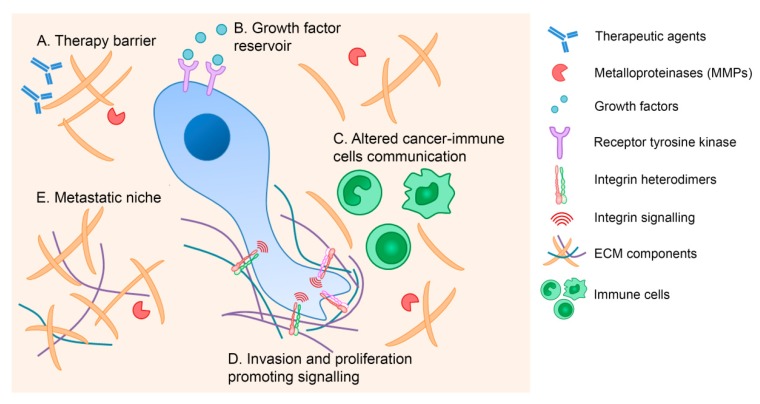
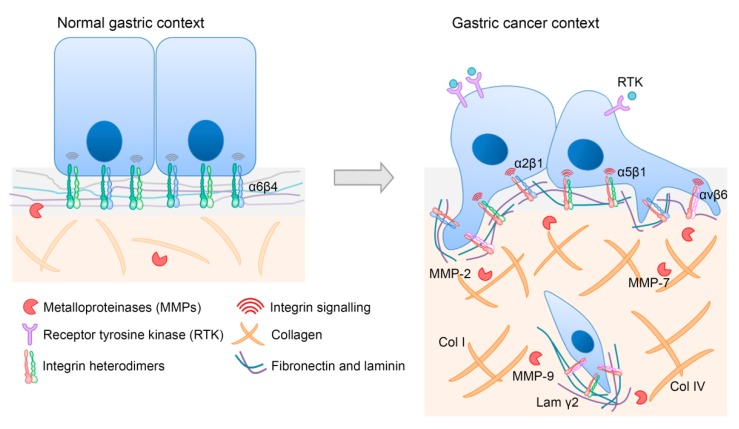
The extracellular matrix (ECM) is a dynamic and highly organized tissue structure, providing support and maintaining normal epithelial architecture. In the last decade, increasing evidence has emerged demonstrating that alterations in ECM composition and assembly strongly affect cellular function and behavior. Even though the detailed mechanisms underlying cell-ECM crosstalk are yet to unravel, it is well established that ECM deregulation accompanies the development of many pathological conditions, such as gastric cancer. Notably, gastric cancer remains a worldwide concern, representing the third most frequent cause of cancer-associated deaths. Despite increased surveillance protocols, patients are usually diagnosed at advanced disease stages, urging the identification of novel diagnostic biomarkers and efficient therapeutic strategies. In this review, we provide a comprehensive overview regarding expression patterns of ECM components and cognate receptors described in normal gastric epithelium, pre-malignant lesions, and gastric carcinomas. Important insights are also discussed for the use of ECM-associated molecules as predictive biomarkers of the disease or as potential targets in gastric cancer.
细胞外基质 (ECM) 是一种动态且高度组织化的组织结构,为细胞提供支持并维持正常的上皮结构。在过去的十年中,越来越多的证据表明,ECM 组成和组装的改变强烈影响细胞功能和行为。尽管细胞-ECM 相互作用的详细机制尚未阐明,但已经确定 ECM 失调伴随着许多病理状况的发展,例如胃癌。值得注意的是,胃癌仍然是一个全球性的问题,是癌症相关死亡的第三大主要原因。尽管增加了监测方案,但患者通常在疾病晚期被诊断出来,这促使人们寻找新的诊断生物标志物和有效的治疗策略。在这篇综述中,我们全面概述了 ECM 成分及其在正常胃上皮、癌前病变和胃癌中的同源受体的表达模式。还讨论了 ECM 相关分子作为疾病预测生物标志物或作为胃癌潜在靶点的重要意义。