Catale Clarissa, Gironda Stephen, Lo Iacono Luisa, Carola Valeria
Department of Psychology, University of Rome "Sapienza", Via dei Marsi, 78, 00185 Rome, Italy.
IRCCS Santa Lucia Foundation, Via Fosso di Fiorano 64, 00143 Rome, Italy.
J Clin Med. 2020 Feb 8;9(2):468. doi: 10.3390/jcm9020468.
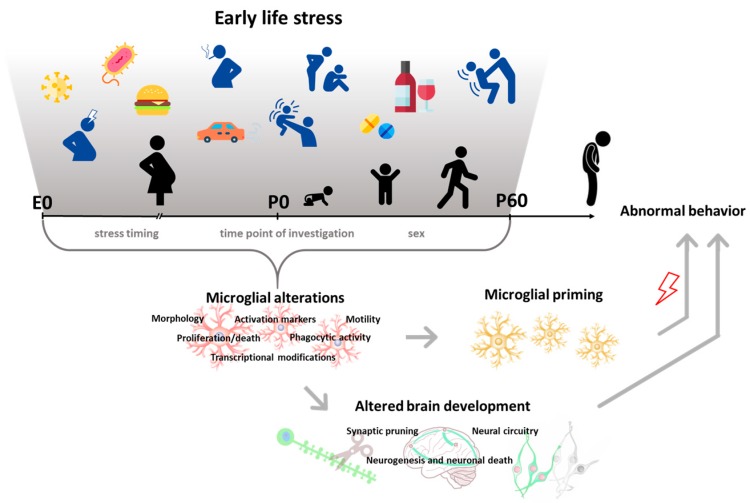
The putative effects of early-life stress (ELS) on later behavior and neurobiology have been widely investigated. Recently, microglia have been implicated in mediating some of the effects of ELS on behavior. In this review, findings from preclinical and clinical literature with a specific focus on microglial alterations induced by the exposure to ELS (i.e., exposure to behavioral stressors or environmental agents and infection) are summarized. These studies were utilized to interpret changes in developmental trajectories based on the time at which the stress occurred, as well as the paradigm used. ELS and microglial alterations were found to be associated with a wide array of deficits including cognitive performance, memory, reward processing, and processing of social stimuli. Four general conclusions emerged: (1) ELS interferes with microglial developmental programs, including their proliferation and death and their phagocytic activity; (2) this can affect neuronal and non-neuronal developmental processes, which are dynamic during development and for which microglial activity is instrumental; (3) the effects are extremely dependent on the time point at which the investigation is carried out; and (4) both pre- and postnatal ELS can prime microglial reactivity, indicating a long-lasting alteration, which has been implicated in behavioral abnormalities later in life.
早年生活应激(ELS)对后期行为和神经生物学的假定影响已得到广泛研究。最近,小胶质细胞被认为在介导ELS对行为的某些影响中起作用。在这篇综述中,总结了临床前和临床文献的研究结果,特别关注暴露于ELS(即暴露于行为应激源、环境因素和感染)所诱导的小胶质细胞改变。这些研究被用于根据应激发生的时间以及所采用的范式来解释发育轨迹的变化。研究发现,ELS和小胶质细胞改变与包括认知表现、记忆、奖赏处理和社会刺激处理在内的一系列缺陷有关。得出了四个一般性结论:(1)ELS干扰小胶质细胞的发育程序,包括其增殖、死亡及其吞噬活性;(2)这会影响神经元和非神经元的发育过程,这些过程在发育过程中是动态的,而小胶质细胞的活性对此至关重要;(3)这些影响极大地取决于进行调查的时间点;(4)产前和产后的ELS均可引发小胶质细胞反应性,表明存在长期改变,这与后期生活中的行为异常有关。