Etim Ndifreke, Pike James, Xie Bin
School of Community and Global Health, Claremont Graduate University, Claremont, United States.
Tob Induc Dis. 2020 Feb 4;18:7. doi: 10.18332/tid/116412. eCollection 2020.
Electronic cigarettes (e-cigarettes) have rapidly become the most commonly used tobacco product among youth in the United States. Exposure to advertising, peer use, and household use, increases the risk of current e-cigarette use; however, the influence of these factors may be dynamic across adolescence. The aim of this study is to examine the age-varying associations between e-cigarette use and peer use, household use, and exposure to e-cigarette commercials among alternative high school students in Southern California.
Using data previously collected for a tobacco marketing study, we examine the age-varying associations of current e-cigarette use and three risk factors (peer use, exposure to commercials, and household use) across ages 15 to 20 years using time-varying effect modeling (TVEM). Analyses include three waves of data from alternative high school students (N=1060 students; 2036 observations).
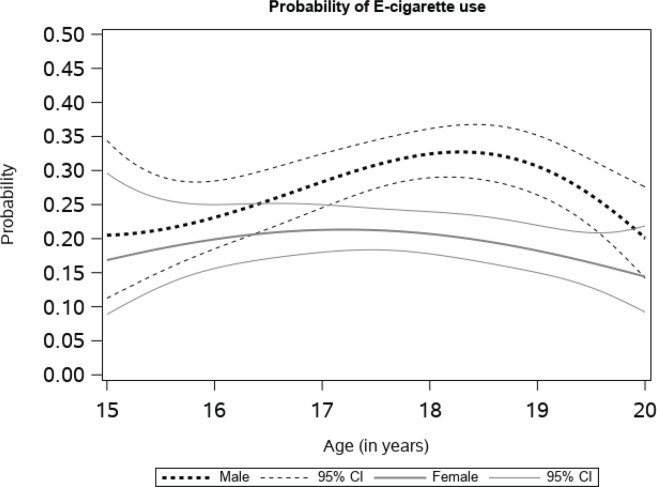
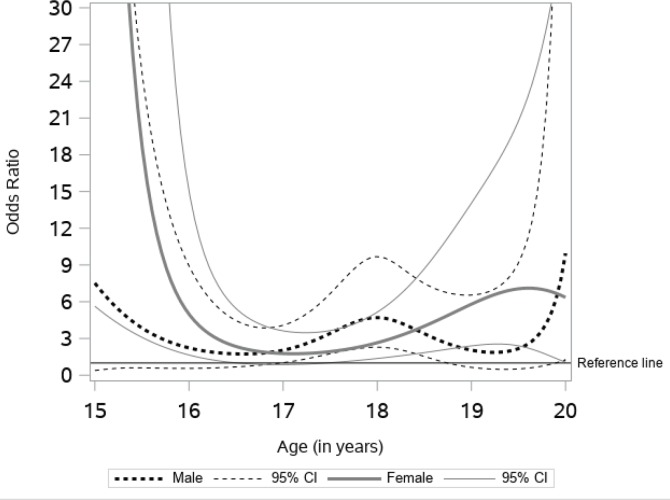
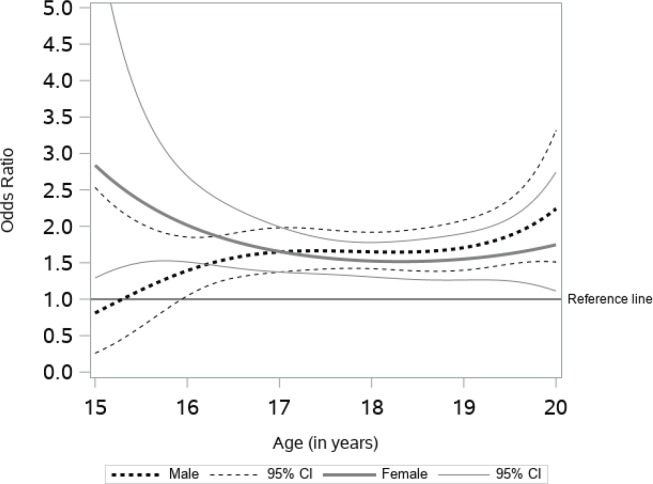
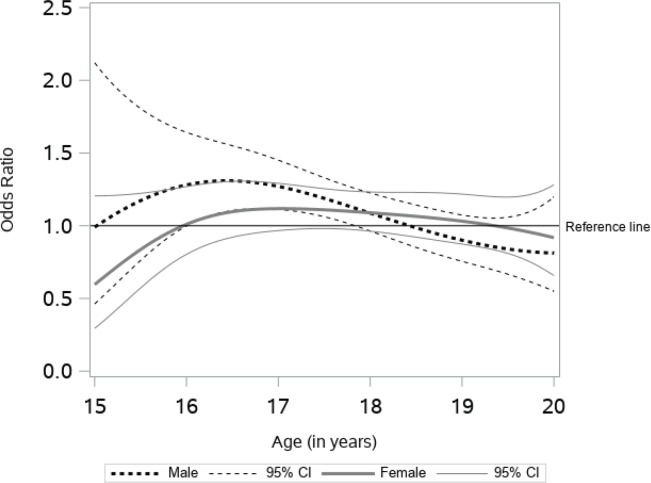
The probability of e-cigarette use gradually increased over the age of 15 years and then decreased by the age of 17 years for females and after the age of 18 years for males. Significant gender differences were observed between the ages of 17 and 19.5 years. Peer e-cigarette use was associated with higher odds of current e-cigarette use across all ages for females and after the age of 16 years for males. Exposure to e-cigarette commercials increased current use significantly for males between the ages of 16 and 18 years. Household use increased the odds of current use of e-cigarettes between the ages of 17 and 19 years for males and under 16.5 and over 18 years for females.
The findings highlight the utility of TVEM in understanding the risk factors of e-cigarette use and suggest that these factors are dynamic across adolescence.
电子烟已迅速成为美国青少年中最常用的烟草产品。接触广告、同伴使用和家庭使用会增加当前使用电子烟的风险;然而,这些因素的影响在整个青春期可能是动态变化的。本研究的目的是调查南加州替代高中学生中电子烟使用与同伴使用、家庭使用以及接触电子烟广告之间随年龄变化的关联。
利用先前为一项烟草营销研究收集的数据,我们使用时变效应模型(TVEM)研究了15至20岁年龄段当前电子烟使用与三个风险因素(同伴使用、接触广告和家庭使用)之间随年龄变化的关联。分析包括来自替代高中学生的三波数据(N = 1060名学生;2036次观察)。
女性在15岁以上电子烟使用概率逐渐增加,然后在17岁时下降,男性在18岁以后下降。在17至19.5岁之间观察到显著的性别差异。同伴使用电子烟与女性所有年龄段以及男性16岁以后当前使用电子烟的较高几率相关。接触电子烟广告显著增加了16至18岁男性的当前使用率。家庭使用使男性在17至19岁以及女性在16.5岁以下和18岁以上当前使用电子烟的几率增加。
研究结果突出了时变效应模型在理解电子烟使用风险因素方面的作用,并表明这些因素在整个青春期是动态变化的。