Serpico Angela Flavia, Grieco Domenico
CEINGE Biotecnologie Avanzate, Naples, 80145, Italy.
DMMBM, University of Naples "Federico II", Naples, 80131, Italy.
F1000Res. 2020 Jan 28;9. doi: 10.12688/f1000research.21185.1. eCollection 2020.
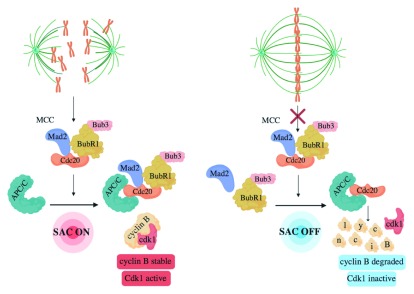
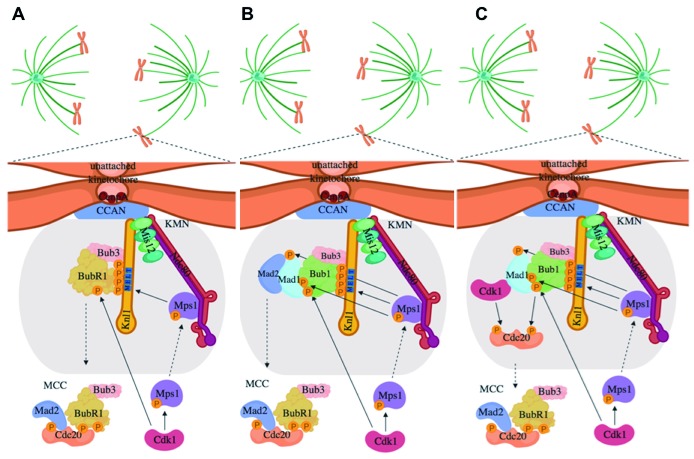
The goal of mitosis is to form two daughter cells each containing one copy of each mother cell chromosome, replicated in the previous S phase. To achieve this, sister chromatids held together back-to-back at their primary constriction, the centromere, have to interact with microtubules of the mitotic spindle so that each chromatid takes connections with microtubules emanating from opposite spindle poles (we will refer to this condition as bipolar attachment). Only once all replicated chromosomes have reached bipolar attachments can sister chromatids lose cohesion with each other, at the onset of anaphase, and move toward opposite spindle poles, being segregated into what will soon become the daughter cell nucleus. Prevention of errors in chromosome segregation is granted by a safeguard mechanism called Spindle Assembly Checkpoint (SAC). Until all chromosomes are bipolarly oriented at the equator of the mitotic spindle, the SAC prevents loss of sister chromatid cohesion, thus anaphase onset, and maintains the mitotic state by inhibiting inactivation of the major M phase promoting kinase, the cyclin B-cdk1 complex (Cdk1). Here, we review recent mechanistic insights about the circuitry that links Cdk1 to the SAC to ensure correct achievement of the goal of mitosis.
有丝分裂的目标是形成两个子细胞,每个子细胞都包含母细胞每条染色体的一个拷贝,这些染色体在之前的S期进行了复制。为实现这一目标,在其主要缢缩部位(即着丝粒)背靠背相连的姐妹染色单体必须与有丝分裂纺锤体的微管相互作用,以便每个染色单体与从纺锤体两极发出的微管建立连接(我们将这种情况称为双极附着)。只有当所有复制后的染色体都实现双极附着后,姐妹染色单体才能在后期开始时彼此失去黏连,并朝着纺锤体的相反两极移动,进而被分离到即将形成子细胞核的区域。一种名为纺锤体组装检查点(SAC)的保障机制可防止染色体分离过程中出现错误。在所有染色体在有丝分裂纺锤体的赤道面上实现双极定向之前,SAC可防止姐妹染色单体黏连的丧失,从而阻止后期的开始,并通过抑制主要的M期促进激酶(即细胞周期蛋白B - cdk1复合物(Cdk1))的失活来维持有丝分裂状态。在此,我们综述了关于将Cdk1与SAC联系起来以确保有丝分裂目标得以正确实现的信号通路的最新机制见解。