Wellbeing and Preventable Chronic Disease Division, Menzies School of Health Research, Darwin 0810, Northern Territory, Australia.
Faculty of Medicine, Monash University, Melbourne 3168, Victoria, Australia.
Int J Environ Res Public Health. 2020 Feb 9;17(3):1094. doi: 10.3390/ijerph17031094.
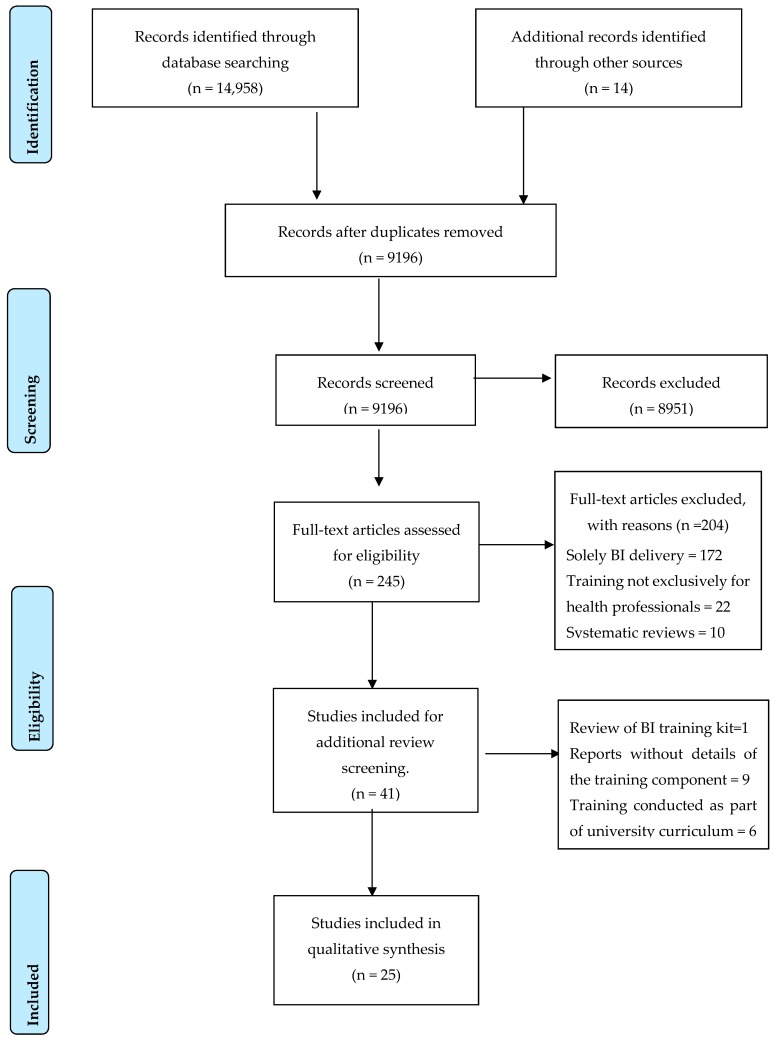
This paper reviews the literature on evaluations of brief intervention training programs for health professionals which address one or more lifestyle factors of chronic disease to identify factors impacting on development and implementation of programs. A search was conducted of the literature evaluating brief intervention training programs from 2000-2019 in the databases: Medline, CINAHL, Psychinfo, Academic Premier, Science Direct, Ovid (Including EMBASE and Healthstar), Web of Science and Informit. The content analysis and data extraction were aligned to the domains in the Consolidated Framework for Implementation Research (CFIR) to assist in the narrative synthesis. The search identified eight evaluations of programs targeting multiple risk factors, and 17 targeting single risk factors. The behavioural risk factor most commonly addressed was smoking, followed by alcohol and drug use. Programs consisted of face-to-face workshops and/or online or distance learning methods. Facilitators included availability of sustainable funding, adapting the program to suit the organisation's structural characteristics and adoption of the intervention into routine client care. For Indigenous programs, the use of culturally appropriate images and language, consultation with Indigenous communities, and development of resources specific to the communities targeted were important considerations.
本文回顾了针对慢性病的一种或多种生活方式因素的简短干预培训计划的评估文献,以确定影响计划制定和实施的因素。从 2000 年至 2019 年,在以下数据库中对评估简短干预培训计划的文献进行了检索:Medline、CINAHL、Psychinfo、Academic Premier、Science Direct、Ovid(包括 EMBASE 和 Healthstar)、Web of Science 和 Informit。内容分析和数据提取与实施研究综合框架(CFIR)的领域一致,以协助叙述性综合。检索确定了八项针对多种风险因素的计划评估,以及 17 项针对单一风险因素的计划评估。最常涉及的行为风险因素是吸烟,其次是饮酒和吸毒。计划包括面对面的研讨会和/或在线或远程学习方法。促进因素包括可持续资金的可用性、根据组织的结构特征调整计划以及将干预措施纳入常规客户护理。对于土著计划,使用文化上合适的图像和语言、与土著社区协商以及为目标社区开发特定资源是重要的考虑因素。