Institut Pasteur Dakar, Arbovirus and viral Hemorrhagic Fevers Unit, 12500 Dakar, Senegal.
Institut Santé et développement (ISED), Université Cheikh Anta Diop, 12500 Dakar, Senegal.
Viruses. 2020 Feb 10;12(2):196. doi: 10.3390/v12020196.
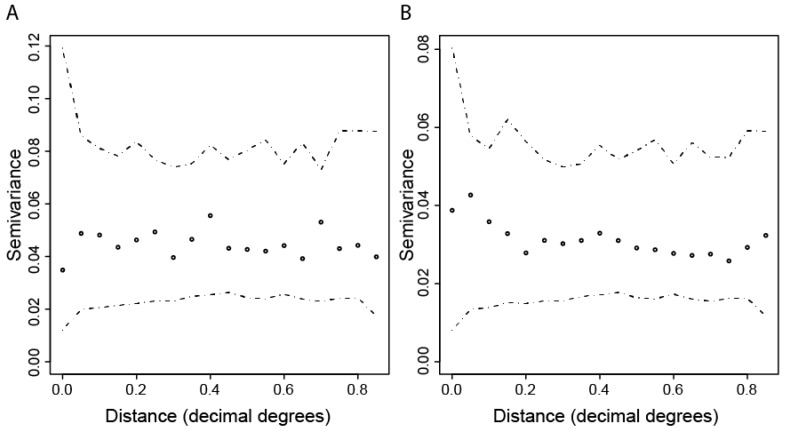
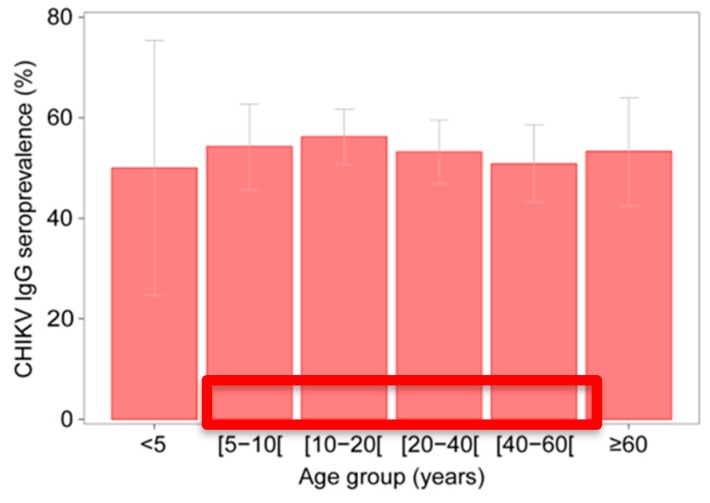
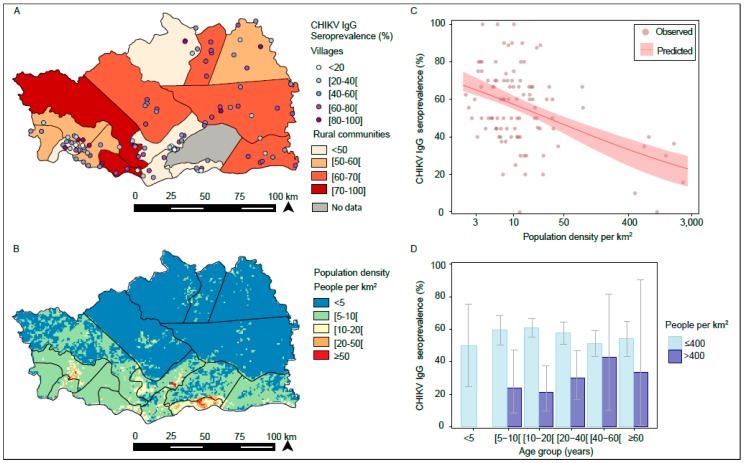
In Senegal, chikungunya virus (CHIKV) is maintained in a sylvatic cycle and causes sporadic cases or small outbreaks in rural areas. However, little is known about the influence of the environment on its transmission. To address the question, 120 villages were randomly selected in the Kedougou region of southeastern Senegal. In each selected village, 10 persons by randomly selected household were sampled and tested for specific anti-CHIKV IgG antibodies by ELISA. We investigated the association of CHIKV seroprevalence with environmental variables using logistic regression analysis and the spatial correlation of village seroprevalence based on semivariogram analysis. Fifty-four percent (51%-57%) of individuals sampled during the survey tested positive for CHIKV-specific IgG. CHIKV seroprevalence was significantly higher in populations living close to forested areas (Normalized Difference Vegetation Index (NDVI), Odds Ratio (OR) = 1.90 (1.42-2.57)), and was negatively associated with population density (OR = 0.76 (0.69-0.84)). In contrast, in gold mining sites where population density was >400 people per km, seroprevalence peaked significantly among adults (46% (27%-67%)) compared to all other individuals (20% (12%-31%)). However, traditional gold mining activities significantly modify the transmission dynamic of CHIKV, leading to a potential increase of the risk of human exposition in the region.
在塞内加尔,基孔肯雅病毒(CHIKV)在森林生态系统中维持着循环,导致农村地区偶尔出现散发病例或小规模疫情。然而,人们对环境对其传播的影响知之甚少。为了解决这个问题,在塞内加尔东南部的凯杜古地区随机选择了 120 个村庄。在每个选定的村庄中,通过随机选择的家庭,随机选择 10 人进行抽样,并通过 ELISA 检测针对特定的抗 CHIKV IgG 抗体。我们通过逻辑回归分析和基于半变异函数分析的村庄血清阳性率的空间相关性,调查了 CHIKV 血清阳性率与环境变量的关联。在调查期间采样的 54%(51%-57%)个体对 CHIKV 特异性 IgG 呈阳性。生活在靠近森林地区(归一化差异植被指数(NDVI)的人群的 CHIKV 血清阳性率明显更高,优势比(OR)=1.90(1.42-2.57)),与人口密度呈负相关(OR=0.76(0.69-0.84))。相比之下,在人口密度>400 人的金矿开采点,成年人的血清阳性率明显更高(46%(27%-67%)),而其他所有人的血清阳性率(20%(12%-31%))。然而,传统的金矿开采活动显著改变了 CHIKV 的传播动态,导致该地区人类暴露的风险潜在增加。