Department of Internal Medicine 3-Rheumatology and Immunology, Friedrich-Alexander University Erlangen-Nuremberg and Universitätsklinikum Erlangen, Ulmenweg 18, 91054, Erlangen, Germany.
Deutsches Zentrum fur Immuntherapie (DZI), Erlangen, Germany.
Arthritis Res Ther. 2020 Feb 12;22(1):26. doi: 10.1186/s13075-020-2111-8.
C-reactive protein (CRP) is often normal in patients with psoriatic disease. Herein, we aimed to define markers of systemic inflammation in patients with monomorphic and polymorphic psoriatic skin, entheseal, and joint disease.
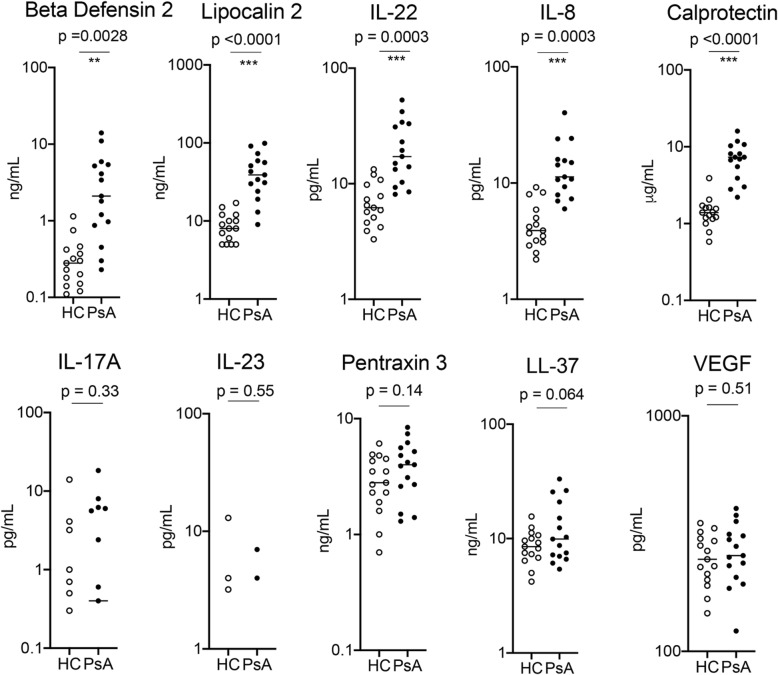
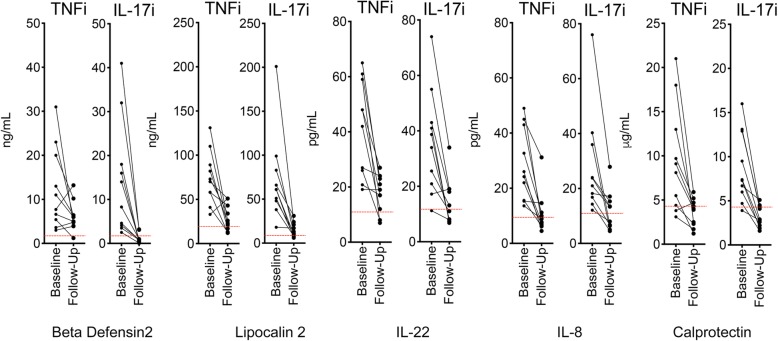
Three-step approach: (i) selection of serum markers elevated in psoriatic arthritis compared healthy controls from a panel of 10 different markers reflecting the pathophysiology of psoriatic disease; (ii) testing of these selected markers as well as C-reactive protein (CRP) in a larger cohort of 210 individuals- 105 healthy controls and 105 patients with psoriatic disease with either monomorphic skin (S), entheseal (E) or joint (A) involvement or polymorphic disease with various combinations of skin, entheseal and joint disease (SE, SA, EA, SEA); (iii) testing whether tumor necrosis factor (TNF) and interleukin (IL)-17 inhibitor therapy normalizes these markers.
CRP was not elevated or was rarely elevated in the subgroups (S 0%, E 0%, A 20%, SE 7%, SA 33%, EA 27%, SEA 33%) despite active psoriatic disease. In sharp contrast, beta-defensin 2 and lipocalin-2 levels were elevated in the majority of patients with monomorphic skin (93% and 73%) and entheseal (both 53%), but not joint disease (27% and 20%). Conversely, elevations of calprotectin and IL-8 were found in the majority of patients with monomorphic joint disease (both 73%). IL-22 was elevated in all three monomorphic disease manifestations (S 60%, E 46%; A 60%). Furthermore, the vast majority of patients with polymorphic psoriatic disease (SE, SA, EA, SEA) showed widespread marker elevation. IL-17- and TNF inhibitor treatment significantly lowered all 5 markers of inflammation in PsA patients.
Systemic inflammation is detectable in the majority of patients with psoriatic disease, even if CRP is normal. The respective marker pattern depends on the manifestation of psoriatic disease with respect to skin, entheseal, and joint involvement.
C 反应蛋白(CRP)在患有银屑病的患者中通常正常。在此,我们旨在确定单一形态和多形态银屑病皮肤、附着点和关节疾病患者的全身炎症标志物。
三步法:(i)从反映银屑病发病机制的 10 种不同标志物的面板中选择在银屑病关节炎患者中升高的血清标志物,并与健康对照进行比较;(ii)在 210 名个体中测试这些选定的标志物以及 CRP-105 名健康对照和 105 名患有银屑病的患者,其中 5 名患有单一形态皮肤(S)、附着点(E)或关节(A)受累或具有皮肤、附着点和关节疾病各种组合的多形态疾病(SE、SA、EA、SEA);(iii)测试肿瘤坏死因子(TNF)和白细胞介素(IL)-17 抑制剂治疗是否使这些标志物正常化。
尽管患有活动性银屑病,但 CRP 在亚组中并未升高或很少升高(S0%、E0%、A20%、SE7%、SA33%、EA27%、SEA33%)。相比之下,贝塔防御素 2 和脂钙蛋白-2 水平在大多数患有单一形态皮肤(93%和 73%)和附着点疾病(均为 53%)的患者中升高,但在关节疾病中没有升高(27%和 20%)。相反,钙卫蛋白和白细胞介素-8 的升高见于大多数患有单一形态关节疾病的患者(均为 73%)。IL-22 在所有三种单一形态疾病表现中均升高(S60%、E46%、A60%)。此外,绝大多数患有多形态银屑病的患者(SE、SA、EA、SEA)表现出广泛的标志物升高。IL-17 和 TNF 抑制剂治疗可显著降低所有 5 种炎症标志物在 PsA 患者中的水平。
即使 CRP 正常,患有银屑病的患者中也可检测到全身性炎症。各自的标志物模式取决于皮肤、附着点和关节受累的银屑病表现。