Podborska Agnieszka, Suchecki Maciej, Mech Krzysztof, Marzec Mateusz, Pilarczyk Kacper, Szaciłowski Konrad
Academic Centre for Materials and Nanotechnology, AGH University of Science and Technology, al. A. Mickiewicza 30, 30-059, Kraków, Poland.
Faculty of Physics and Applied Computer Science, AGH University of Science and Technology, al. A. Mickiewicza 30, 30-059, Kraków, Poland.
Nat Commun. 2020 Feb 12;11(1):854. doi: 10.1038/s41467-020-14675-5.
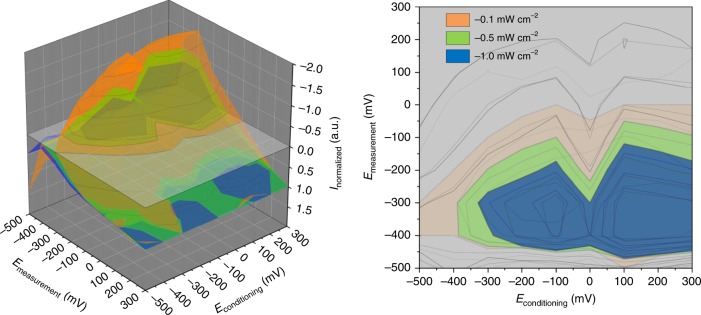
A better control over processes responsible for the photocurrent generation in semiconductors and nanocomposites is essential in the fabrication of photovoltaic devices, efficient photocatalysts and optoelectronic elements. Therefore, new approaches towards photochemical properties tuning are intensively searched for. Among numerous parameters, the photocurrent polarity is of great importance to the overall performance of a device. Usually, the polarity is controlled through an alignment of electronic states/bands, tailoring of applied potential or suitable selection of incident light wavelengths. In most scenarios though, the influence of light intensity is somehow neglected and either some arbitrarily chosen, natural conditions are mimicked or this parameter is varied only in a narrow range. Here we present a ternary nanocomposite in which the persistent photocurrent polarity switching is achieved through changes in the light intensity. We also present arguments suggesting this behaviour is of a general character and should be considered also in other photochemical systems.
在制造光伏器件、高效光催化剂和光电器件时,更好地控制半导体和纳米复合材料中负责光电流产生的过程至关重要。因此,人们正在深入寻找调节光化学性质的新方法。在众多参数中,光电流极性对器件的整体性能至关重要。通常,极性是通过电子态/能带的排列、施加电势的调整或入射光波长的适当选择来控制的。然而,在大多数情况下,光强的影响在某种程度上被忽略了,要么模拟一些任意选择的自然条件,要么仅在很窄的范围内改变这个参数。在此,我们展示了一种三元纳米复合材料,其中通过光强的变化实现了持久的光电流极性切换。我们还提出了一些论据,表明这种行为具有普遍特征,在其他光化学系统中也应予以考虑。