Department of Psychology, University of Essex, Colchester, Essex, UK.
School of Psychology, Queen's University Belfast, Belfast, GB, UK.
Med Decis Making. 2020 Feb;40(2):222-234. doi: 10.1177/0272989X20904725. Epub 2020 Feb 13.
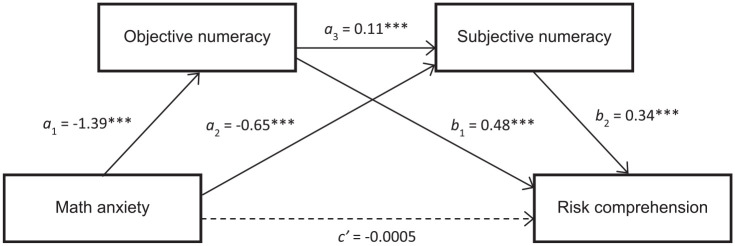
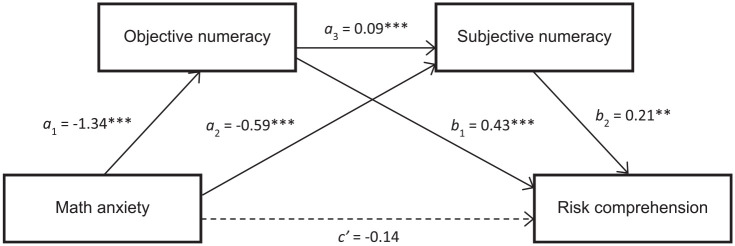
Numeracy skills are important for medical decision making as lower numeracy is associated with misinterpreting statistical health risks. Math anxiety, characterized by negative emotions about numerical tasks, and lower subjective numeracy (i.e., self-assessments of numerical competence) are also associated with poor risk comprehension. To explore independent and mediated associations of math anxiety, numerical ability, and subjective numeracy with risk comprehension and to ascertain whether their associations are specific to the health domain. Objective numeracy was measured with a 14-item test. Math anxiety and subjective numeracy were assessed with self-report scales. Risk comprehension was measured with a 12-item test. In experiment 1, risk comprehension items were limited to scenarios in the health domain. In experiment 2, participants were randomly assigned to receive numerically equivalent risk comprehension items in either a health or nonhealth domain. Linear regression analyses revealed that individuals with higher objective numeracy were more likely to respond correctly to the risk comprehension items, as were individuals with higher subjective numeracy. Higher math anxiety was associated with a lower likelihood of correct responding when controlling for objective numeracy but not when controlling for subjective numeracy. Mediation analyses indicated that math anxiety may undermine risk comprehension in 3 ways, including through 1) objective numeracy, 2) subjective numeracy, and 3) objective and subjective numeracy in serial, with subjective numeracy mediating the association between objective numeracy and risk comprehension. Findings did not differ by domain. Math anxiety, objective numeracy, and subjective numeracy are associated with risk comprehension through unique pathways. Education initiatives for improving health risk comprehension may be most effective if jointly aimed at tackling numerical ability as well as negative emotions and self-evaluations related to numeracy.
计算能力对于医学决策很重要,因为计算能力较低与错误解读统计健康风险有关。数学焦虑,其特征是对数值任务的负面情绪,以及较低的主观计算能力(即对数值能力的自我评估),也与风险理解能力差有关。本研究旨在探索数学焦虑、数值能力和主观计算能力与风险理解的独立和中介关联,并确定它们的关联是否特定于健康领域。客观计算能力通过 14 项测试进行测量。数学焦虑和主观计算能力通过自我报告量表进行评估。风险理解能力通过 12 项测试进行测量。在实验 1 中,风险理解项目仅限于健康领域的情景。在实验 2 中,参与者被随机分配到接受健康或非健康领域中数值相等的风险理解项目。线性回归分析显示,客观计算能力较高的个体更有可能正确回答风险理解项目,主观计算能力较高的个体也是如此。在控制客观计算能力的情况下,较高的数学焦虑与正确回答的可能性较低相关,但在控制主观计算能力的情况下则不然。中介分析表明,数学焦虑可能通过 3 种方式破坏风险理解,包括 1)客观计算能力,2)主观计算能力,以及 3)客观和主观计算能力的串联,其中主观计算能力中介了客观计算能力与风险理解之间的关联。研究结果不因领域而异。数学焦虑、客观计算能力和主观计算能力通过独特的途径与风险理解相关。如果教育计划旨在共同解决与数值能力相关的负面情绪和自我评估,而不仅仅是针对数值能力,那么改善健康风险理解的教育计划可能最有效。