Ding Si-Ran, Li Guang-Sheng, Chen Si-Rui, Zhu Feng, Hao Jin-Ping, Yang Fang-Xi, Hou Zhuo-Cheng
National Engineering Laboratory for Animal Breeding, Key Laboratory of Animal Genetics, Breeding and Reproduction of the Ministry of Agriculture, College of Animal Science and Technology, China Agricultural University, Beijing 100193, China.
Beijing Golden Star Duck Center, Beijing 100076, China.
Anim Biosci. 2021 Jul;34(7):1193-1201. doi: 10.5713/ajas.19.0612. Epub 2019 Dec 24.
According to market demand, meat duck breeding mainly includes 2 breeding directions: lean Pekin duck (LPD) and fat Pekin duck (FPD). The aim of the present study was to compare carcass and meat quality traits between 2 strains, and to provide basic data for guidelines of processing and meat quality improvement.
A total of 62 female Pekin ducks (32 LPDs and 30 FPDs) were slaughtered at the age of 42 days. The live body weight and carcass traits were measured and calculated. Physical properties of breast muscle were determined by texture analyzer and muscle fibers were measured by paraffin sections. The content of inosine monophosphate (IMP), intramuscular fat (IMF) and fatty acids composition were measured by high-performance liquid chromatography, Soxhlet extraction method and automated gas chromatography respectively.
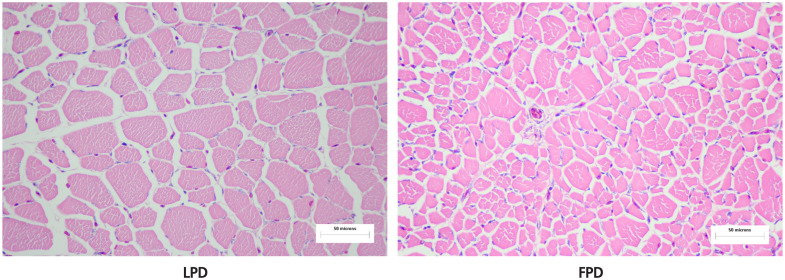
The results showed that the bodyweight of LPDs was higher than that of FPDs. FPDs were significantly higher than LPDs in subcutaneous fat thickness, subcutaneous fat weight, subcutaneous fat percentage, abdominal fat percentage and abdominal fat shear force (p<0.01). LPDs were significantly higher than FPDs in breast muscle thickness, breast muscle weight, breast muscle rate and breast muscle shear force (p<0.01). The muscle fiber average area and fiber diameter of LPDs were significantly higher than those of FPDs (p<0.01). The muscle fiber density of LPDs was significantly lower than that of FPDs (p<0.01). The IMF of LPDs in the breast muscle was significantly higher than that in the FPDs (p<0.01). There was no significant difference between the 2 strains in IMP content (p>0.05). The polyunsaturated fatty acid content of LPDs was significantly higher than that of FPDs (p<0.01), and FPDs had higher saturated fatty acid and monounsaturated fatty acid levels (p<0.05).
Long-term breeding work resulted in vast differences between the two strains Pekin ducks. This study provides a reference for differences between LPD and FPD that manifest as a result of long-term selection.
根据市场需求,肉鸭养殖主要包括两个养殖方向:瘦肉型北京鸭(LPD)和肥育型北京鸭(FPD)。本研究的目的是比较两个品系之间的胴体和肉质性状,为加工指南和肉质改良提供基础数据。
共62只42日龄雌性北京鸭(32只LPD和30只FPD)被屠宰。测量并计算活体重和胴体性状。用质构分析仪测定胸肌的物理特性,用石蜡切片测量肌纤维。分别采用高效液相色谱法、索氏提取法和自动气相色谱法测定肌苷酸(IMP)、肌内脂肪(IMF)含量和脂肪酸组成。
结果表明,LPD的体重高于FPD。FPD的皮下脂肪厚度、皮下脂肪重量、皮下脂肪百分比、腹脂百分比和腹脂剪切力显著高于LPD(p<0.01)。LPD的胸肌厚度、胸肌重量、胸肌率和胸肌剪切力显著高于FPD(p<0.01)。LPD的肌纤维平均面积和纤维直径显著高于FPD(p<0.01)。LPD的肌纤维密度显著低于FPD(p<0.01)。LPD胸肌中的IMF显著高于FPD(p<0.01)。两个品系之间的IMP含量无显著差异(p>0.05)。LPD的多不饱和脂肪酸含量显著高于FPD(p<0.01),FPD的饱和脂肪酸和单不饱和脂肪酸水平较高(p<0.05)。
长期的育种工作导致两个北京鸭品系之间存在巨大差异。本研究为长期选择导致的LPD和FPD之间的差异提供了参考。