Blombery Piers, Fox Lucy, Ryland Georgina L, Thompson Ella R, Lickiss Jennifer, McBean Michelle, Yerneni Satwica, Trainer Alison, Hughes David, Greenway Anthea, Mechinaud Francoise, Wood Erica M, Lieschke Graham J, Szer Jeff, Barbaro Pasquale, Roy John, Wight Joel, Lynch Elly, Martyn Melissa, Gaff Clara, Ritchie David
Clinical Haematology, Peter MacCallum Cancer Centre, Melbourne, Australia.
Department of Pathology, Peter MacCallum Cancer Centre, Melbourne, Australia.
Haematologica. 2021 Jan 1;106(1):64-73. doi: 10.3324/haematol.2019.237693.
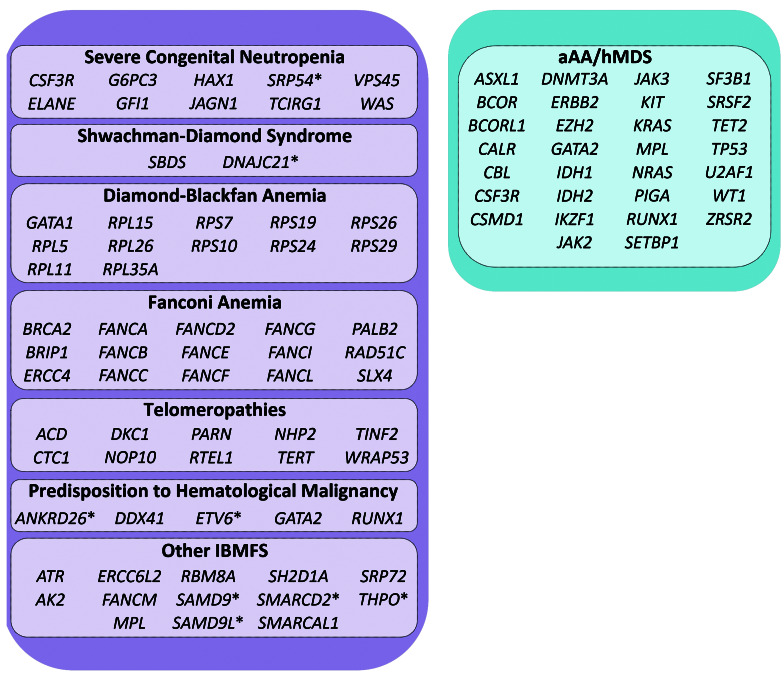
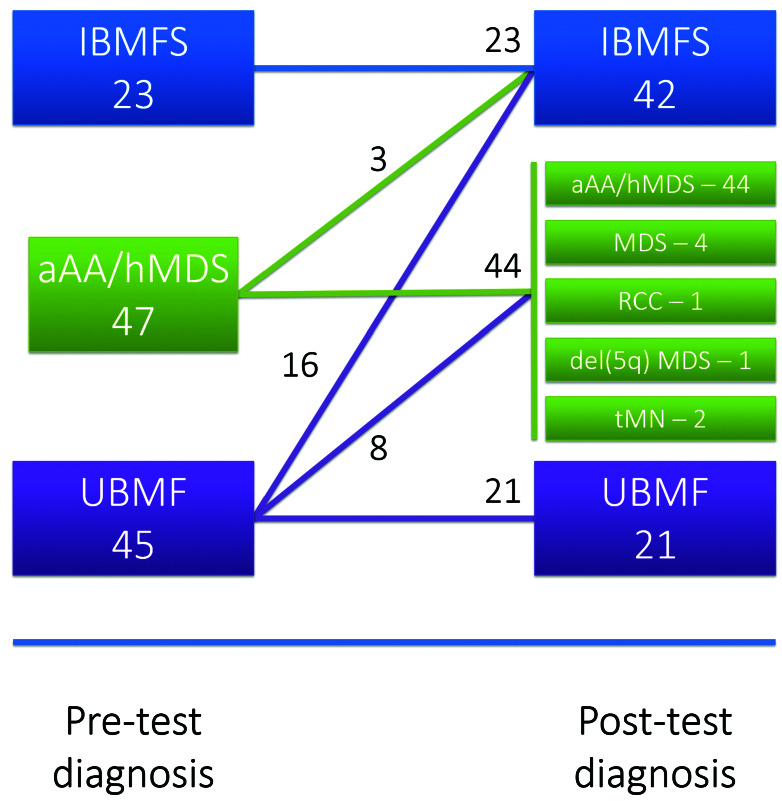
Bone marrow failure (BMF) related to hypoplasia of hematopoietic elements in the bone marrow is a heterogeneous clinical entity with a broad differential diagnosis including both inherited and acquired causes. Accurate diagnostic categorization is critical to optimal patient care and detection of genomic variants in these patients may provide this important diagnostic and prognostic information. We performed real-time, accredited (ISO15189) comprehensive genomic characterization including targeted sequencing and whole exome sequencing in 115 patients with BMF syndrome (median age 24 years, range 3 months - 81 years). In patients with clinical diagnoses of inherited BMF syndromes, acquired BMF syndromes or clinically unclassifiable BMF we detected variants in 52% (12/23), 53% (25/47) and 56% (25/45) respectively. Genomic characterization resulted in a change of diagnosis in 30/115 (26%) including the identification of germline causes for 3/47 and 16/45 cases with pre-test diagnoses of acquired and clinically unclassifiable BMF respectively. The observed clinical impact of accurate diagnostic categorization included choice to perform allogeneic stem cell transplantation, disease-specific targeted treatments, identification of at-risk family members and influence of sibling allogeneic stem cell donor choice. Multiple novel pathogenic variants and copy number changes were identified in our cohort including in TERT, FANCA, RPS7 and SAMD9. Whole exome sequence analysis facilitated the identification of variants in two genes not typically associated with a primary clinical manifestation of BMF but also demonstrated reduced sensitivity for detecting low level acquired variants. In conclusion, genomic characterization can improve diagnostic categorization of patients presenting with hypoplastic BMF syndromes and should be routinely performed in this group of patients.
与骨髓造血细胞发育不全相关的骨髓衰竭(BMF)是一种异质性临床实体,鉴别诊断范围广泛,包括遗传和后天病因。准确的诊断分类对于患者的最佳治疗至关重要,检测这些患者的基因组变异可能会提供这一重要的诊断和预后信息。我们对115例BMF综合征患者(中位年龄24岁,范围3个月至81岁)进行了实时、经认可(ISO15189)的全面基因组特征分析,包括靶向测序和全外显子组测序。在临床诊断为遗传性BMF综合征、后天性BMF综合征或临床无法分类的BMF患者中,我们分别在52%(12/23)、53%(25/47)和56%(25/45)的患者中检测到变异。基因组特征分析导致115例中有30例(26%)的诊断发生改变,其中分别为47例中3例以及45例中16例在检测前诊断为后天性和临床无法分类的BMF病例中确定了种系病因。准确诊断分类所观察到的临床影响包括选择进行异基因干细胞移植、疾病特异性靶向治疗、识别高危家庭成员以及对同胞异基因干细胞供体选择的影响。在我们的队列中鉴定出多个新的致病变异和拷贝数变化,包括TERT、FANCA、RPS7和SAMD9中的变异。全外显子组序列分析有助于鉴定两个通常与BMF的主要临床表现无关的基因中的变异,但也显示出检测低水平后天变异的敏感性降低。总之,基因组特征分析可以改善发育不全性BMF综合征患者的诊断分类,并且应该在这组患者中常规进行。