From Gateshead Health (C.M.) and Newcastle Upon Tyne Hospitals (J.R., J.L.N.), NHS Foundation Trust; Faculty of Medical Sciences (C.M., J.L.N., D.J.B.), Newcastle University, UK; and Zealand University Hospital (K.W.), Roskilde, Denmark.
Neurology. 2020 Mar 31;94(13):e1427-e1433. doi: 10.1212/WNL.0000000000008931. Epub 2020 Feb 13.
To assess the feasibility and efficacy of bladder training for troublesome lower urinary tract symptoms (LUTS) in Parkinson disease (PD).
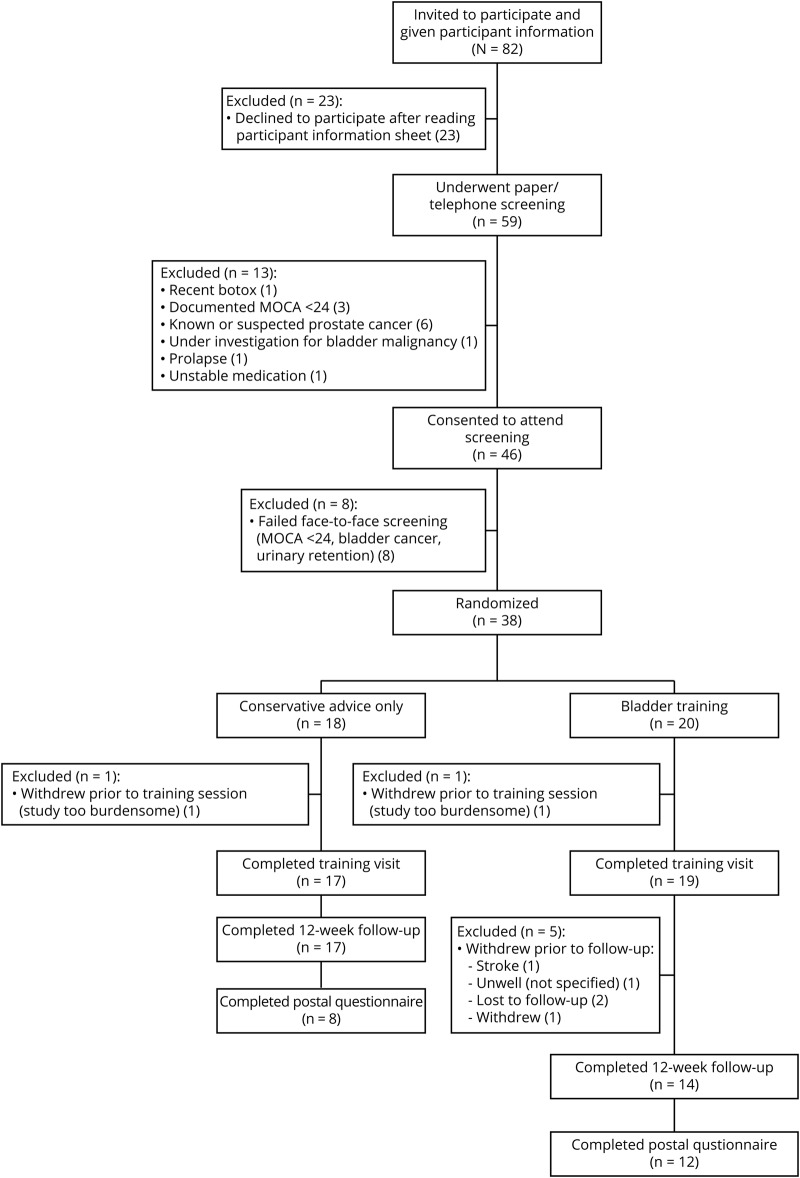
In this single-center, single-blinded, randomized controlled trial, participants with a history of PD and LUTS were randomized to a 12-week bladder training program (BT) or conservative advice (CA). Outcome measures included a 3-day volume frequency diary, International Consultation on Incontinence Questionnaire (ICIQ)-Overactive Bladder Module, and ICIQ-Quality of Life Module. Co-primary endpoints were (1) patient perception of change and (2) change in number of urgency episodes at 12 weeks. Secondary endpoints included change in ICIQ scores, number of micturitions, and volume voided.
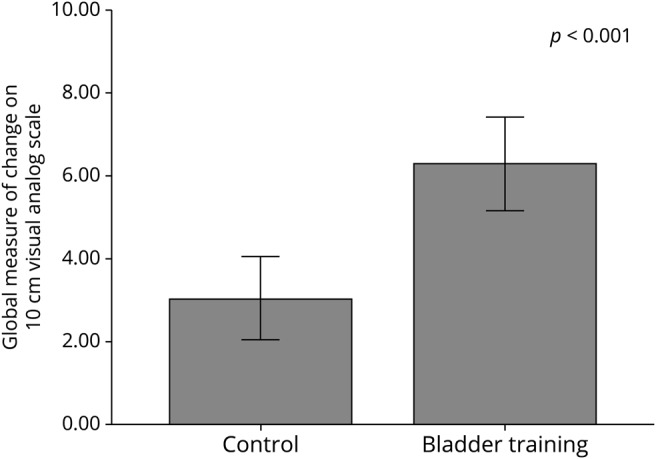
Thirty-eight participants were randomized (18 to CA, 20 to BT). Both CA and BT were associated with significant improvements in volume voided, number of micturitions, symptom severity scores, and measures of quality of life (all < 0.05). At 12 weeks, compared to CA, BT was associated with significant superiority on patient perception of improvement ( = 0.001), significantly greater reductions in number of voids in 24 hours (mean decrease 2.3 ± 0.8 voids vs 0.3 ± 0.5 [ < 0.05]), and greater reductions in interference with daily life (2.1 ± 0.8 point improvement vs 0.3 ± 0.7 point deterioration [ < 0.05]). BT was not associated with change in urgency episodes (mean change 2.4 ± 1.5 urgency episodes vs 3.5 ± 1.5 [ NS]). At 20 weeks, BT remained associated with greater improvement in interference in daily life. Loss of significance in other measures may reflect loss of power from loss to follow-up.
This controlled trial demonstrated the potential benefits of BT for LUTS in PD.
This study provides Class III evidence that for patients with PD and LUTS, BT significantly increased patient perception of improvement but did not significantly reduce urgency episodes.
评估膀胱训练治疗帕金森病(PD)患者烦扰性下尿路症状(LUTS)的可行性和疗效。
在这项单中心、单盲、随机对照试验中,将有 PD 和 LUTS 病史的参与者随机分为 12 周的膀胱训练计划(BT)组或保守治疗(CA)组。主要结局指标包括 3 天容量频率日记、国际尿失禁咨询问卷(ICIQ)-膀胱过度活动症模块和 ICIQ 生活质量模块。主要终点包括(1)患者对变化的感知和(2)12 周时急迫性发作次数的变化。次要结局指标包括 ICIQ 评分、排尿次数和排尿量的变化。
共 38 名参与者被随机分配(CA 组 18 名,BT 组 20 名)。CA 和 BT 均与排尿量、排尿次数、症状严重程度评分和生活质量测量值的显著改善相关(均 < 0.05)。在 12 周时,与 CA 相比,BT 与患者对改善的感知有显著优势( = 0.001),24 小时内的排尿次数显著减少(平均减少 2.3 ± 0.8 次 vs 0.3 ± 0.5 次[ < 0.05]),日常生活干扰显著减少(2.1 ± 0.8 点改善 vs 0.3 ± 0.7 点恶化[ < 0.05])。BT 与急迫性发作次数的变化无关(平均变化 2.4 ± 1.5 次急迫性发作 vs 3.5 ± 1.5 次[NS])。在 20 周时,BT 仍然与日常生活干扰的更大改善相关。其他指标的显著性丧失可能反映了随访损失导致的效能丧失。
这项对照试验证明了 BT 治疗 PD 患者 LUTS 的潜在益处。
本研究提供了 III 级证据,对于 PD 合并 LUTS 的患者,BT 显著提高了患者对改善的感知,但并未显著减少急迫性发作次数。