Department of Biomaterials, Max Planck Institute of Colloids and Interfaces, 14424, Potsdam, Germany.
Department of Chemistry, McGill University, 801 Sherbrooke Street West, Montréal, QC, H3A 0B8, Canada.
Nat Commun. 2020 Feb 13;11(1):862. doi: 10.1038/s41467-020-14709-y.
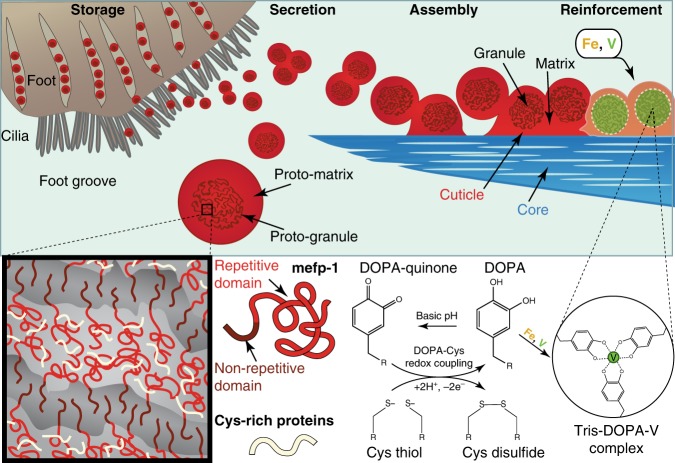
Complex hierarchical structure governs emergent properties in biopolymeric materials; yet, the material processing involved remains poorly understood. Here, we investigated the multi-scale structure and composition of the mussel byssus cuticle before, during and after formation to gain insight into the processing of this hard, yet extensible metal cross-linked protein composite. Our findings reveal that the granular substructure crucial to the cuticle's function as a wear-resistant coating of an extensible polymer fiber is pre-organized in condensed liquid phase secretory vesicles. These are phase-separated into DOPA-rich proto-granules enveloped in a sulfur-rich proto-matrix which fuses during secretion, forming the sub-structure of the cuticle. Metal ions are added subsequently in a site-specific way, with iron contained in the sulfur-rich matrix and vanadium coordinated by DOPA-catechol in the granule. We posit that this hierarchical structure self-organizes via phase separation of specific amphiphilic proteins within secretory vesicles, resulting in a meso-scale structuring that governs cuticle function.
复杂的层次结构控制着生物聚合材料的涌现特性;然而,相关的材料加工过程仍了解甚少。在这里,我们研究了贻贝足丝贝壳在形成前后的多尺度结构和组成,以深入了解这种坚硬但可拉伸的金属交联蛋白复合材料的加工过程。我们的研究结果表明,作为可拉伸聚合物纤维的耐磨涂层至关重要的颗粒亚结构,是在凝聚的液相分泌小泡中预先组织的。这些小泡会发生相分离,形成富含 DOPA 的原颗粒,被富含硫的原基质包裹,在分泌过程中融合,形成贝壳的亚结构。随后以特定的方式添加金属离子,其中铁存在于富含硫的基质中,钒与颗粒中的 DOPA-儿茶酚配位。我们假设这种分层结构通过分泌小泡中特定两亲性蛋白的相分离自组织,导致控制贝壳功能的介观结构形成。