State Key Laboratory of Resources and Environmental Information System, Institute of Geographic Sciences and Natural Resources Research, Chinese Academy of Sciences, Beijing, 100101, China.
State Key Laboratory of Earth Surface Processes and Resource Ecology, Beijing Normal University, Beijing, 100875, China.
Sci Rep. 2020 Feb 13;10(1):2541. doi: 10.1038/s41598-020-59265-z.
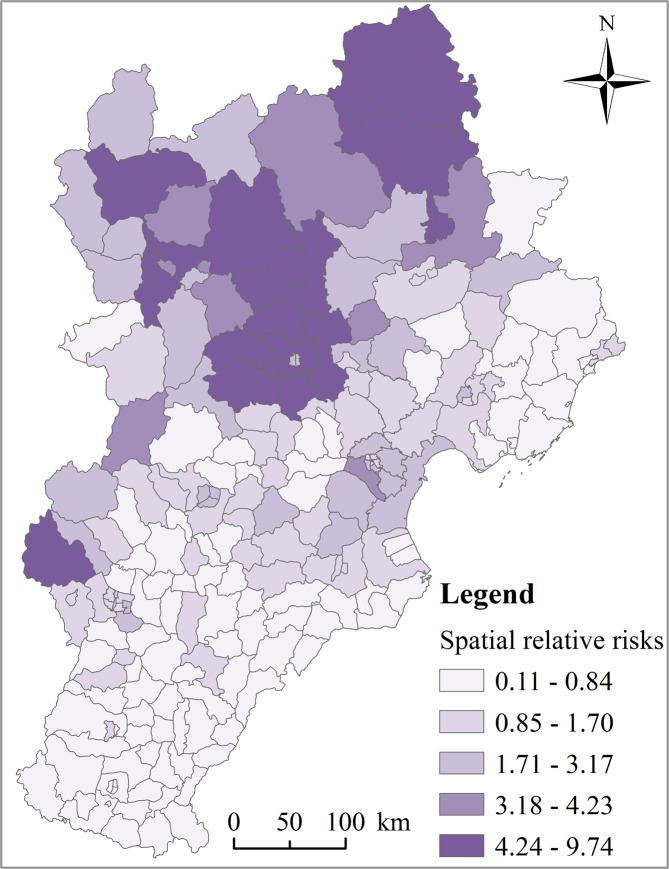
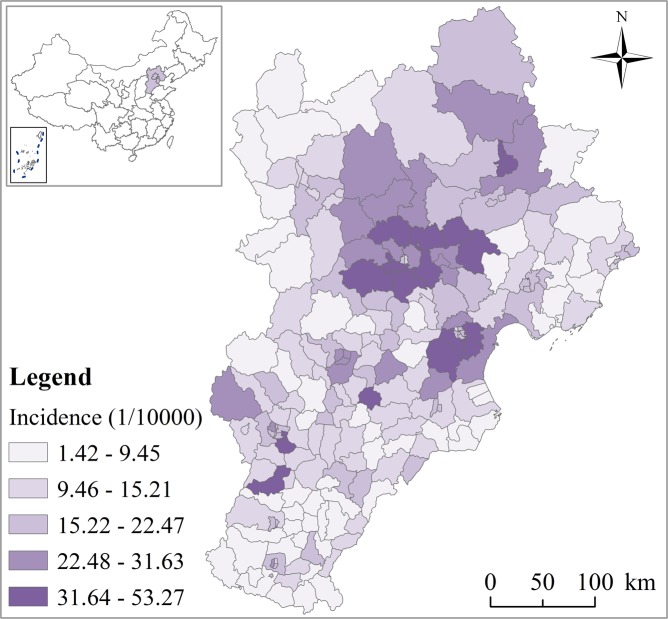
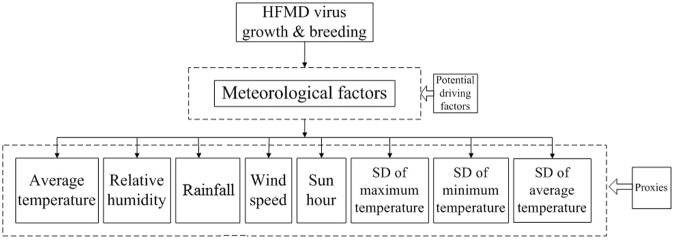
Hand, foot, and mouth disease (HFMD), predominantly occurs among infants and children. Previous studies have shown that suitable, stable temperatures favor HFMD virus reproduction; however, temperature fluctuations also affect virus transmission, and there are, so far, no studies concerning the association between such fluctuations and the incidence of HFMD. The objective of this study was to map the spatial-temporal distribution of HFMD incidence and quantify the long-term effects of temperature fluctuations on HFMD incidence in children. HFMD cases in children under five, from January 2009 to December 2013, in Beijing, Tianjin, and Hebei provinces of China, were used in this study. The GeoDetector and Bayesian space-time hierarchy models were employed to explore the spatial-temporal association between temperature fluctuations and HFMD incidence. The results indicate that HFMD incidence had significant spatial stratified heterogeneity (GeoDetector q-statistic = 0.83, p < 0.05), and that areas with higher risk mainly appeared in metropolises and their adjacent regions. HFMD transmission was negatively associated with temperature fluctuations. A 1 °C increase in the standard deviation of maximum and minimum temperatures was associated with decreases of 8.22% and 11.87% in the risk of HFMD incidence, respectively. The study suggests that large temperature fluctuations affect virus growth or multiplication, thereby inhibiting the activity of the virus and potentially even leading to its extinction, and consequently affecting the spatial-temporal distribution of HFMD. The findings can serve as a reference for the practical control of this disease and offer help in the rational allocation of medical resources.
手足口病(HFMD)主要发生在婴儿和儿童中。先前的研究表明,适宜、稳定的温度有利于 HFMD 病毒的繁殖;然而,温度波动也会影响病毒的传播,到目前为止,还没有关于这种波动与 HFMD 发病率之间的关联的研究。本研究的目的是绘制 HFMD 发病率的时空分布,并量化温度波动对儿童 HFMD 发病率的长期影响。本研究使用了 2009 年 1 月至 2013 年 12 月期间中国北京、天津和河北省 5 岁以下儿童的 HFMD 病例。本研究采用 GeoDetector 和贝叶斯时空层次模型来探讨温度波动与 HFMD 发病率之间的时空关联。结果表明,HFMD 发病率存在显著的空间分层异质性(GeoDetector q 统计量=0.83,p<0.05),高风险地区主要出现在大都市及其周边地区。HFMD 传播与温度波动呈负相关。最大和最小温度标准差每增加 1°C,HFMD 发病率的风险分别降低 8.22%和 11.87%。本研究表明,较大的温度波动会影响病毒的生长或繁殖,从而抑制病毒的活性,甚至导致其灭绝,从而影响 HFMD 的时空分布。研究结果可为该疾病的实际控制提供参考,并有助于合理分配医疗资源。