Gosnell Greer, Tavoni Alessandro
Grantham Research Institute, London School of Economics and Political Science, Houghton Street, London, WC2A 2AE UK.
Clim Change. 2017;142(3):575-586. doi: 10.1007/s10584-017-1975-3. Epub 2017 May 4.
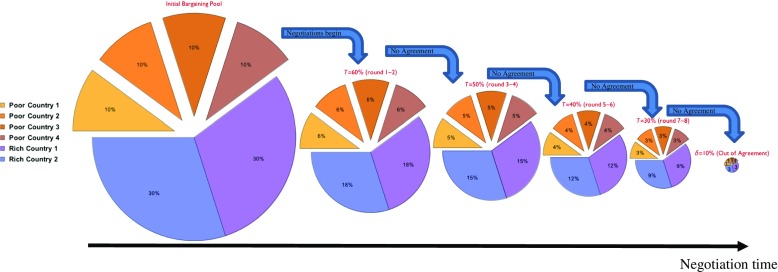
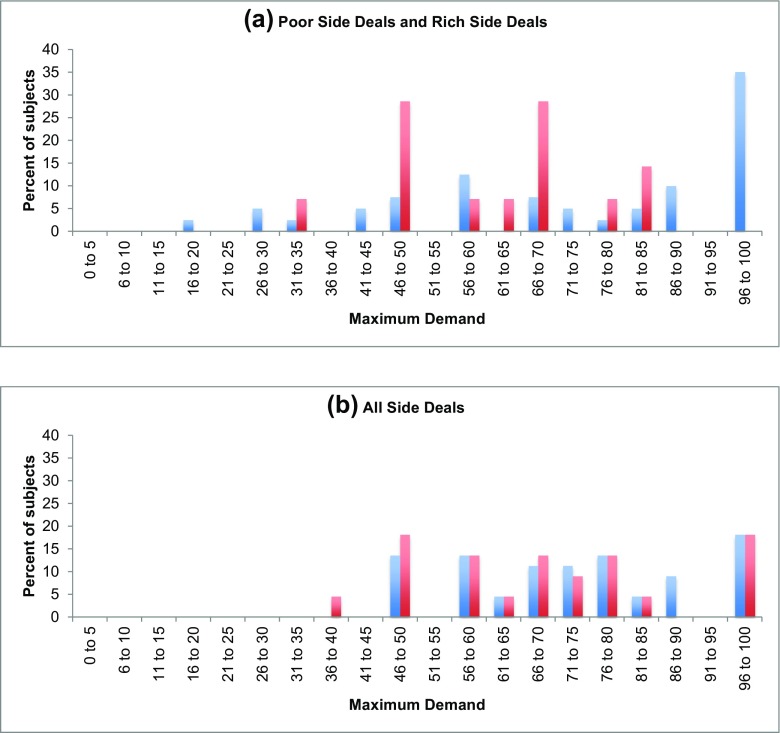
The recent global climate change agreement in Paris leaves a wide gap between pledged and requisite emissions reductions in keeping with the commonly accepted 2 °C target. A recent strand of theoretical and experimental evidence establishes pessimistic predictions concerning the ability of comprehensive global environmental agreements to improve upon the business-as-usual trajectory. We introduce an economic experiment focusing on the dynamics of the negotiation process by observing subjects' behavior in a Nash bargaining game. Throughout repeated rounds, heterogeneous players bargain over the allocation of a fixed amount of profit-generating emissions with significant losses attached to prolonged failure to reach agreement. We find that the existence of side agreements that constrain individual demands among a subset of like countries does not ensure success; however, such side agreements reduce the demands of high-emission parties. Our results highlight the importance of strong signals among high emitters in reaching agreement to shoulder a collective emission reduction target.
近期达成的巴黎全球气候变化协议,在按照普遍认可的2摄氏度目标所承诺的减排量与所需减排量之间,留下了巨大差距。最近一系列理论和实验证据,对全面的全球环境协议能否改善照常发展轨迹的能力作出了悲观预测。我们开展了一项经济实验,通过观察受试者在纳什讨价还价博弈中的行为,来聚焦谈判过程的动态变化。在反复进行的多轮博弈中,异质性参与者就固定数量的产生利润的排放量分配进行讨价还价,若长期无法达成协议会带来重大损失。我们发现,存在约束部分同类国家个体诉求的附带协议并不能确保成功;然而,此类附带协议会降低高排放方的诉求。我们的研究结果凸显了高排放方之间发出强烈信号对于达成承担集体减排目标协议的重要性。