Haines Sarah R, Adams Rachel I, Boor Brandon E, Bruton Thomas A, Downey John, Ferro Andrea R, Gall Elliott, Green Brett J, Hegarty Bridget, Horner Elliott, Jacobs David E, Lemieux Paul, Misztal Pawel K, Morrison Glenn, Perzanowski Matthew, Reponen Tiina, Rush Rachael E, Virgo Troy, Alkhayri Celine, Bope Ashleigh, Cochran Samuel, Cox Jennie, Donohue Allie, May Andrew A, Nastasi Nicholas, Nishioka Marcia, Renninger Nicole, Tian Yilin, Uebel-Niemeier Christina, Wilkinson David, Wu Tianren, Zambrana Jordan, Dannemiller Karen C
Department of Civil, Environmental & Geodetic Engineering, College of Engineering, Environmental Health Sciences, College of Public Health, and Environmental Sciences Graduate Program, The Ohio State University, Columbus, OH, 43210, USA.
Plant & Microbial Biology, University of California, Berkeley, CA, 94720, USA.
Build Environ. 2019 Dec 18;170:1-16. doi: 10.1016/j.buildenv.2019.106589.
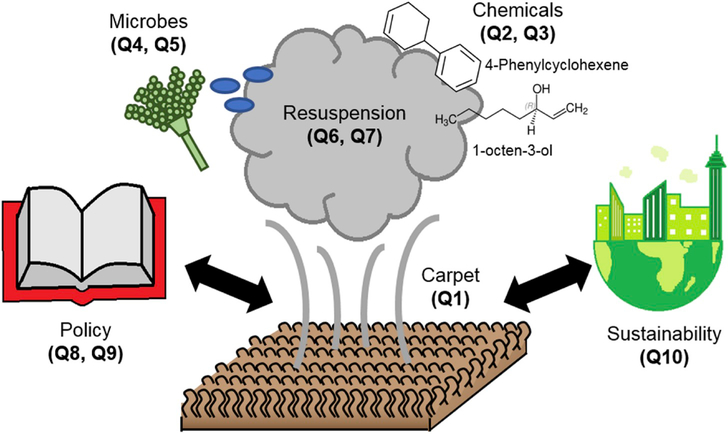
Carpet and rugs currently represent about half of the United States flooring market and offer many benefits as a flooring type. How carpets influence our exposure to both microorganisms and chemicals in indoor environments has important health implications but is not well understood. The goal of this manuscript is to consolidate what is known about how carpet impacts indoor chemistry and microbiology, as well as to identify the important research gaps that remain. After describing the current use of carpet indoors, questions focus on five specific areas: 1) indoor chemistry, 2) indoor microbiology, 3) resuspension and exposure, 4) current practices and future needs, and 5) sustainability. Overall, it is clear that carpet can influence our exposures to particles and volatile compounds in the indoor environment by acting as a direct source, as a reservoir of environmental contaminants, and as a surface supporting chemical and biological transformations. However, the health implications of these processes are not well known, nor how cleaning practices could be optimized to minimize potential negative impacts. Current standards and recommendations focus largely on carpets as a primary source of chemicals and on limiting moisture that would support microbial growth. Future research should consider enhancing knowledge related to the impact of carpet in the indoor environment and how we might improve the design and maintenance of this common material to reduce our exposure to harmful contaminants while retaining the benefits to consumers.
地毯目前约占美国地板市场的一半,作为一种地板类型有诸多优点。地毯如何影响我们在室内环境中接触微生物和化学物质,这对健康有重要影响,但目前尚不清楚。本论文的目的是整合关于地毯如何影响室内化学和微生物学的已知信息,并找出仍然存在的重要研究空白。在描述了地毯目前在室内的使用情况后,问题集中在五个具体领域:1)室内化学,2)室内微生物学,3)再悬浮和接触,4)当前做法和未来需求,以及5)可持续性。总体而言,很明显地毯可以通过作为直接来源、环境污染物的储存库以及支持化学和生物转化的表面,来影响我们在室内环境中接触颗粒物和挥发性化合物的情况。然而,这些过程对健康的影响尚不清楚,清洁做法如何优化以尽量减少潜在负面影响也不清楚。当前的标准和建议主要集中在地毯作为化学物质的主要来源以及限制支持微生物生长的湿度上。未来的研究应考虑加强对地毯在室内环境中影响的认识,以及我们如何改进这种常见材料的设计和维护,以减少我们接触有害污染物的机会,同时保留对消费者的益处。