Kaewthong Pensiri, Pomponio Luigi, Carrascal Jorge R, Knøchel Susanne, Wattanachant Saowakon, Karlsson Anders H
Department of Food Technology, Faculty of Agro-Industry, Prince of Songkla University, Hat Yai, Songkhla, 90112, Thailand.
Department of Food Science, Faculty of Sciences, University of Copenhagen, Rolighedsvej 26, DK-1958 Frederiksberg C, Denmark.
J Poult Sci. 2019 Oct 25;56(4):308-317. doi: 10.2141/jpsa.0180106.
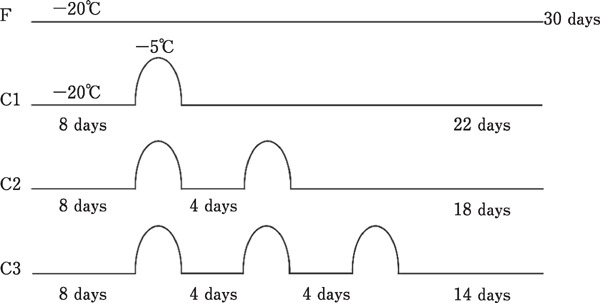
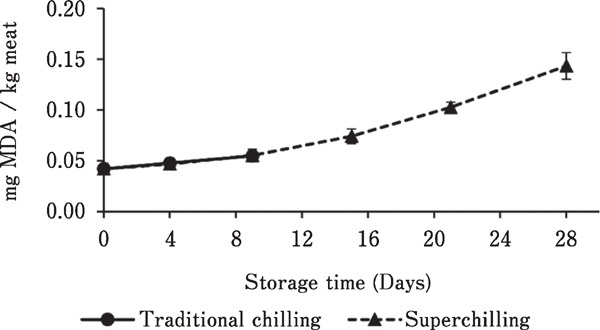
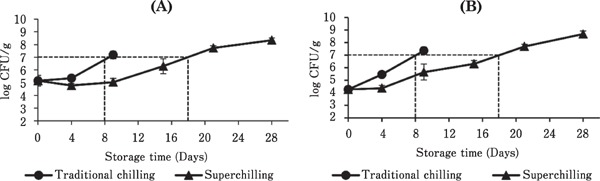
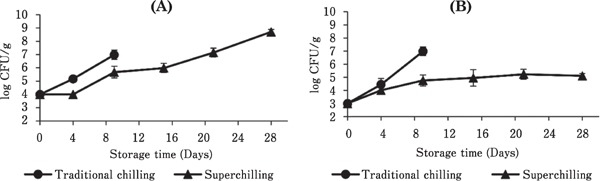
The aim of this study was to determine the changes in chicken breast meat quality (water-holding capacity, color, texture, myofibrillar fragmentation index (MFI), total protein solubility, thiobarbituric acid reactive substances (TBARS), total viable count (TVC), and lactic acid bacteria (LAB) count) due to storage under superchilling conditions (-1.3°C) and fluctuating temperatures (ranging from -20°C to -5°C) as compared to the quality of meat stored at chilled (2-4°C) and frozen (-20°C) temperatures, respectively. Results indicated that the TVC and LAB count of the chilled and superchilled breast meat increased with storage time. TVC of the chilled and superchilled breast meat reached the safety level of 7 log cfu/g at approximately day 8 and18, respectively. This suggested that the superchilling method extended the storage duration by 10 days. Weight loss and TBARS of the chilled and superchilled samples tended to increase with increasing storage time. The color, texture, protein solubility, and MFI were stable throughout the entire storage period of the chilled (9 days) and superchilled (28 days) samples. Results indicated that while three cycles of storage temperature fluctuation influenced the weight loss and dry matter of the meat, they did not affect the TVC, LAB count, texture, color, pH, MFI, and protein solubility. The superchilling technique (-1.3°C) could extend the shelf-life of meat and maintain the quality of chicken breast meat. Fluctuations in temperature during frozen storage decreased the water-holding capacity of chicken breast meat, indicating that temperature stability should be maintained during frozen storage.
本研究的目的是确定与分别在冷藏(2-4°C)和冷冻(-20°C)温度下储存的鸡肉品质相比,鸡胸肉在过冷条件(-1.3°C)和温度波动(-20°C至-5°C)下储存时肉质(持水能力、颜色、质地、肌原纤维破碎指数(MFI)、总蛋白溶解度、硫代巴比妥酸反应性物质(TBARS)、总活菌数(TVC)和乳酸菌(LAB)计数)的变化。结果表明,冷藏和过冷鸡胸肉的TVC和LAB计数随储存时间增加。冷藏和过冷鸡胸肉的TVC分别在大约第8天和第18天达到7 log cfu/g的安全水平。这表明过冷方法将储存时间延长了10天。冷藏和过冷样品的重量损失和TBARS倾向于随储存时间增加。冷藏(9天)和过冷(28天)样品在整个储存期间颜色、质地、蛋白质溶解度和MFI保持稳定。结果表明,虽然三个储存温度波动周期影响了肉的重量损失和干物质,但它们不影响TVC、LAB计数、质地、颜色、pH、MFI和蛋白质溶解度。过冷技术(-1.3°C)可以延长肉的保质期并保持鸡胸肉的品质。冷冻储存期间的温度波动降低了鸡胸肉的持水能力,表明冷冻储存期间应保持温度稳定。