Wang Jing, Wang Dong-Xia, Ma Jia-Yi, Wang Ya-Xin, Kong De-Ming
State Key Laboratory of Medicinal Chemical Biology , Tianjin Key Laboratory of Biosensing and Molecular Recognition , Research Centre for Analytical Sciences , College of Chemistry , Nankai University , Tianjin 300071 , P. R. China . Email:
Collaborative Innovation Center of Chemical Science and Engineering (Tianjin) , Tianjin , 300071 , P. R. China.
Chem Sci. 2019 Aug 29;10(42):9758-9767. doi: 10.1039/c9sc02281c. eCollection 2019 Nov 14.
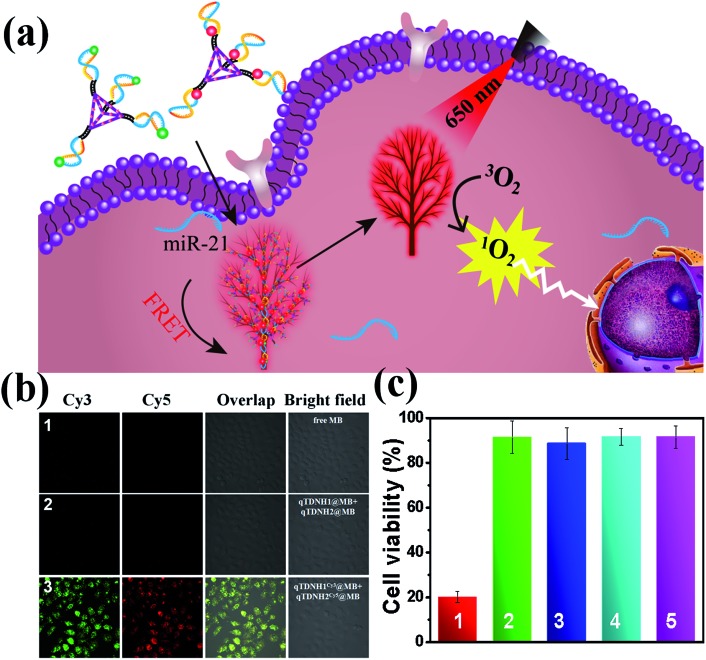
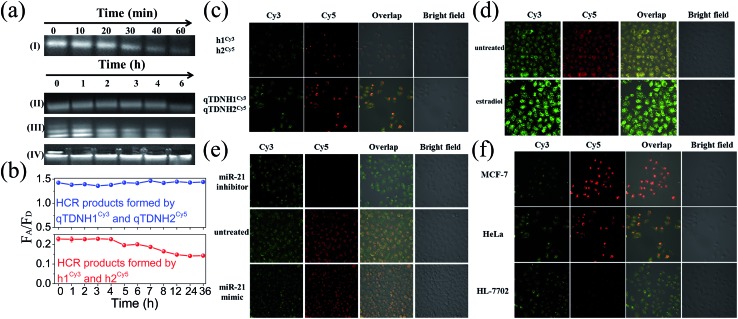
Nonenzymatic nucleic acid amplification techniques ( the hybridization chain reaction, HCR) have shown promising potential for amplified detection of biomarkers. However, the traditional HCR occurs through random diffusion of DNA hairpins, making the kinetics and efficiency quite low. By assembling DNA hairpins at the vertexes of tetrahedral DNA nanostructures (TDNs), the reaction kinetics of the HCR is greatly accelerated due to the synergetic contributions of multiple reaction orientations, increased collision probability and enhanced local concentrations. The proposed quadrivalent TDN (qTDN)-mediated hyperbranched HCR has a ∼70-fold faster reaction rate than the traditional HCR. The approximately 76% fluorescence resonance energy transfer (FRET) efficiency obtained is the highest in the reported DNA-based FRET sensing systems as far as we know. Moreover, qTDNs modified by hairpins can easily load drugs, freely traverse plasma membranes and be rapidly cross-linked the target-triggered HCR in live cells. The reduced freedom of movement as a result of the large crosslinked structure might constrain the hyperbranched HCR in a confined environment, thus making it a promising candidate for imaging and photodynamic therapy. Hence, we present a paradigm of perfect integration of DNA nanotechnology with nucleic acid amplification, thus paving a promising way to the improved performance of nucleic acid amplification techniques and their wider application.
非酶核酸扩增技术(杂交链式反应,HCR)在生物标志物的扩增检测方面已显示出有前景的潜力。然而,传统的HCR是通过DNA发夹的随机扩散发生的,使得动力学和效率相当低。通过将DNA发夹组装在四面体DNA纳米结构(TDN)的顶点处,由于多种反应取向的协同作用、增加的碰撞概率和增强的局部浓度,HCR的反应动力学得到了极大的加速。所提出的四价TDN(qTDN)介导的超支化HCR的反应速率比传统HCR快约70倍。据我们所知,所获得的约76%的荧光共振能量转移(FRET)效率在已报道的基于DNA的FRET传感系统中是最高的。此外,用发夹修饰的qTDN可以轻松负载药物,自由穿过质膜,并在活细胞中被目标触发的HCR快速交联。由于大的交联结构导致的运动自由度降低可能会在受限环境中限制超支化HCR,从而使其成为成像和光动力疗法的有前景的候选者。因此,我们提出了一种将DNA纳米技术与核酸扩增完美整合的范例,从而为提高核酸扩增技术的性能及其更广泛的应用铺平了一条有前景的道路。