Lopes Sofia, Gomes Nuno, César Artur, Barros Ana Margarida, Pinheiro Jorge, Azevedo Filomena
Department of Dermatology and Venereology, Centro Hospitalar e Universitário de São João EPE, Porto, Portugal.
Department of Pathology, Centro Hospitalar e Universitário de São João EPE, Porto, Portugal.
Indian Dermatol Online J. 2019 Sep 26;11(1):83-86. doi: 10.4103/idoj.IDOJ_74_19. eCollection 2020 Jan-Feb.
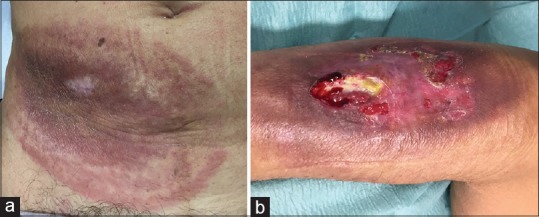
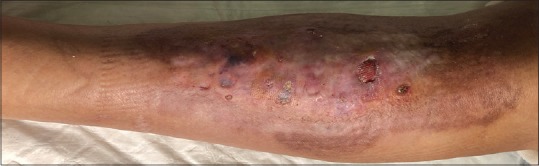
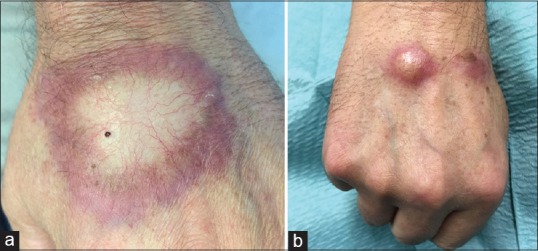
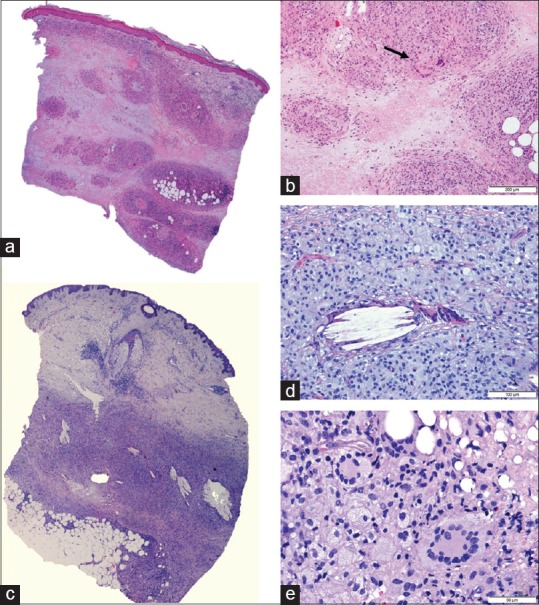
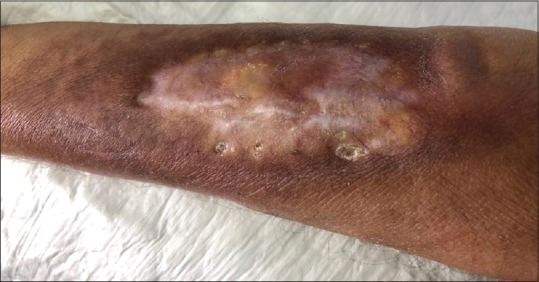
Necrobiotic xanthogranuloma (NXG) is a rare form of inflammatory granulomatous disease of the skin characterized by the presence of pruritic to painful lesions, generally located in the periorbital area, although trunk and proximal extremities may also be involved. We report a case of a 69-year-old male patient with extensive involvement of the trunk, upper and lower extremities, and an associated gamma monoclonal gammopathy. The skin biopsy was consistent with the diagnosis of NXG. Necrobiosis lipoidica and granuloma annulare were the major differential diagnosis in this case. We highlight the importance of searching for clinical and histological features that may differentiate these entities, which is crucial to select an adequate therapeutic and surveillance strategy.
坏死性黄色肉芽肿(NXG)是一种罕见的皮肤炎性肉芽肿性疾病,其特征为出现瘙痒至疼痛性皮损,通常位于眶周区域,不过躯干和近端肢体也可能受累。我们报告一例69岁男性患者,其躯干、上肢和下肢广泛受累,并伴有γ单克隆丙种球蛋白病。皮肤活检结果与NXG诊断相符。在本病例中,主要的鉴别诊断为类脂质渐进性坏死和环状肉芽肿。我们强调寻找可区分这些疾病的临床和组织学特征的重要性,这对于选择合适的治疗和监测策略至关重要。